

Blankets, Nitro, and a Borrowed Buggy
The Great Horicon Post Office Job of 1913
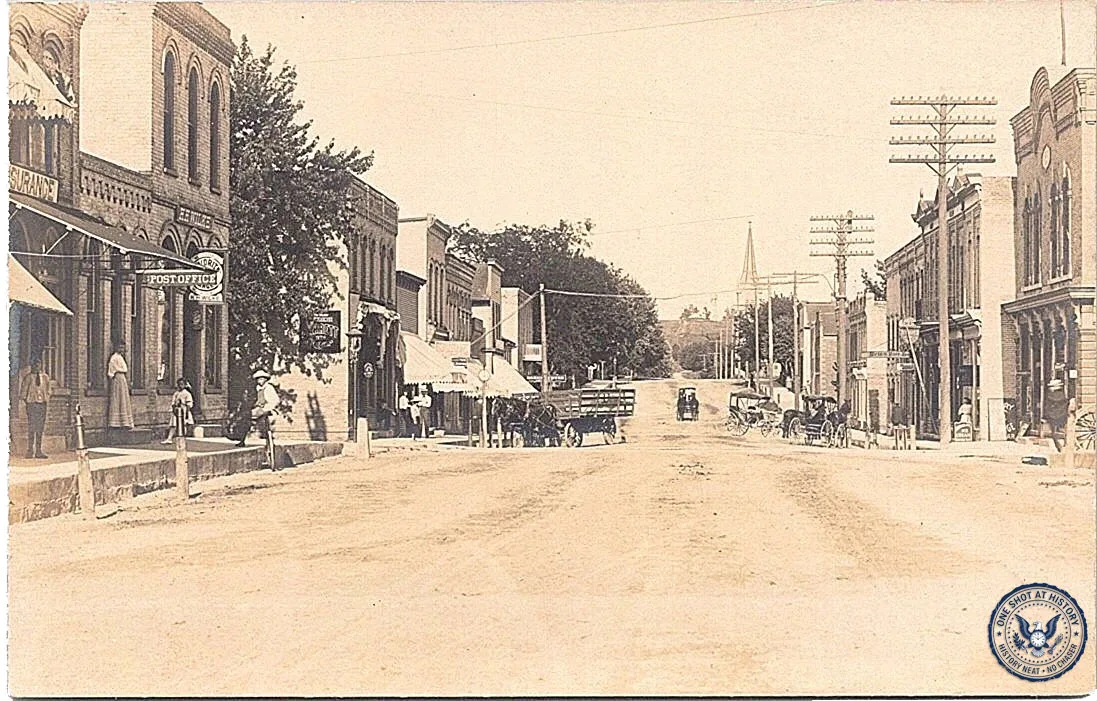
Picture Horicon in the second week of June, 1913. The marsh north of town would have been turning green, the cattails springing up, the smell of water that rises off the Rock River basin once the weather turns, and by mid-month that Wisconsin heat had already settled in — the kind of early-summer warmth that hangs on through the evening and keeps the kerosene lamps burning and screen doors open past dark. Lake Street would have smelled of horses and coal smoke from the Van Brunt works, its machine shop still running that season, its teamster’s barn stocked with the everyday clutter of a working town: harness leather, hay, and stacks of heavy woolen blankets meant for nothing more sinister than covering a wagon load on a cold run.


It was a town used to its rhythms — the evening train, the lamplighters, the postmaster locking up the office on the corner of the business district and walking home past the darkened shopfronts. Nobody was awake to see what happened next, and that, as it turned out, was exactly the point.
Sometime between the close of business on June 10th and the opening of the mail window the next morning, someone walked into the Horicon post office, wrapped its safe in a stack of those stolen blankets, and blew it wide open with nitroglycerin. By the time local businessman and postmaster Edward C. Rehfeld walked the two blocks from his home on Lynn Street, unlocked the door for the day’s business, the safe was a wreck, roughly $800 in cash and stamps was gone, and the culprits were long gone too — last seen, presumably, disappearing down a dark road in a stolen horse and buggy while the smell of scorched metal and spent explosive still hung in the office air.
It reads like something out of a dime novel. It also happened about two blocks from where I’m sitting.
It was a town used to its rhythms — the evening train, the lamplighters, the postmaster locking up the office on the corner of the business district and walking home past the darkened shopfronts. Nobody was awake to see what happened next, and that, as it turned out, was exactly the point.
Sometime between the close of business on June 10th and the opening of the mail window the next morning, someone walked into the Horicon post office, wrapped its safe in a stack of those stolen blankets, and blew it wide open with nitroglycerin. By the time postmaster Edward C. Rehfeld walked the two blocks from his home on Lynn Street, unlocked the door for the day’s business, the safe was a wreck, roughly $800 in cash and stamps was gone, and the culprits were long gone too — last seen, presumably, disappearing down a dark road in a stolen horse and buggy while the smell of scorched metal and spent explosive still hung in the office air.
It reads like something out of a dime novel. It also happened about two blocks from where I’m sitting.
The Job
Whoever cracked the Horicon safe knew exactly what they were doing. The local paper didn’t mince words: this was the work of “professional safe blowers,” and the evidence backed it up. Before they ever touched the safe, the men slipped into the teamster’s barn at the Van Brunt Manufacturing Co. and helped themselves to a pile of heavy blankets — not to keep warm, but to muffle the blast. Wrap a safe in enough wool and canvas, and a nitroglycerin charge that would otherwise wake half the county can go off with barely a whisper.
It worked. Nobody heard a thing.

They got away with about $400 in cash and another $400 in stamps, but — in a nice bit of criminal restraint — left a small amount of money behind and didn’t touch the money order blanks. Professionals, in other words, working fast and taking only what moved easily.
Then came the getaway, which is where the story turns almost comic. The gang broke into a nearby garage first, clearly hoping to find an automobile for a quick escape. No luck — nothing suitable inside. So instead, four men who’d just successfully dynamited a federal safe fell back on 1913’s most reliable backup plan: they walked over to the barn behind the Horicon House, “borrowed” Henry Gessner’s horse and a single buggy, and rode out of town at whatever speed one horse can manage.
By morning, lawmen across the region were on alert, including Chief of Police A. L. Goetsch over in Beaver Dam. The general opinion was that the gang had turned toward Mayville. Nobody caught them that day.
The Sequel: Kewaskum
The Horicon job wasn’t a one-off. That same summer — the indictments would later peg it to July 8, 1913 — the same crew tried the same trick on the post office in Kewaskum. This time, it didn’t go their way. Lawmen pulled several men off a Soo Line train the following day, and this time the men were carrying the tools of the trade with them: “large outfits of burglar tools,” about as damning a thing as you could be caught with in 1913.
Word went out, and fourteen residents of Kewaskum and Horicon were summoned all the way to Chicago to help sort out who was who — Horicon folks to help pin the nearly $2,000 in combined losses on the right men, Kewaskum folks to identify the strangers who’d been casing their town. The men in question: William Houlihan, William Burns, Daniel Murphy, and James Moore.
Enter Walter Houlihan, Gentleman Yegg
“Yeggmen” — the period slang for itinerant professional safecrackers
Of the four, Houlihan is the one who steals the show. Fifty-nine years old, described as a wealthy Chicago property owner, he was extradited not from some flophouse but from Detroit — where he’d been sitting in jail on an entirely separate charge of passing counterfeit Canadian currency. The kicker: he committed that alleged offense while out on a $10,000 bond a woman had put up to spring him after his Wisconsin arrest. The man could not stay out of trouble even while out on bail for other trouble.
At his Milwaukee hearing before Judge Geiger, Houlihan pleaded not guilty to a genuinely staggering stack of charges: five indictments, twenty counts between the four defendants, covering the Horicon safe-blowing, the Kewaskum attempt, aiding and abetting on both, helping Burns and Murphy escape afterward, and — the specialty of the fourth man, Moore — hauling the nitroglycerin itself from Illinois into Wisconsin. U.S. District Attorney Guy D. Goff wasn’t worried about overcharging. “We are certain to convict on one or more of the indictments,” he told the press, and noted that if all four men were convicted on every count, the combined sentences would run past 160 years.
The Girl With the Toolbox
The trial also turned up one of those small, human details that makes local history worth digging for. After his arrest, Daniel Murphy reportedly wrote to his sweetheart back in Chicago and asked her to hide a box belonging to him — a box federal agents eventually tracked down and opened to find it packed with “tools of every description used in safe blowing.” She claimed she never knew what was inside. She was in Milwaukee during the trial but, in the end, was never called as a witness. Whether that was mercy or just prosecutorial focus, the record doesn’t say.

The Verdict
Houlihan, Murphy, Burns, and Moore were convicted and, that Monday, Judge F. A. Geiger sentenced each of them to five years in the federal penitentiary at Fort Leavenworth, plus a $1,000 fine apiece. Good behavior could trim the terms to around four years; failure to collect the fines would only add thirty days. Burns, said to be recovering from tuberculosis, asked to serve his time in the Milwaukee county jail instead — a request the judge left for the U.S. Marshal to decide. Houlihan, expected to appeal, apparently thought better of it and took his sentence quietly, same as the rest.
And that was the end of Horicon’s brush with the “yeggmen” — the period slang for itinerant professional safecrackers, men who traveled town to town with a kit of tools and, when needed, a can of nitroglycerin. For one quiet June night in 1913, our little post office on the main business street was their target, and for a few months that summer, half the small towns in this part of the state were watching the roads for a horse-drawn getaway.
Have a hidden history lead of your own — Horicon, Wisconsin, or otherwise? I’d love to hear it. More stories like this one at oneshotathistory.com.

Nice, I have lived in Kewaskum since 1997, and I had never heard this story, and better yet, I worked for the post office there for a short while as well! I had no clue, Thanks for sharing this rich history
Thank you, I apprciate your comments!
I truly love reading your stories; the invisible history here seems to get lost. I hope you are writing a book on all this! Keep up the fascinating research you do, it is appreciated!.
Thanks Rose!
So very interesting!!
Thanks Don!