
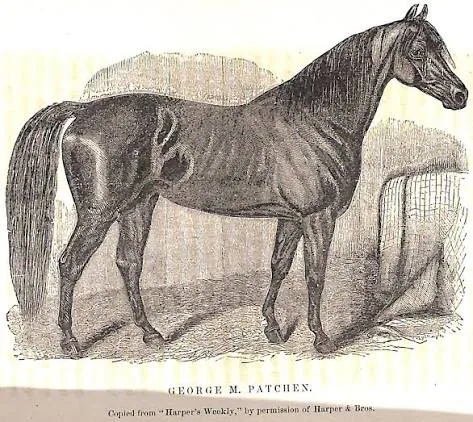

The Rise and Strange Death of Horicon’s prize-winning horse –‘Ripon Boy’
On a Tuesday morning in December 1873, a groom at George W. Van Brunt’s stables in Horicon led a nine-year-old mahogany bay stallion out to water and noticed something was wrong. The horse drank only sparingly, and trembled in every limb with each attempt. Within four days the animal — known across Wisconsin’s racetracks simply as “the Boy” — would be dead of a disease that terrified nineteenth-century Americans more than almost any other. That horse was Ripon Boy, and for a few remarkable years in the early 1870s, Newspapers did not consider it an exaggeration to call him the fastest trotter in the state.

A Horse from St. Lawrence County
Ripon Boy came into the world in 1863, “of Ethan Allen stock” — descended from one of the era’s most celebrated trotting sires — and was raised in St. Lawrence County, bred by John Mott in Potsdam, in far northern New York. Mott brought him west to Wisconsin and sold him on to George Van Brunt, a Horicon Seed Drill businessman, for $5,000 — an enormous sum for a single animal in the early 1870s, on the order of the same price a substantial farm would have cost.
Van Brunt had the money to spend. He and his brother, Daniel. C. Van Brunt, were the inventors behind one of the era’s genuinely significant agricultural advances: the first successful machine for mechanically broadcasting grain seed, patented around 1861. Their firm, built in Horicon, grew over the following decades into the Van Brunt Manufacturing Company — the ancestor of what is today John Deere’s Horicon Works. It was that fortune, made from seed drills rather than racehorses, that let George Van Brunt indulge a genuine passion for fast trotting stock.
The Fastest Horse in the State
Ripon Boy’s coat, Mahogany bay, a deep, rich reddish-brown coat with black points was one of the most celebrated and dominant colors for elite American trotting stallions, and he was compact, and — by every account — extraordinarily fast once the right hands were on the reins, Ripon Boy did not start out as a sure thing. At the 1872 meeting at Oshkosh’s Cold Spring Course — remembered locally as the “Goldsmith Maid and Lucy” meeting, after two far more famous mares who also raced there that year — Ripon Boy broke badly under driver McMann and dropped the first two heats of a five-horse field, while the betting pools shifted hard against him. Mid-race, the judges made an unusual call: they put the reins in the hands of Orrin Hickok, one of the era’s most respected professional reinsmen. The change worked. After six heats, with two rivals disqualified along the way, Ripon Boy was declared the winner in 2:27 — his best time on that course, and, as one account later put it, proof that the faith placed in him was “well-founded.”


He kept improving. In July 1873, racing at Oshkosh, he swept a sweepstakes field of Lady Mack, Badger Girl, and Capitola in three straight heats. At Chicago’s Dexter Park that same summer, he fought a heavily wagered, multi-day duel against a horse named Fred Hooper, winning the second and third heats outright before being ruled out of a later heat on a weight technicality — a disqualification, not a defeat. And that same year, at a Dexter Park meeting, he set his fastest recorded time of all: 2:25, fast enough that Van Brunt was immediately offered $25,000 in 1872, in the newspapers’ own words, “a very heavy price” for him — and refused it. Soon after, at Joliet, Illinois, Ripon Boy did something that put his name in papers across the Midwest: he defeated American Girl, one of the most celebrated trotting mares of the age, in 2:25½.
Travelling in 1st Class
Ripon Boy traveled in style; Van Brunt had a Private train car for himself here in Horicon, and a private railway express car which was a passenger car modified to transport valuable animals like Ripon Boy. It was heated, had interior stalls, padded dividers, and attendant quarters, and a room for sulky and equipment.
Discher Park Driving Track
The horse’s fame wasn’t confined to distant tracks like Cold Spring Course and Dexter Park. On the north end of Horicon, about a mile from the Van Brunt family home, a stretch of farmland belonging to Charles Discher had become the village’s driving park — informal grounds close enough to walk to from town, where residents exercised horses and carriages and held trotting races of their own. It was there that Van Brunt showed Ripon Boy off to his own neighbors.

The family had a direct stake in the park’s future, too: when the driving park association eventually deeded its land to the city, D. C. Van Brunt covered by far the largest share of the settlement — $178.46, against two other contributors’ roughly $15 apiece. That ground is still a public park today, renamed Discher Park in 1936 in honor of Charles Discher, both for the land and for his standing, by then, as Horicon’s last surviving Civil War veteran.
The Death of Ripon Boy

None of it protected him from an ordinary farm accident with an extraordinary cause. About a month before his death, a dog had been found dead in Ripon Boy’s stall at Van Brunt’s Horicon stable; at the time, no one thought much of it, though the dog had reportedly been noticed acting strangely for a day or two beforehand. On the Tuesday before Ripon Boy died, the groom noticed him drinking only sparingly at the water trough, trembling with each attempt. By the next afternoon he had grown more nervous still, and turned on the groom who tried to arrange his blankets, biting and kicking. Van Brunt himself came to look him over, applying medicine to a sore on the horse’s nose — Ripon Boy allowed his owner to approach, but showed “great vice” whenever Van Brunt actually tried to touch him.
Unable to account for the change, Van Brunt first suspected poisoning — he thought the horse might have eaten sumac mixed into his hay — and telegraphed the famous Milwaukee horse veterinary surgeon William M. Ormond on Wednesday to come look at him. Ormond reached Horicon Thursday afternoon and, after watching the horse for only a few moments, pronounced the diagnosis: hydrophobia. What followed, in the words of one newspaper account, was “terrible to behold.” Offered water, Ripon Boy was seized with spasms and violent viciousness; he ran his head against the stall wall hard enough to knock out his own upper teeth and finally fracture his jaw. With no hope of saving him, Van Brunt had the stall boarded up to keep him from hurting himself or anyone else further. The horse lingered until two in the morning, when, with one last breath collapsed to the ground.
Newspapers across the country picked up the story in nearly identical language— evidence of just how well known Ripon Boy really was. All of them noted the same grim, unsettling event: once Van Brunt understood the horse had rabies, he remembered that dead dog in the stall from a month before, and realized what must have happened.
The Other Bite
The dog did not stop at the horse. A separate item that circulated alongside the news of Ripon Boy’s death reported that the same rabid animal had also bitten Spencer E. Davis, described in the clipping as “Van Brunt’s partner.” Davis had reportedly been trying to get the dog to perform tricks; when it refused, he whipped it, and it was during that whipping that it bit him. The item closes on a genuinely ominous note: “As the bite killed the horse, there is little ground for hope that Davis will escape.”


At the time, Davis was a partner with Willard Van Brunt, George’s nephew, but the documented partnership — and the winding road Davis took to get there — is a story in itself. Spencer Edmund Davis was born in Cazenovia, New York, on March 30, 1841. He had already been a farmer, a woodsman, a hotel clerk, a cattle buyer, and a melodeon (a small musical instrument like an accordian) factory hand before he enlisted in the Union Army. He served first as a soldier and later as a wound dresser, came home to run a grocery store in New Woodstock, New York, and then, tired of his surroundings, took a job as a baggageman on the Chicago, Milwaukee and St. Paul Railway — the job that carried him west to Horicon, Wisconsin. There he went to work, as an employee rather than a partner, for Van Brunt and Barber, manufacturers of grain drills, before leaving to buy lumber and then, in 1870, to run the Northwestern Furnace Company’s pig-iron works at nearby Mayville.
It was from that furnace superintendent’s desk, in 1871, that Davis and Willard A. Van Brunt — George’s nephew — organized their own company to build the “New Van Brunt” grain drill, in direct competition with Davis’s former employer, and literally, just down the block on Front Street. In 1878 the two men incorporated as the Van Brunt and Davis Company, capitalized at $75,000 (raised to $100,000 two years later), and before long renamed their product Monitor, after the Civil War ironclad — a seeder that was retailing for about $75 by 1882 and selling across the Midwest.

Davis, meanwhile, had built a real political career alongside his business one: a prominent Wisconsin Republican and convention delegate, he served three terms as mayor of Horicon. When he lost a bitter campaign for a fourth term to a man he intensely disliked, he decided he was done with the city. He bought out enough of the company’s small stockholders to secure control of the corporation outright, then went looking for a new home for it — as much, by one telling, to nurse his wounded politics as to get closer to the wheat fields his seeders were built to serve. On November 9, 1891, he filed articles of incorporation for the Monitor Manufacturing Company of St. Louis Park, Minnesota — capitalized at $400,000, with his wife Alice, his brother Gilbert, and, among the other incorporators, two Horicon men named Ancil and Martin Rich rounding out the ownership.
Whatever fear that 1873 newspaper line was meant to convey, Davis did not die of the bite — and, since untreated rabies was very nearly always fatal once symptoms set in, the likelier explanation isn’t a recovery so much as a narrow miss: whatever the dog’s teeth caught of him, they apparently never broke the skin badly enough to pass on the infection. He went on to build the Monitor works in St. Louis Park into a genuine rival to the Van Brunts’ Horicon operation, at its peak employing 300 men and turning out over a thousand grain drills a year, before selling to the Moline Plow Company and retiring wealthy in 1908. He died in 1913, at seventy-two, taken ill in his private train car, on a train home from California.
Springdale Farm
By 1873, Van Brunt had already made one fortune off the seed drill and stepped back from it — he’d sold his interest in the Van Brunt Seeder works in 1870 — and that same year, 1873, he bought a 320-acre farm in the town of Summit, Waukesha County, that would become known as Springdale Farm. He built an ornate house there and set about converting the farmstead for breeding and raising trotting horses, adding outbuildings including, in 1874, a two-story limestone barn built to hold fifty animals. A 1964 newspaper retrospective on the old Van Brunt mansion razed that year, after decades serving as the Wisconsin Masonic Home — the institution itself lives on today in Dousman as Three Pillars Senior Living Communities) recalled that barn stocked with “some of the finest horses of the times, including Ripon Boy, the fastest trotter in Wisconsin” — a claim worth a second look, since the barn itself wasn’t built until the year after Ripon Boy died. He almost certainly never stood in it. More likely it was his son and namesake, Ripon Boy Jr., who carried the bloodline forward at Springdale once the farm’s stable was up and running.
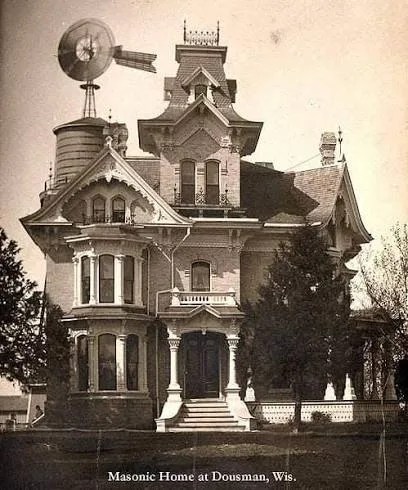


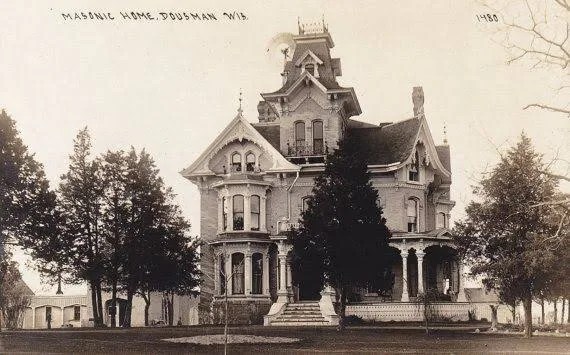
Van Brunt Mansion in Dousman, Wisconsin. Gifted to the Masons for a home for seniors, now Three Pillars Senior Community
A dispersal sale of Van Brunt’s trotting stock, drawing roughly 250 people despite bad weather, sold off a run of get by both stallions: the horse ‘Mart Rich’ (Named after Horicon dam and mill builder, Martin Rich), sired by Ripon Boy, was bought by Van Brunt’s own brother and business partner D. C. Van Brunt for $500, the top price of the day; Horses Nashotah and Evangeline, also sired by Ripon Boy; and Leona, sold to a brother of the celebrated New York horseman and publisher Robert Bonner. Red Bird and Elvie, sired by Ripon Boy Jr., were already coming up by the time of the sale — the bloodline carrying on even after the original horse was gone.
Legacy
For a few years in the early 1870s, Ripon Boy was as close to a local celebrity as Dodge County produced: a horse whose speed drew crowds to Milwaukee, Chicago, Racine, Appleton, Cold Spring Course and Dexter Park alike, whose bloodline was worth traveling to Waukesha County to bid on, and whose owner’s fortune — built on a grain-seeding invention that would eventually become part of John Deere’s Horicon Works — was, by every account, willingly spent chasing that speed. His death made news across the state not merely because a valuable animal had died, but because of how he died, and because the same misfortune had reached out, almost as an afterthought, to touch the life of a man who would go on to build a rival empire out of the very same Horicon invention that made the Van Brunts rich.
Today the mansion at Springdale Farm is gone, torn down in 1964; Van Brunt Manufacturing and Monitor Drill alike have long since passed into other companies’ hands; and Ripon Boy himself survives only in a handful of newspaper columns, betting books, and horse lineages from a hundred and fifty years ago. But for one December in Horicon, an entire state’s sporting press stopped to mourn a horse.
What an amazing story! I love your hidden history articles, you need to put out a book