
Three Revolutionary War Veterans Who Shaped Wisconsin’s Early Frontier

Historical Horicon Wisconsin
As the United States marks the 250th anniversary of its founding, three quiet Dodge County cemeteries hold a story that connects Wisconsin’s farmland to the cannon smoke of the American Revolution. Three men—Levi Holcomb, Gershom Noyes, and Richard Newsam—each carried the memory of that war westward across a young nation, ending their days among the Yankee settlers of what would become Wisconsin.
Two of their stories are well-documented. The third remains an enduring mystery.
Levi Holcomb: The Teenager Who Served Three Times

Levi Holcomb was born on January 15, 1763, in Granby, Connecticut—a frontier farming community of scattered homesteads and tight-knit Congregational families. Like many young men of his generation, he came of age in a community stretched thin by war. Town meetings debated supply shortfalls and draft exemptions, and the burden fell heavily on ordinary sons like Levi.
He first entered the war not for bounty or glory, but as a substitute for his brother Enos. In September 1779 or 1780, at just sixteen or seventeen years old, he joined Captain Phelps’s company and spent two months on garrison duty at Stratford, Connecticut—a coastal outpost on Long Island Sound vulnerable to British raids from occupied New York. His job was unglamorous but essential: patrolling shorelines, mounting watches, and manning artillery against enemy shipping.
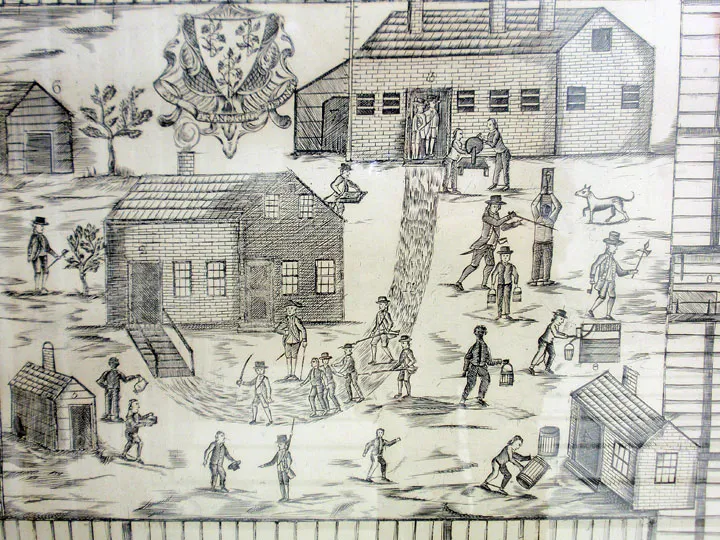
A second call came in 1781, when Holcomb again substituted for a brother—this time Ezra—for a six-month term. He was assigned to Captain Elijah Owen’s company at the Simsbury Mines, a converted copper mine in East Granby that had become one of colonial America’s most notorious prisons. Known as New-Gate, the site held Loyalists in dark underground caverns, descended by a precarious 25-foot ladder, under conditions a contemporary described as “chambers of punishment.” Today it is a National Historic Landmark.
Holcomb did not rest long. Immediately upon his discharge from Simsbury, he enlisted a third time, joining Captain Granger’s company in Colonel Samuel Canfield’s regiment for thirteen to fifteen months—one of the longer militia commitments of the late-war period. Stationed again at Stratford through 1782–83, his unit patrolled the Sound as peace negotiations unfolded, their vigilance helping Connecticut reach the end of the war without British occupation.
After the war, Holcomb joined the great westward migration of New England veterans, passing through New York’s Kingsbury and Steuben County and later Tioga County, Pennsylvania, before the frontier pulled him further still. By 1850, now an octogenarian, he had settled in the Town of Burnett, Dodge County, living near his daughter Huldah Grant and her family.
He died in 1854 and was buried at Burnett Corners Cemetery. For many years his grave went largely unnoticed, but research by local historians, the Nathaniel Ames Chapter of the Sons of the American Revolution, and the Wisconsin Society SAR eventually confirmed his service through pension records and Connecticut military rolls. Today a government marker and interpretive plaque at Burnett Corners Cemetery explicitly name him a “Revolutionary War Veteran”—the only identified burial of its kind in the county.
Gershom Noyes: Sergeant of the Rangers

Gershom Noyes was born in Stonington, Connecticut, and later moved to Guilford, Vermont, where at age 17 he enlisted for a nine-month tour with Captain Blakely’s Company of Colonel Fletcher’s Regiment of Vermont State Troops. Serving as Orderly Sergeant of the Rangers at Fort Ticonderoga and Fort Independence, he earned a military pension for his service—a credential that would follow him for the rest of his long life.
After the Revolution, Noyes settled in Preston, Chenango County, New York. On February 2, 1790, he married Mary Stanton in Stonington, Connecticut, a union that would last roughly fifty years. Together they raised nine children to maturity. After Mary’s death in Solsville, New York, Noyes made one final move—to Wisconsin in 1845, to live with his son Samuel.
He died on October 1, 1850, at age 86, and is believed to be buried in Samuel’s plot at Clyman Center Cemetery, Section 20, Town of Clyman, Dodge County—near the intersection of Highways 16, 60, and 26, on land that once belonged to his son.
For decades, the cemetery fell into neglect. Headstones were damaged by weather and vandals, though a hand-drawn map from the 1980s documented surviving markers and Noyes’s presumed site. Recovery began in 2000 when Tim Zimmerman, a new neighbor, organized family and community members—including Charles and Lynn Zimmerman, Dale and Mary Kreuziger, and his wife Nikki—to clear the overgrown grounds. Members of the Sons of the American Revolution followed with more extensive work ahead of a 2011 dedication ceremony, felling dead trees, resetting stones, and reassembling broken markers. Bailey Concrete of Clyman donated materials and labor for a memorial base supporting a State of Wisconsin plaque near Noyes’s resting place.
Richard Newsam: A Mystery in Mayville

Not every Revolutionary War story ends in certainty. The grave of Richard Newsam in Mace Methodist Cemetery, Mayville, bears the bold inscription “Revolutionary War Soldier”—yet decades of research have failed to find a single military record to support it.
Census records suggest Newsam was born in England around 1763 or 1764. He eventually settled in the Town of Hubbard, Dodge County, amid the wave of Massachusetts settlers colonizing Wisconsin’s frontier. He died in Wisconsin in 1851 at approximately age 87. His gravestone also claims Masonic affiliation—another detail researchers have been unable to verify through lodge records.
Searches of pension rolls and muster books have turned up nothing. Historians and the Wisconsin Society of the Sons of the American Revolution both examined the case, issuing a cautious synopsis that noted the complete absence of primary evidence. A summary report: “Revolutionary soldier’s history is doubtful,” detailed the exhaustive but fruitless efforts to verify his story.
Was Newsam a British deserter who slipped into American ranks? A man who adopted a veteran’s identity in old age to claim respect or benefits? Or was he genuinely a soldier whose records were lost in the chaos of war and migration? The question remains open.
His story serves as a reminder that pioneer gravestones sometimes blended fact with frontier folklore—and that the allure of Revolutionary prestige was powerful enough, in 19th-century Wisconsin, to outlast the truth.
A Legacy Rooted in Wisconsin Soil
As commemorations for the nation’s 250th anniversary unfold, the stories of Levi Holcomb, Gershom Noyes, and—if his account is taken at face value—Richard Newsam offer Dodge County a direct link to the founding generation. Their service was vital: garrison duty on a windswept coastline, guard shifts in an underground prison, ranger patrols at Lake Champlain forts.
But they carried that experience across mountains and prairies, through New York, Pennsylvania, and Vermont, until they arrived at last in Wisconsin—old men in a young territory, their Revolutionary past buried beneath decades of clearing timber, raising families, and building communities.
Their graves, tended now by neighbors, volunteers, and patriotic societies, are where that history resurfaces. On the eve of America’s 250th birthday, Dodge County has its own answer to the question of where the Revolution ended: here, in rural Wisconsin, under modest stones in country cemeteries.