

The Building That Would Not Sit Still: Horicon’s Old Stone Shop

Today, at the corner of Mill and Vine streets sits nothing more dramatic than a highway bridge and the quiet current of the Rock River sliding underneath it. It’s easy to stand there and forget how much history that stretch of water has actually carried. Long before Horicon had a name, Potawatomi and Ho-Chunk (Winnebago) villages stood along this same river, drawing on a marsh and floodplain that already supported people the way it still supports wildlife today. In the nineteenth century, a dam just downstream backed the Rock River up into the broad, island-dotted Lake Horicon — a genuine inland lake that drew steamboats and hunters, fishermen, and trappers for decades before the dam came out and the lake drained away for good. And just below this same quiet corner, Blue Heron Landing still sends visitors out onto Horicon Marsh today, into the restored wetland that grew up in that old lake’s place — proof that people have always found reasons to come down to this river, long before anything called the Old Stone Shop ever stood on its bank, and long after it was gone.
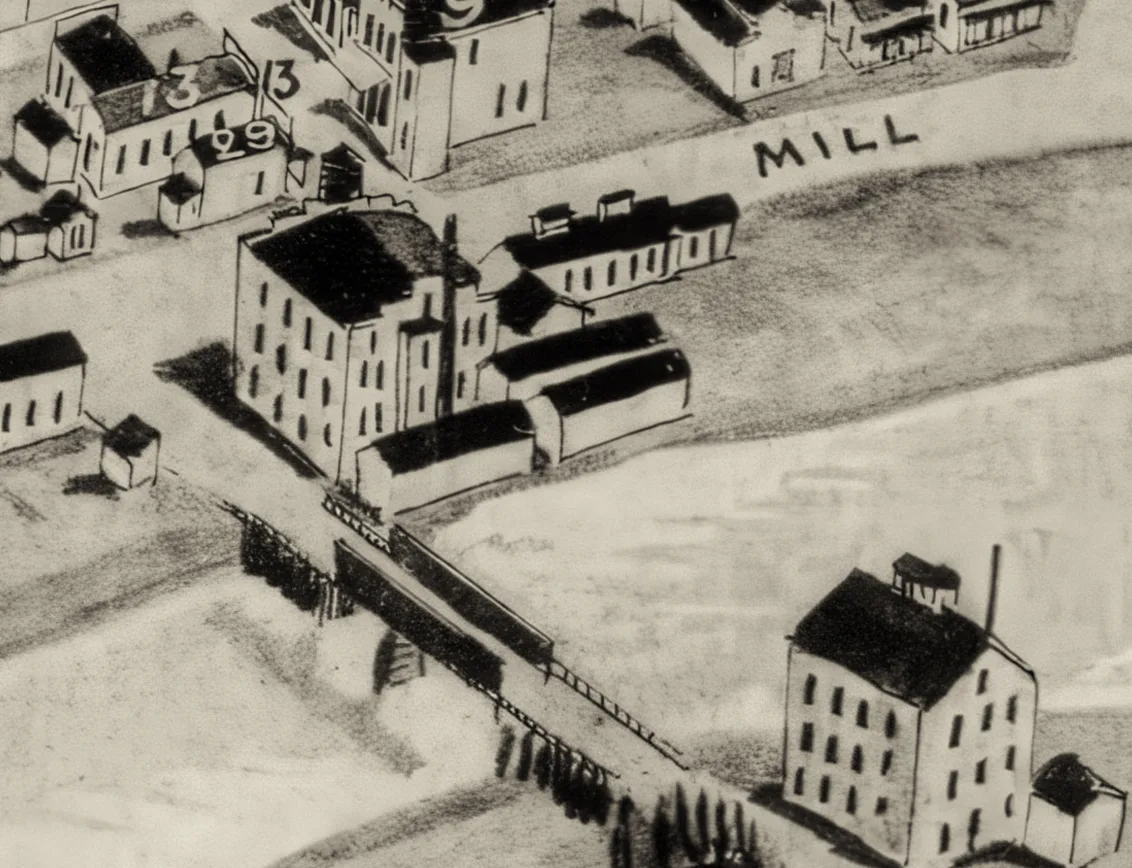
For almost a hundred years, though, that corner was dominated by one enormous building — a stone-block structure so large and so stubbornly permanent-looking that everyone in town just called it the Old Stone Shop, whatever it happened to be doing at the time. And it did a lot of things. In the span of one lifetime, that single footprint of Horicon ground was a grist mill, then a piece of a farm-machinery company that would eventually belong to John Deere, then a Prohibition-era brewery bankrolled by out-of-town money, then a neighborhood meat market and food locker plant run by a war veteran and his wife — and it finally went out, fittingly, in a fire nobody could quite control, torn down to make way for the very highway bridge that replaced it. Four completely different businesses, one building, and every single one of them left a paper trail.
A Mill on the River

The building started, like a lot of Wisconsin river towns’ first serious construction, as power harnessed from moving water. The first section went up in 1859 as a saw mill and grist mill, right where Horicon’s early industry naturally clustered — on Mill Street, at the Rock River. Four years later, in 1863, the owners added a floor and built a second section onto it, turning what had started as a modest milling operation into a considerably larger structure. It was solid enough, and built heavy enough out of quarried stone, that it would still be standing — doing three more completely different jobs — nearly a century later.
The building’s next chapter arrived by way of a manufacturing plant run by the Van Brunt and Davis Company — the same corner, the same building, doing its second job under a name most Horicon residents wouldn’t have connected to farm equipment yet.
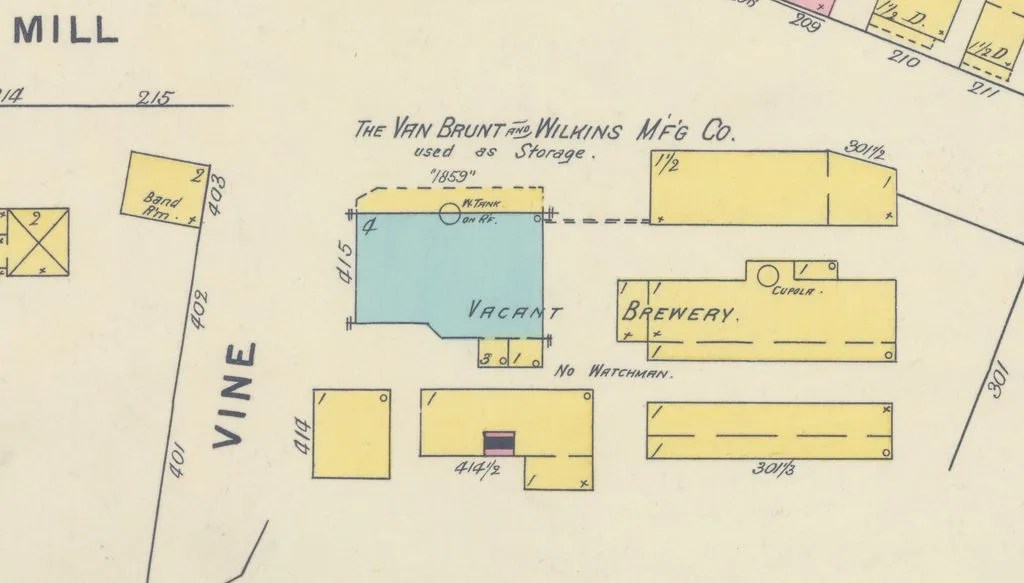
That name deserves a story of its own, because it isn’t a small one. The Van Brunts had already tried their hand at manufacturing seeding machines a few miles away, patenting the seeder first at Rolling Prairie, then a small manufacturing shop in Mayville, before moving their growing operation to Horicon. Here, working out of what was becoming known as the “Monitor” plant — this same stone building, repurposed for farm-machinery manufacture — the company kept building on that early momentum. Van Brunt and Davis, was actually a competitor of the Van Brunt Company. It’s here, running as Van Brunt & Davis Co., that the building actually picked up the nickname it would carry for the rest of its life: the Old Stone Shop. In 1890, W. A. Van Brunt, the son of company founder D. C. Van Brunt, rejoined the family firm after a stretch working as his own business, but sharing the same last name. The Van Brunt & Davis operation — a small, human detail buried in old ledgers and letters, but a real one: a second generation of the same family, working the same stone building, on its way toward something much bigger. The Van Brunt Manufacturing Company that grew out of this period would go on to build more than 100,000 machines, get bought out by Deere & Company in 1911, and still runs today as Deere’s Horicon Works — one of the largest employers in the county. The Old Stone Shop’s own role in that story faded as the main operation grew and modernized elsewhere, but the building stayed in the family’s hands for years afterward as a plain company warehouse, quietly storing whatever a growing farm-equipment giant needed stored, long after it had stopped making anything itself.
A Brewery, Built on Borrowed Money
Then, in 1933 — Prohibition’s last year — the Old Stone Shop changed identities completely. A group of investors from Sheboygan, led by a man named John Cesar Jr. later the President of the Horicon Brewery Company, and the Sheboygan Malt Products company, bought the property and gutted it. Every one of its four original wooden floors came out. In their place went three brand-new floors of steel and concrete, an entirely new interior built to hold a modern industrial cold-storage operation: cork insulation lining the walls, the floor, and the underside of the roof (a three-inch layer of cork sandwiched between two layers of concrete on the floor alone), a brick elevator shaft rising up the building’s south side, and a boiler room built onto its southwest corner to house a steam plant big enough to run the whole operation. Steel arrived in loads from the Skobis Company; storage tanks arrived “huge affairs,” as the local paper put it, meant for nothing less than “the manufacture and storage of beer.” Nobody would say for certain, at first, whether the finished building would end up a brewery or a malting plant — the paper only knew the Sheboygan men were interested in both. By that October, the answer was settled: six large brewing tanks and fermenting kettles had gone in, and the Horicon Brewery Company was open for business, with the former Sheboygan Brewer, John Cesar Jr., as its president.
For a few years, it was simply one more Horicon institution, doing ordinary Horicon-institution things — its president was civic-minded enough to arrange for the Horicon City Band or the Ashippun Band to escort a county fair special train, a nice small proof that the brewery had settled into the rhythm of small-town life rather than remaining some outside company’s curiosity. Cesar spent lavishly in the area, hosted dinner parties, and purchased a Stinson airplane “for business purposes“. But that wave of high income and profits didn’t last.
The timing could hardly have been worse. Through the early and middle 1930s, the same punishing heat and dust storms scouring the rest of the Great Plains hit Midwestern barley and grain crops hard, and farm incomes across the region collapsed right along with them. High-grade malting barley here in Wisconsin — the specific, carefully grown crop a brewery actually needs, not just any grain — stayed scarce for years after Prohibition ended, nowhere near the volumes American brewers had taken for granted before the First World War. Beer made in that stretch often tasted like it: thinner and less potent than the old pre-Prohibition product, missing some of its familiar “kick” simply because the malt that gave it that character wasn’t reliably available. The Horicon Brewery Company was no exception, and like plenty of small brewers of the period, it apparently leaned on cheaper adjuncts — corn, sorghum, even potatoes — to stretch its mash further when good malting barley was hard to find.
Not every experiment landed, either. At some point the brewery took a run at malt liquor — a sweeter, more heavily carbonated alternative to a traditional lager — and advertised it locally under the slogan “the bubbles tickle my nose.” The bubbles, as it turned out, were about the only thing that tickled anybody: Dodge County drinkers wanted beer, not a carbonated novelty, and the malt liquor line quietly vanished from the brewery’s lineup.
By 1937, the whole venture had come apart at the seams — financially, not physically. A Dodge County judge’s ruling that August ordered the building sold at a sheriff’s sale to satisfy the brewery’s massive debts, and the list of parties suing to get their money back reads almost like a receipt for the 1933 remodel itself: the steel supplier, the boiler works, the elevator company, an ice-machinery company, a chemical company, a concrete company — every contractor and vendor who’d helped build the modern brewery apparently still waiting to be paid for it, four years on. John Cesar Jr. and his wife Angela were named as defendants alongside the Van Brunt Manufacturing Company itself, which still held some interest in the property as well as the Horicon Iron and Manufacturing Company. The sale went forward that October at the courthouse in Juneau. The brewery that had been built to last, with steel and concrete replacing a century-old building’s wooden bones, hadn’t survived a single decade.



The Building That Fed the Neighborhood
The Old Stone Shop sat empty in the years right after the 1937 sale; its brewery contents retrieved and hauled away. By the mid-1940s, though, the building found its most beloved identity yet — and, in a nice bit of continuity, it did so by reusing rather than replacing what the failed brewery had left behind. Julius H. Brown bought the property and set about converting the same cork-insulated, refrigeration-ready interior the Sheboygan investors had built for beer into something far more useful to ordinary households: a food locker plant. This was the era just before home freezers were common, when a family wanting to keep a side of beef or a summer’s worth of garden vegetables through the winter rented locker space instead of owning it, and Brown’s Locker Service opened with 150 lockers on the building’s second floor, with room, via a new Frigidaire system, to grow toward well over 300. A family paid an annual fee for their own numbered locker, brought in farm-butchered meat, garden produce, or wild game, had it flash-frozen in a shared sharp-freezing chamber, and then simply stopped by whenever they needed a package — the whole neighborhood’s frozen-food storage, in effect, at a time when almost nobody owned a home freezer of their own.


It grew even further under new ownership. On February 15, 1946, James and Mrs. Cocking bought the locker business from Brown and made it their own — the Horicon Locker Plant, eventually rented out to the tune of 700 individual lockers, alongside a full meat market and grocery store that made the building, for the first time in its history, a place families visited on ordinary Tuesdays rather than an industrial site they simply worked at or lived beside. The Cockings’ homemade sausage became famous well beyond Horicon’s own borders, and the family lived in the building itself, making the old Stone Shop — mill, machine shop, brewery — a home as well as a business for the only time in its life. Jim Cocking brought a genuine local-hero résumé to the job: an American Legion member, a fixture of the Chamber of Commerce, and, more strikingly, a Lieutenant Colonel in the Air Force Reserve who’d spent two years of World War II on duty at the headquarters of General Dwight D. Eisenhower before coming home to run a butcher shop and grocery store (and Horicon Liqour Store and Beer Depot!) out of a hundred-year-old stone building on the Rock River.

It’s still a living memory for plenty of Horicon families, too. Just the other day, I had Horicon’s class of 1966 out on the boat tour. More than one of them lit up at the mention of the old locker plant — sent down as kids by their parents to pick up brats or steaks for supper, running the same errand their grandparents might have run a generation earlier at that very corner, in a building that had already been three other things before it ever kept anybody’s meat cold.
An Ending Written by the Highway Department
The building’s fourth act was the one that finished it off — not a fire this time, well, not at first, but a road project. In the mid-1950s, the State Highway Commission decided to relocate Highway 33 through Horicon and build a new bridge over the Rock River, and the route the engineers wanted ran directly into the Old Stone Shop’s corner. The building, by then, was doing exactly what it had been doing for a decade — housing the Cockings’ locker plant, meat market, and family home — right in the path of the state’s new right-of-way, and right at what the highway commission’s own surveyors called “a very bad curve” they were finally in a position to eliminate. The city appraised the property for purchase; the Cockings put the locker plant’s entire contents up for public auction and, sometime around the first of the month, moved out of the building that had also been their home.

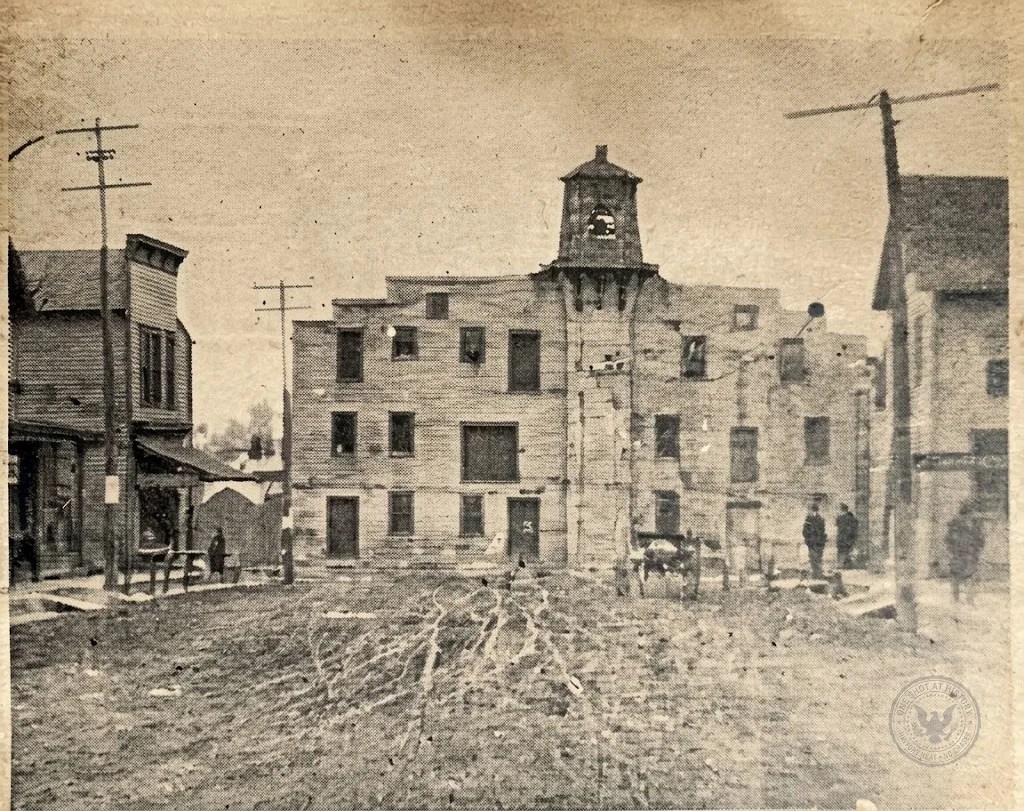
Then came the demolition itself, and it went about as far off-script as a demolition can go. Workmen started what should have been a routine, controlled fire in the basement, meant to slowly burn out the building’s remaining lumber ahead of pulling down the stone walls — a standard-enough way of clearing a structure this size. Instead, the fire found its way up a wall still lined with the brewery-era cork insulation from two decades before, climbed straight through the upper stories and the roof, and turned the whole interior into what one photo caption unforgettably called a “helpful holocaust.” It burned for roughly twenty hours. Thirty firemen and a thousand feet of hose showed up — not to put the fire out, but to keep it from spreading to the rest of the block, since the building was doomed either way and the blaze, if anything, was doing the demolition crew’s job for them. Only after the fire finally burned itself down to embers did workers spend two more days knocking apart the charred but still-standing stone walls, on October 6th through 8th, 1955. When the new Highway 33 bridge opened to traffic the following May — ten months of construction, a ribbon cut by three different Horicon mayors who’d each carried the project a little further along — the view south down Vine Street had changed for good. Some of the large stones that made up the building can still be seen throughout Horicon today, reused and repurposed as retaining walls, foundations and curbs. Where a formidable, nearly hundred-year-old stone building had once forced traffic to jog left and then right around it, there was now just open river, a new bridge deck, and, in the distance, the spire of St. Malachy’s.
It’s hard to find a tidier stand-in for a full century of a small Wisconsin river town’s working life than that one building’s four careers: water-powered milling, then a piece of a farm-equipment empire that grew into one of Dodge County’s largest employers, then a brewer’s overreaching bet on Repeal-era optimism financed entirely on credit, then a genuinely beloved neighborhood butcher shop and cold-storage plant that fed families for a decade. It took a state highway project — and one wildly uncooperative demolition fire — to finally put an end to all of it. The Old Stone Shop is gone, but for ninety-six years, it never once sat still.
Sources
• “In 1890 W. A. Van Brunt, son of D. C. Van Brunt, became again associated with the company…” (undated retrospective clipping; Van Brunt & Davis Co., the “Monitor” plant, and the Old Stone Shop nickname: research by Carl Reinemann).
• “Will Take Band” (Horicon Reporter; John Cesar Jr., president, Horicon Brewery Company).
• “J. H. Brown Will Operate Lockers In Horicon Soon” (Horicon Reporter; Brown’s Locker Service).
• “Appraise Horicon Plant Needed For Highway Change” (Horicon Reporter).
• “Sell Contents Horicon Locker” (undated clipping).
• “City to Have New Industry” (Horicon Reporter clipping, 1933).
• “Steel I Beams Arrive for Brewery Interior” (Horicon Reporterd clipping, 1933).
• “Laying Cork Insulation in New Brewery Building” (Horicon Reporter clipping, 1933).
• “Large Tanks Arriving for Brewery Installation” (Horicon Reporter clipping, 1933).
• “Forty Years Ago,” retrospective column recapping Oct. 19, 1933 (Horicon Reporter published c. 1973).
• “Sheriff’s Sale… Judgment of Lien Sale,” State of Wisconsin Circuit Court, Dodge County, dated at Juneau, Wis., Aug. 19, 1937 (Dodge County Courts- judgment dated Aug. 13, 1937; sale set for Oct. 4, 1937 – research by Carl Reinemann).
• “Meet Your Horicon Merchants” (Cocking family profile, mid-1950s; photo by Roy Maas).
• The Horicon Reporter, Horicon, Wis., Thursday, May 31, 1956, p. 3, “New Highway 33 Bridge Here Opens Ten Months after Construction Began.”
• “Fire Sweeps Through Old Stone Shop, Speeds Work of Demolishing” (Horicon Reporter clipping, companion to the above; the “helpful holocaust” photo caption also appears here).
• Photographed handwritten museum-label card, “Locker Plant” (local collection).
• Related material already on file: the M. Winter boiler-explosion account (Horicon Lake Association research by Carl Reinemann); George W. Van Brunt’s 1861 patent and the Van Brunt Manufacturing Company/Deere & Company history (Rolling Prairie research).
