


Drive the back road between Horicon and Beaver Dam today and you could pass through Rolling Prairie without ever knowing you’d been there. It’s not a village anymore, not officially — just an unincorporated place name hung on a stretch of country between the towns of Oak Grove and Burnett, a few farms and a crossroads where something bigger was supposed to happen. Because for a run of years in the middle of the 1800s, this quiet stretch of Dodge County road had every reason to become a real town: a railroad running straight through it, a busy grain trade, and a village plat already drawn up to hold nearly two hundred building lots. It just never quite got there — and the story of why turns out to be a better story than the town itself would have been.
Before the Survey, a Trail Through the Prairie
Long before there was a grid on paper, this ground already had its own traffic. C. C. Deits, who arrived here as a boy with his family in the 1840s, remembered in a 1914 letter home that his father’s new claim sat along a well-worn trail running from Mud Lake to Horicon, used by local Winnebago families — sometimes a hundred people passing at once, “one behind the other,” the men riding ponies while the women walked alongside carrying their children. In spring, Winnebago families camped nearby and traded maple sugar to the new settlers for flour; deer, black bear, wolves, prairie chickens, and wild ducks were still so plentiful that one neighbor, caught out after dark with a load of beef on his back, had to drop it and run when the wolves closed in. Even the place itself hadn’t settled on a name yet: Deits remembered his own family’s arrival at “Rolling Prairie South of Big Mound, as it was then called” — one more piece of this area’s early identity that, like so much that came after it, simply didn’t stick.
A Grid on Paper, Long Before Anyone Arrived
The land was surveyed before it was settled, the way most of Wisconsin was. Somewhere around 1837, federal surveyors walked this stretch of prairie and staked it into the neat, anonymous one-mile squares of the federal land grid — section lines, corner markers, a distant creek noted in passing, even a spot flagged for a small lime works. It’s a bureaucratic, faintly funny kind of document: the land divided and numbered years before a single settler had a reason to care which square mile was which. Seven years later, in 1844, a Yankee named Ranslow Smith rode into one of those squares and started turning it into somewhere people actually lived.


Smith wasn’t quite starting from nothing, after obtaining land in a land patent in 1848 — a fellow settler’s letter later recalled that Smith “had just bought the claim” from a man named Deits — but he moved fast once he arrived. By 1845 he was already a school-district trustee, helping organize the area’s first log schoolhouse. Two of his brothers, George and Lyman, settled nearby and each opened a tavern of his own, so that this stretch of road briefly had three Smith-family inns strung along it.
The Four Mile House — “the Forties”
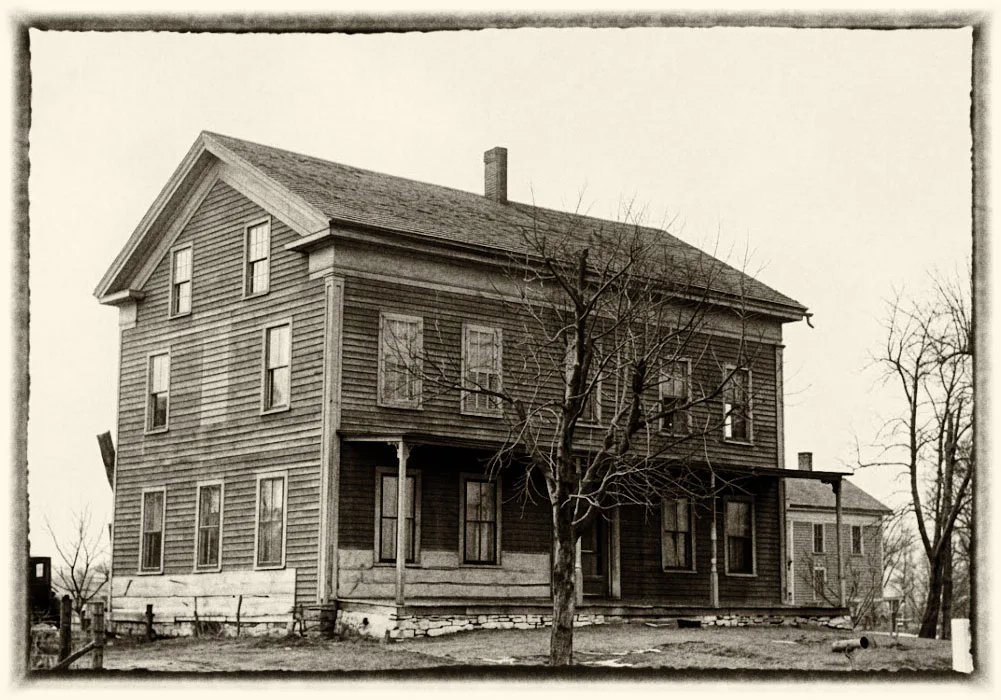
Ranslow’s own tavern went up in 1853: a proper two-and-a-half-story frame inn built exactly four miles out on the Watertown–Fox Lake stage road — close enough for a coach to reach comfortably, far enough to be worth the stop. Everyone called it the Four Mile House, though locally it also picked up a shorter nickname: “the Forties.” A surviving real-estate ad from later in the building’s life gives its actual dimensions — a 26-by-40-foot main house with a 16-by-24-foot ell, fifteen rooms, and an 18-by-40-foot hall on the third floor — and it was that third floor, more than the rooms below it, that made the place a genuine community fixture rather than just a place to change horses: it hosted meetings of the Rolling Prairie Debating Society, the Good Templars, and the Temperance Dramatic Club, along with oyster suppers and maple-sugar festivals, for years after the stagecoach trade itself had dried up.
Smith ran the inn and also served as the local Justice of the Peace, with decidedly mixed results. Old-timers loved to retell the night he misdated a court summons for 2 a.m. instead of 2 p.m., hauling half the neighborhood’s lawyers and witnesses out of bed. Rather than send them home, Smith reportedly said, “It is my mistake and my treat, walk right in” — and they made a party of it. He also had a habit of reaching for big words “that would be hard to find in Webster’s big dictionary,” a running joke among his neighbors, and when a lone horseman in army uniform rode through one day in the early 1860s and stopped at the hotel, Smith’s own confident guess was that the stranger must be a government man out to “reconnoiter” the lay of the land.
Smith sold the property in 1867, and it changed hands repeatedly after that — Oliver Crowl, then Peter Worthy and A. Vesper, then a long run of owners through the 1870s to the 1890s, ending with Julius Keske selling to Herman Naffin in 1904 for $3,000. One clipping from right around that sale even gives the building’s construction year as “about 1854” rather than 1853 — a small discrepancy, but a reminder that no two accounts of this building’s history agree on every detail. What every account does agree on is that it kept right on serving as the neighborhood’s real gathering hall, long after it had stopped being anyone’s idea of a growing business.
The building’s last private owners, Lee and Nancy Wanie, sold it to the Wisconsin Historical Society in 1980. They marked the occasion with a farewell party at the old place that November, the two of them dressed for the day in 1850s costume, and by December the Society had begun taking “the Forties” apart, board by board, to move it eighty miles east to Old World Wisconsin, the Society’s outdoor living-history museum in Eagle. It was restored there to its 1870s appearance and still stands today as part of the museum’s re-created crossroads village — a genuine piece of Rolling Prairie’s working history, just relocated. Its influence didn’t stop at its own restoration, either: more than a century after it was built, a Wisconsin builder named Dean Herriges used the restored Four Mile House as the direct architectural model for a brand-new building of his own, the Eagle Centre House bed-and-breakfast, built in 1989–90 near Eagle — right down to hand-copying its distinctive eyebrow windows, door hinges, and staircase details. The museum’s own curator has called the Four Mile House representative of “Greek Revival influences in Wisconsin.” A building put up to feed stagecoach travelers on a road that stopped mattering more than 150 years ago is, in a small way, still being built.


The Four Mile House in 1920, and then as it is being reassembled at Old World Wisconsin, and as it is today.
A Railroad, Four Wheat Buyers, and a Village on the Rise
By the fall of 1856, the promise the 1837 survey had only sketched in pencil started to look real. The La Crosse & Milwaukee Railroad ran a siding through Rolling Prairie, and for a stretch, construction stalled right there — meaning the depot briefly served as the literal end of the line, “always crowded with goods” bound for points a hundred miles further out. Four wheat buyers — S. H. Ford, Ed Richardson, Sam Eastman, and a fourth man named George Van Brunt — set up board shanties right on the siding to buy grain off farmers’ wagons. Longtime local postmaster L. L. Fairchild, looking back on it decades later, remembered harvest season teams strung “as far as the eye could reach,” wheat pouring in from towns as far off as Waupun and Juneau. Wheat sold for 46 cents a bushel in 1856. It was, briefly, a real boomtown moment.
Remember that name, George Van Brunt — he’s about to matter to a much bigger story. Farmers of the day still sowed grain the old way, broadcasting it by hand across a field and hoping enough of it landed right, and Van Brunt thought a machine could do better. As the story is usually told in company histories and antique-farm-equipment writeups, he whittled an early working model of the seeder’s key mechanism — a “force-feed” device that metered seed out evenly — from a carved turnip. By 1860 he and his brother Daniel had built and sold seven of the machines. He wasn’t the only one in Rolling Prairie trying to solve the same problem, either: a local blacksmith named A. Linning built his own grain drill around the same time, but, in Fairchild’s words, “it did not prove a success and it rotted down by the roadside.” Van Brunt’s did.

On November 12, 1861, George W. Van Brunt was granted U.S. Patent No. 33,720 for an “Improvement in Seeding-Machines,” and the document lists his residence plainly: “Rolling Prairie, in the county of Dodge and State of Wisconsin” — not Mayville, not Horicon, the two towns every published history of his company mentions instead. Every secondary account of the Van Brunt seeder starts the story in Mayville, where the brothers ran a wagon shop through the 1850s, and has them moving straight to Horicon in 1861 without ever passing through Rolling Prairie at all. But the actual patent — the legal record of the invention itself, filed at the exact moment the machine existed and worked — gives this crossroads as George Van Brunt’s home address, and now it’s clear why: he already had a wheat-buying business here, right on the rail siding, and it was from that address that he filed to protect the invention that would define the rest of his life. Within a few years he and Daniel moved their growing operation to Horicon, where it became the Van Brunt Manufacturing Company — eventually building over 100,000 machines, bought out by Deere & Company in 1911, and still running today as Deere’s Horicon Works.
A piece of one of Wisconsin’s biggest agricultural-equipment stories, in other words, was actually invented on a Rolling Prairie rail siding, not in either of the two towns that usually get the credit.
The Man Who Platted the Village — and Priced It Into Failure
Someone had to run the actual depot, and the job first went to Ranslow Smith, who — per Fairchild — “proved wholly incompetent to run the business or keep the books.” His replacement, Samuel B. Ormsbee, was a much more interesting kind of failure. Ormsbee arrived from a Fond du Lac livery-stable business with a reputation as “an unconscionable teller of big yarns,” and as depot agent he turned out to be smart, well-liked by railroad officials, and thoroughly dishonest. Fairchild’s account of him is specific and damning: a stolen boxcar of cordwood that Ormsbee simply hauled home himself; a barrel of pork, gone missing from a Portage-bound shipment, that turned up years later stenciled with its rightful owner’s name in Ormsbee’s own cellar; a habit of quietly overcharging freight customers. His own son admitted, in confidence, “that the perquisite of the agency exceeded the salary.” The railroad eventually moved him along to Minnesota, where he failed again and died poor. Fairchild’s verdict: “He was a strong illustration of ‘Honesty is the best policy.’” Another old-timer put it in five words: “Smart and dishonest. A grafter.”
That’s the man — almost certainly the same one, by every surviving account — who partnered with Ranslow Smith around 1860 to plat their adjoining land into Rolling Prairie’s village: eight streets, twelve blocks, close to two hundred lots, a station house and side track marked right on the map, and a street literally named Produce Street, the unmistakable signature of a place meant to be a shipping town. A Horicon newspaper, looking back on it in 1908 with fifty years of hindsight, explained exactly what went wrong:
“S. B. Ormsbee and Ranslow Smith were the early owners of the land at Rolling Prairie. They plotted it in small lots and asked city prices for the lots. A business man could not buy a half acre unless he paid a price equalling or exceeding the price of large towns. Many people in the fifties came here to locate. But nearly all were scared away by prices asked. At that time there was no Minnesota Junct. or Burnett Junction, and a good opening to build up a town. But the land owners scared nearly everybody away. Had they given away half the lots and sold the balance at reasonable prices the chances of the village would have been ahead of the growth of surrounding places.”
— The Reporter, Horicon, Wis., January 17, 1908
Rolling Prairie didn’t lose its shot at becoming a town to bad luck or poor soil — the railroad ran right through the plat. It lost it because the two men who owned the ground priced half-acre lots like Milwaukee real estate, at the exact moment Dodge County was filling up with settlers looking for cheap village land. And given what we know about Ormsbee’s other job in this same small town, it’s hard to read the 1908 verdict as anything but pointed: this wasn’t a village undone by an absentee landlord’s bad judgment. It was undone, at least in part, by a man the town already had good reason not to trust with money.


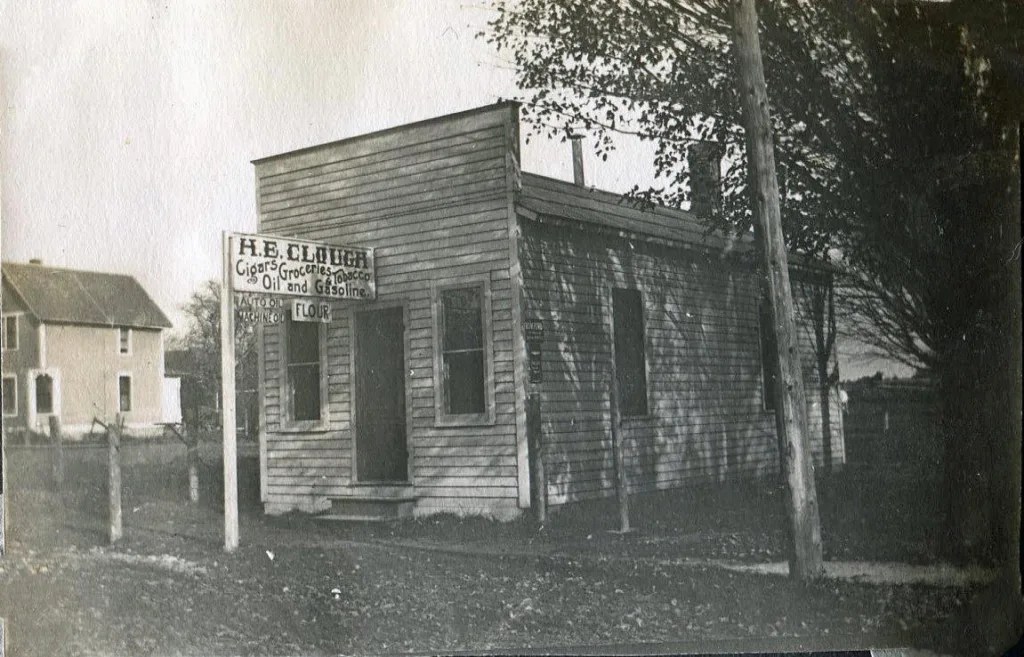
Above Photos Courtesy of Paulette Horn
What Came Instead
Rolling Prairie never grew into the shipping town its plat promised — but it didn’t dry up and vanish, either. It kept functioning as a genuine small farm community for decades: an elevator moving tens of thousands of bushels of grain a year, cattle and hogs shipped out by the carload, a post office, a creamery, a blacksmith, a school.
Its strangest and most unexpected claim to fame, though, came in 1889, when it picked up a specialty cheese company nobody platting streets in 1860 could have predicted. The Behle family — Alsace-Lorraine immigrants who’d already been in the Wisconsin cheese business since 1864, at a factory in Ladoga, over in Fond du Lac County — sent four brothers, Albert, Gustav, Emil, and Otto Behle, to Rolling Prairie to build a new plant of their own, making French-style Camembert and Brie the way they’d learned it back home. Milk from 38 area farms came in daily. The cheese caught on, and in 1904 it caught the attention of a genuinely notable early customer: Mrs. C. A. Vollrath, grandmother of future Wisconsin governor Walter Kohler, whose enthusiasm for the French varieties encouraged the company to expand into American-style cheeses as well. By the early 1900s Otto Behle was the sole surviving brother running the place; he summoned his own family back from Ohio, where they’d gone to expand the French-cheese side of the business, to keep a first-and-second-generation family operation going in Rolling Prairie, with his son C. Paul Behle at his side. In 1918 the company started boxing assorted cheeses together as gift boxes for a growing mail-order trade, and in 1937 a third generation — Roland C. Behle — joined the business and pushed further into direct mail order. The factory finally closed only when the area’s dairy farms converted from cheese-grade milk to the fluid-milk market. For the better part of a century, in other words, a village that never got its shot at being a real town was quietly home to one of the country’s earliest specialty Camembert-and-Brie operations, with a future governor’s family in its customer book.
Rolling Prairie bids to become State of Wisconsin Capital
By 1905, the platters’ old ambition had curdled into a running joke — one Fairchild himself was happy to tell. Writing that year to the Beaver Dam Argus, he made the case, straight-faced, for why Rolling Prairie ought to be named Wisconsin’s new capital: it had “as many acres to the mile as Oshkosh, Milwaukee, or any swell town,” sat at the center of a widening circle of real Dodge County towns, and offered every practical amenity a state government could need — a rag-carpet weaver to furnish the Senate and Assembly rooms, a blacksmith for the ironwork, and an elevator to supply “the barley and malt to lubricate the whole state machinery, including the Assembly and Senate.” “We must have the Capital!” he wrote. “And we will ever prey and bray as loud as either Milwaukee or Oshkosh.” Nobody in Madison took it seriously, least of all, one suspects, Fairchild himself — but it’s a fitting joke from the one man who’d spent decades chronicling exactly how far short of its own ambitions this little crossroads had actually landed.
That’s the shape of the whole story, really. Not the town on the map — the quiet, half-accidental things that happened anyway. Fairchild himself, writing around 1915 with the wheat boom fifty years behind him, put the ending better than anyone else could: “I doubt if a load of wheat has been unloaded at the elevator the past year.” The four men who’d once run competing shanties on that siding, racing each other for the first bid on every farmer’s wagonload, were all long dead by then — “the wheat buyers here in the fifties have all been dead for years.” The town they were racing to build never quite arrived. But look at what came out of that brief, overpriced, badly-managed rush anyway: a stagecoach tavern nicknamed “the Forties” that outlasted its own road by more than a century and now stands eighty miles from home as a museum piece and an architect’s model; a seed-drill patent that helped build a company still making farm equipment in Horicon today; and, of all things, an early American Camembert factory with a Wisconsin governor’s family in its customer book. Rolling Prairie’s big plans never worked out. Almost everything else about it did, just not the way anyone platting streets in 1860 could have guessed.

WOW!, I had no idea. I was born in 1959 in Beaver Dam, I lived on the farm just north of Rolling Prairie, I had only heard about the old Train station, after I married an moved to Appleton, I had read an article somewhere about the Hotel being moved to Old World Wisconsin, but I never put the two together, and I have been to Old World Wisconsin, and the Four Mile House many, many times!
Thanks very much for your comment, glad to see I reached a ‘local’!
What is the current intersection that would be in Rolling Prairie? Definitely an interesting read.
It is the intersection of County I and Prospect Road, you can still see some of the original buildings, excpet the Four Mile house.