
Atwater, Wisconsin:
Before it was Atwater, it was Mill Creek.
The place sits in the Town of Chester, five miles down the tracks from Waupun. The Milwaukee & Horicon Rail Road, chartered in 1852, pushed its line from Horicon to Waupun by 1855, and the rails ran right through. A year later, a settler from Atwater, Ohio, gave the crossroads a hometown name, and it stuck.

The railroad made the town. Atwater sits at milepost 148.7, measured from Chicago: 9.6 miles out of Horicon, 4.4 past Burnett, and 5 short of Waupun. The line became part of the Milwaukee Road and carried passengers until 1958. Trains operating out of the Horicon yard regularly serviced local grain elevators and manufacturing customers up the branch. Because it is a secondary route, traffic frequencies vary depending on seasonal harvest spikes and the needs of regional agricultural hubs
The post office followed the rails. It opened July 22, 1858, went dark for a stretch around the Civil War, and came back in December 1875. When Rural Free Delivery wiped out crossroads post offices across Wisconsin in the early 1900s, Atwater’s hung on. It finally closed August 31, 1943, and the mail went to Waupun, the city straddling the county line at Chester’s north edge.
Then there was the milk. The Atwater Creamery Co., run by Edwin C. Beske, appears on the state Dairy and Food Commissioner’s roll of Dodge County creameries. It was one more reason for a farmer to hitch up and head to town.
Atwater never incorporated. It never had to. It had a railroad stop, a siding, a post office, a creamery, and a Main Street.

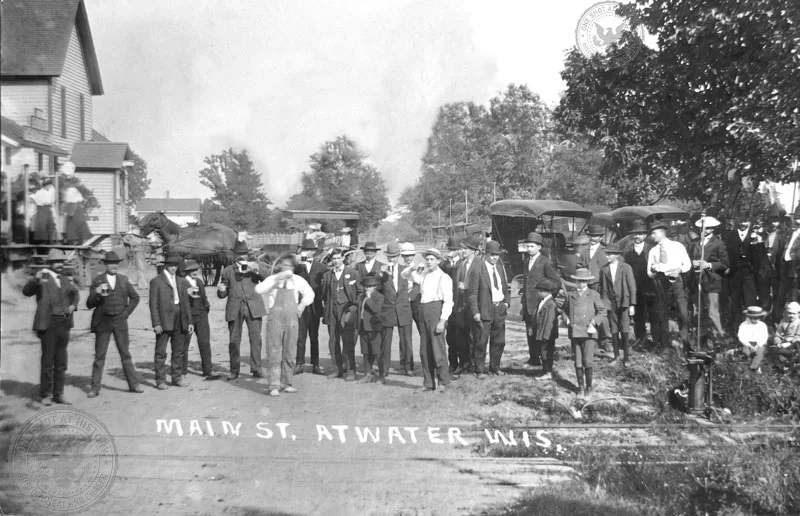
These two photos catch the town on what was clearly a big day. In one, a crowd of men in derbies and caps packs the yard beside the tracks, a boxcar spotted at the elevator behind them. In the other, the men of Atwater line up across Main Street, right at the rail crossing, and hoist their beer glasses to the photographer. Boys stand up front. Buggies line the street. Women watch from a porch.
We don’t know what they were celebrating, but it looked fun! If you do, tell us.

The crowd is long gone, and so is the post office. The rails are still there, and so is the name that Ohio settler picked in 1856.
Because the past only happens once.
P.S. So who was the settler from Atwater, Ohio?

Robert Gard’s The Romance of Wisconsin Place Names book say a settler from Atwater, Ohio renamed Mill Creek in 1856.

Edwin Hillyer was born to a pioneer family in Atwater, Portage County, Ohio, on September 30, 1825. He landed in Waupun in 1847 with his brother, Joseph Talcott Hillyer, and the two went to work in the local lumber business. And in 1856, the very year Mill Creek became Atwater, Hillyer was recruited to lead construction of the Milwaukee & Horicon Railroad between Waupun and Horicon. A man from Atwater, Ohio, builds a railroad through a tiny crossroads, and the crossroads takes the name Atwater that same year. No record we’ve found says it outright, so call it a strong lead, not a settled fact.
Hillyer was worth knowing either way.
In 1849 he caught gold fever and lit out for California with eight other Waupun men. He kept a detailed journal of the trip, a first-rate look at the trials of the forty-niners, and the Wisconsin Magazine of History ran it in 1966.
He was back in Wisconsin by 1852. He opened a general store with his brother, sold his share a few years later, and went into the insurance business alongside some of Waupun’s leading industrialists. Through the 1850s, if something was happening in Waupun, Hillyer was probably in the middle of it: industry, public office, city planning.
In 1853 he won the seat for Dodge County’s 6th Assembly District and spent a year in Madison. One family biography credits him with leading the push to end capital punishment in Wisconsin, which the state abolished that same year.
He did a stint as deputy warden of the state prison at Waupun and laid out the original landscaping of the prison grounds. He was a founding member of the Forest Mound Cemetery Association.
In 1858 he started a Library Association: nine feet of shelves in his downtown insurance office, open to paying subscribers. He ran it for 37 years without pay, then turned the collection over to the city in 1895 as the Free Public Library of Waupun. Today’s Waupun Public Library is its direct descendant. The library and the historical society still own many of Hillyer’s books, though you won’t find them in regular circulation.
When the Civil War came, Hillyer helped raise a company of Waupun men and went with them as Captain of Company K, 10th Wisconsin Infantry.
Above all, he was a family man. In 1898 a grand “Golden Wedding” marked his fifty years with Angeline Coe Hillyer. The two spent his retirement traveling the country, and he died in St. Petersburg, Florida, on December 8, 1908, at age 83. He came home to Waupun and lies in the center of Forest Mound Cemetery.