

Origins, Archaeology, the Horicon/Van Brunt Connection, and the “de-extinction’ Plan to Bring It Back
Did you know Wisconsin once hosted billions of passenger pigeons?
The story of the passenger pigeon’s rise and fall has long fascinated historians and naturalists. Science writer Charles C. Mann revisited this ecological mystery in his acclaimed book 1491: New Revelations of the Americas Before Columbus. Building on archaeological work by researchers including Thomas Neumann and William Woods, Mann laid out a provocative hypothesis: the vast passenger pigeon flocks European settlers described in the 19th century may not have reflected a natural, ancient baseline at all. Instead, they may have been a population explosion triggered by the catastrophic decline of Native American populations after European contact — a collapse driven above all by smallpox and other introduced epidemics, which unraveled centuries of Indigenous land management and hunting practices that had likely kept pigeon numbers in check. It’s worth noting this remains a debated hypothesis rather than settled fact — some historians, including Joel Greenberg, author of a major history of the species, read the evidence differently.
The archaeological piece of the puzzle is genuinely striking. Excavations of pre-contact Native American sites across eastern North America turn up surprisingly few passenger pigeon bones in midden (refuse) deposits, especially compared with the remains of other wild birds. That scarcity suggests the species may not have been the ubiquitous presence in the pre-contact landscape that later 19th-century accounts implied — possibly because Indigenous communities actively managed the mast-producing trees (oaks, beech, and other nut- and acorn-bearing species) the pigeons depended on, and hunted the birds themselves.
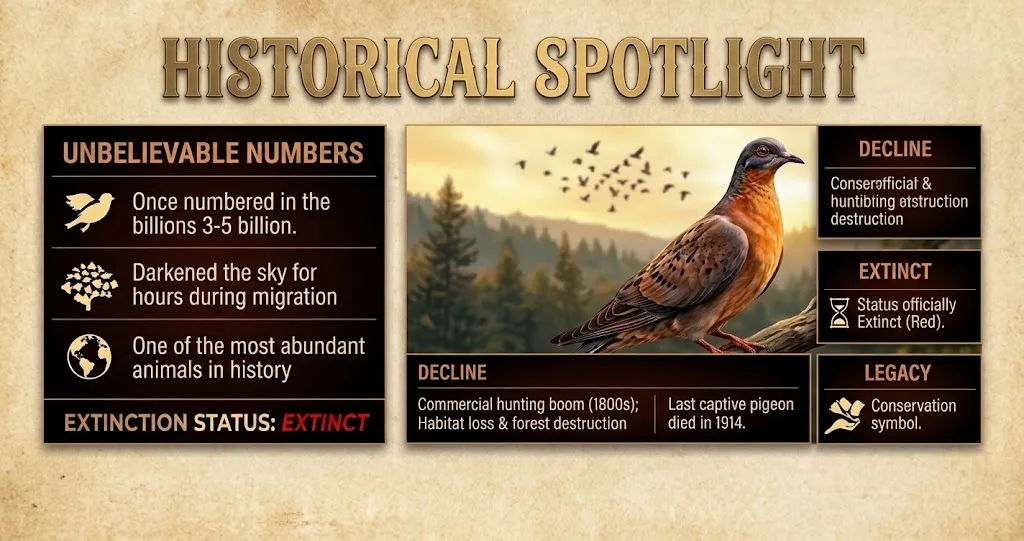
In Wisconsin, and especially around the ecologically rich Horicon Marsh, the aftermath of Indigenous depopulation was stark, at least under this hypothesis. With hunting pressure reduced and mast piling up in untended oak-savanna forests, passenger pigeon numbers are believed to have surged. Contemporary 19th-century observers described flocks so vast they darkened the skies over the marshlands for hours at a stretch. Before the epidemics, local Native communities are understood to have hunted passenger pigeons seasonally and managed the surrounding oak savanna in ways that intertwined human activity with avian ecology.
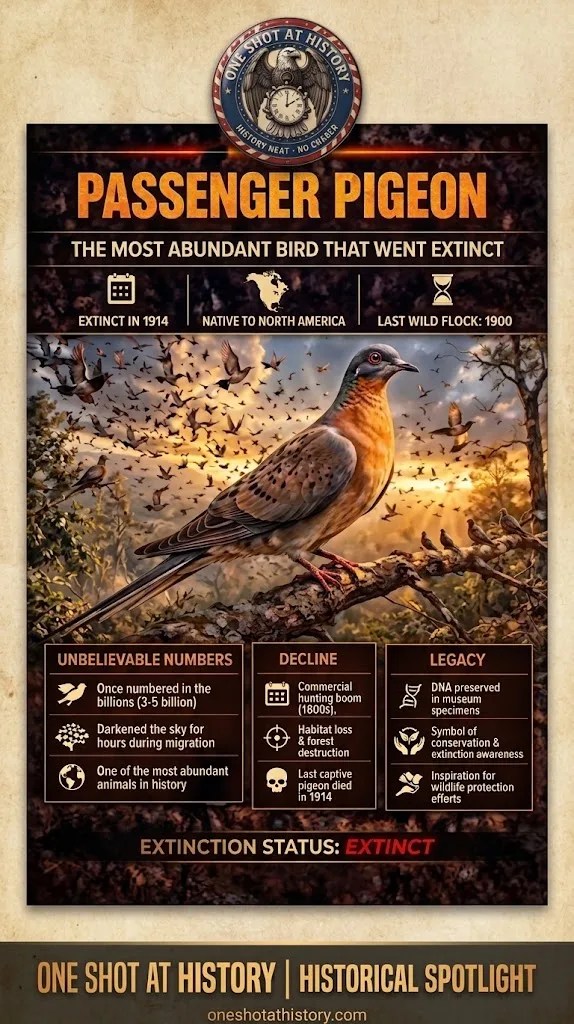
That population surge foreshadowed a tragic decline. By the late 19th century, Wisconsin had become a critical staging ground for commercial passenger pigeon hunting. The largest documented nesting in history unfolded in the spring of 1871, stretching across roughly 850 square miles of central Wisconsin, in a rough “V” reaching from Black River Falls south toward the Wisconsin Dells and north to Wisconsin Rapids — hundreds of millions of birds, possibly more, packed into the trees. Contemporary press accounts describe tens of thousands of hunters converging on the nesting and shipping birds by the barrel to eastern and midwestern cities by rail, with local dealers in towns across the pigeon’s range doing brisk business in shot and powder to supply them. The combined pressure of relentless hunting, repeated nest-site disturbance, and large-scale deforestation proved fatal: passenger pigeons typically laid a single egg per nesting attempt and are thought to have bred only once a year, leaving them with almost no capacity to rebound.


Among the more local and unusual effects of the pigeon boom was an agricultural headache. According to local accounts — including a 1933 retrospective in Horicon’s newspaper, The Reporter — farmers in the Horicon area struggled through the late 1850s with pigeon flocks that swept through newly planted fields and stripped exposed seed before it could take root. Around that time, brothers George and Daniel C. Van Brunt, wagon- and implement-makers with operations in Mayville and Horicon, developed one of the earliest successful mechanical seeders in the United States: a force-feed drill, patented and put into full production in Horicon by 1861, that placed seed safely below the soil surface — out of reach of pigeons and other seed-eating birds alike — using a rotating disc and drag chains to close the furrow behind it. Whatever the precise mix of motivations behind it, the invention proved transformative, reshaping planting practices across the Midwest and eventually growing into the Van Brunt Manufacturing Company, which merged with John Deere in 1911.

The species’ last confirmed wild Wisconsin specimen was shot near Babcock in September 1899. The Wisconsin Society for Ornithology commemorates the loss with a monument at Wyalusing State Park, dedicated in 1947 and featured in Aldo Leopold’s essay “On a Monument to the Pigeon.” Its inscription reads, in part: “Dedicated to the last Wisconsin Passenger Pigeon shot at Babcock, Sept. 1899. This species became extinct through the avarice and thoughtlessness of man.” The species itself didn’t outlast the wild population by much: Martha, the last known passenger pigeon anywhere, died in captivity at the Cincinnati Zoo in 1914 — marking the end of a species that had once numbered in the billions.
The pigeons’ disappearance left a real ecological gap. They were prodigious consumers of acorns and other mast, and researchers have proposed — though by their own admission this is difficult to test now that the species is gone — that their absence may have allowed mast-eating rodent populations, like the white-footed mouse, to boom in years of heavy acorn production, with downstream effects on tick populations and tick-borne disease. It’s an intriguing hypothesis rather than a settled one.
Today, a mounted passenger pigeon greets visitors at the Horicon Marsh Education and Visitor Center, and it has a story of its own. Around the turn of the 20th century, a young passenger pigeon was mounted in Waukesha County by William Zimdars, an amateur taxidermist who assembled a sizable personal collection of birds over his lifetime. The mount was passed down through the family — to his son, and then to his son’s wife, Mildred Zimdars — before it resurfaced during a family estate review after her husband’s death. Recognizing its rarity, the family brought in Wisconsin DNR naturalist Bill Volkert to help evaluate the collection, since mounted migratory birds are subject to special federal handling requirements. The family ultimately decided the pigeon belonged on public display: William Zimdars’s granddaughter, Kathy Robinson, and her husband, Clyde, delivered the bird to Horicon Marsh, where it was unveiled to the public at a Horicon Marsh Bird Club program soon after.

Horicon Marsh endures today as more than a wildlife sanctuary — it’s a living record of Indigenous stewardship, ecological upheaval, and human impact, all layered on top of one another. The passenger pigeon’s story remains one of the starkest cautionary tales in North American natural history, and it continues to shape how conservationists think about preventing the next extinction.
— Carl Reinemann
Sources
- The Horicon Argus (Horicon, WI). “Cleaning Up.” April 2, 1858.
- The Horicon Argus (Horicon, WI). “Pigeons, Ducks Etc.” April 2, 1856.
- Forest and Stream. “Horicon Marsh Pigeon Tournament.” Vol. 49, 1887.
- Peet, S. D. “Pigeon Effigy Mound, Fig. 232.” Prehistoric America, Vol. 2. Office of the American Antiquarian, 1890.
- Mann, Charles C. 1491: New Revelations of the Americas Before Columbus. Vintage Books, 2005.
- Woods, William I., and Neumann, Thomas W. Studies on pre-Columbian passenger pigeon abundance in Native American sites, as referenced in Mann, 1491, and in American Scientist, 2005.
- Wisconsin Society for Ornithology. “Passenger Pigeons: The Extinction of a Species.” Wisconsin Historical Society, 2012.
- PBS Wisconsin. “Wisconsin And The Extinction Of The Passenger Pigeon.” July 10, 2017.
- Southern Wisconsin Bird Alliance. “Passenger Pigeon.” March 1, 2018.
- BirdWatching Daily. “From Billions to None: A Passenger Pigeon Timeline.” August 1, 2024.
- Burke Museum. “From Billions to None: The Passenger Pigeon.” January 31, 2004.
- Peggy Notebaert Nature Museum. “Project Passenger Pigeon.” March 23, 2025.
- The Reporter (Horicon, WI). “Van Brunt Brothers Invent Seeder to Combat Passenger Pigeons.” March 2, 1933.
- Wisconsin Life. “A Tribute to the Passenger Pigeon.” July 9, 2018.
- Smithsonian Institution. “The Passenger Pigeon.” 2024.
- Aldo Leopold, dedication inscription, Wyalusing State Park Passenger Pigeon Monument, 1947, as referenced by the Wisconsin Society for Ornithology.
- Daily Citizen. “Passenger Pigeon Donated to Marsh Education Center.” (clipping provided by author; original publication date not shown).

A living epilogue
The passenger pigeon’s story may not be entirely finished. The nonprofit Revive & Restore is working to bring the species back — not by cloning the extinct bird itself, but by using CRISPR gene-editing to transfer passenger pigeon DNA, recovered from museum specimens, into the genome of its closest living relative, the band-tailed pigeon. The goal is a bird that looks, behaves, and fills its forest niche the way the original passenger pigeon did, potentially hatching by the 2030s. In the meantime, the project’s scientists are studying present-day forest ecology, including in Wisconsin, to understand what a landscape would need to look like before any bird could realistically be released into it.
Should we do this? It’s worth sitting with that question rather than rushing past it. There’s a real case for it: passenger pigeons once disturbed forests at a scale nothing alive today replicates, and their absence may still be quietly reshaping eastern woodlands more than a century later. But there’s an equally real case for caution — the 19th-century landscape these birds shaped no longer exists, engineered animals released into wild ecosystems are notoriously hard to predict, and every dollar spent resurrecting an extinct species is a dollar not spent protecting the thousands of species still here and still declining.
Dr. Ian Malcolm’s line from Jurassic Park keeps getting invoked for a reason: “Your scientists were so preoccupied with whether or not they could, they didn’t stop to think if they should.” Whether that warning applies here, or whether the passenger pigeon is precisely the kind of second chance worth taking, is a question this piece will leave open —
The science that makes de-extinction possible:
Three technologies emerged shortly after the turn of the millennium that turned the idea of passenger pigeon de-extinction from science fiction to a realizable goal.
- Next Generation Genomics
- CRISPR-Cas Gene Editing Systems
- Germline Transmission Reproductive Technology
