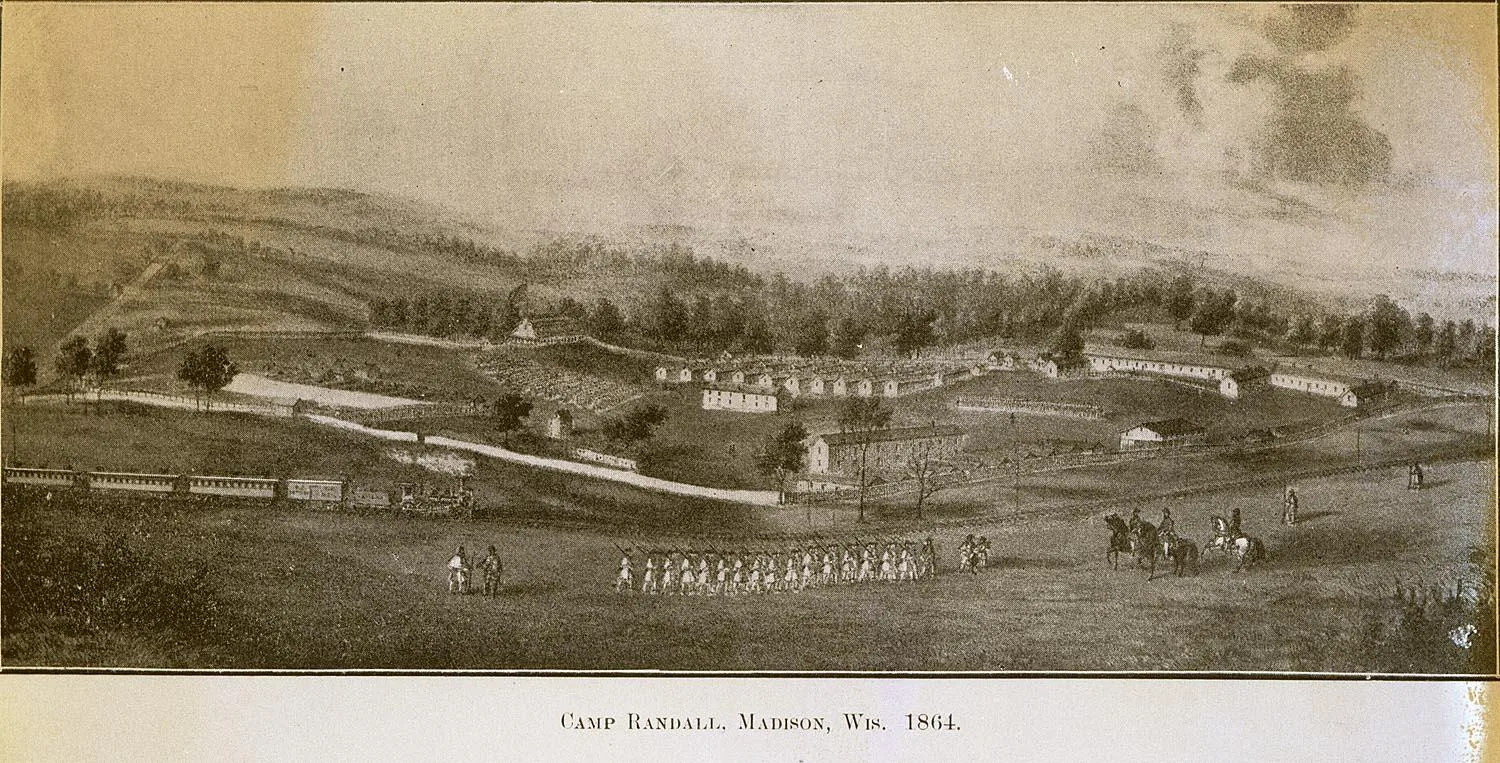

Madison, Wisconsin’s Civil War Cemetery
1862 – Present
How the survivors of a Mississippi River battle came to rest in Wisconsin soil, and the Northern woman who called them “her boys”
This piece is a companion to Horicon’s Civil War Story, tracing what became of the Confederate prisoners taken at the same battle where Horicon’s own 7th Battery served.
A Victory on the Mississippi
On April 8, 1862, Confederate General William W. Mackall surrendered his garrison at Island No. 10, a fortified bend in the Mississippi River just south of Cairo, Illinois. The defenders had held on for weeks, fighting from trenches flooded to the knees, hopelessly outnumbered and hemmed in after Union engineers cut a canal around the island in nineteen days. When Mackall’s men finally laid down their arms, Union commander General John Pope reported capturing nearly 7,000 prisoners, 123 pieces of heavy artillery, and vast stores of supplies. It was one of the first great Union triumphs of the war in the West, and it blew open the Mississippi River as far south as Fort Pillow, Tennessee.


Among the Union batteries that helped force the surrender were gunners of the 7th Wisconsin Light Artillery, dug in along the riverbank just 800 yards from the Confederate works — a battery that would later carry more than twenty men from the small Dodge County town of Horicon. It is one of the odd threads of this story: the same battle that put Horicon boys within rifle shot of the Confederate fort also set in motion the fate of hundreds of Confederate prisoners who would be sent, of all places, to Wisconsin.

North to Camp Randall
Officers captured at Island No. 10 were separated out and held elsewhere, as was standard practice. The enlisted men — 1,156 of them — were put on railroad cars bound for Madison, Wisconsin, and Camp Randall, the state’s training ground for its own volunteer regiments. The first contingent of 881 prisoners arrived on April 20, 1862; a second group of 275 followed on April 24. That second, smaller group carried the heaviest sickness of all — men whose illness had kept them behind on the first trains out.
Camp Randall had never been built to hold prisoners of war. It was a recruit depot, and its newest guard unit, the inexperienced 19th Wisconsin Infantry, was neither large enough nor disciplined enough for the job it was suddenly handed. Most of the prisoners arrived already sick — pneumonia, measles, mumps, and chronic diarrhea, the toll of weeks spent fighting from flooded trenches on the Mississippi. Madison residents turned out to watch the trains come in, and many brought what comfort they could: fresh milk, tobacco, small kindnesses extended across the lines that had just been drawn in blood at Island No. 10.

Camp Randall Becomes a Prison

“Confederate Prisoners Buried At Forest Hill,” a later newspaper retrospective drawing on The History of the First Regiment, Alabama Volunteer Infantry, C.S.A., recounts the surrender at Island No. 10 and the prisoners’ journey to Camp Randall.
An inspection on May 1, 1862 found the camp hospital unable to cope with the scale of illness among its new occupants. Lieutenant Colonel William Hoffman, the Union’s commissary general of prisoners, ordered additional surgeons, medicine, and supplies rushed to Madison. It helped, but not enough. One guard from the 19th Wisconsin described the scene in a letter home with blunt, unsentimental horror: “They die off like rotten sheep. There was 11 die off yesterday and today, and there ain’t a day but what there is from two to nine dies.”
“Ninety-Eight Dead by May 23”
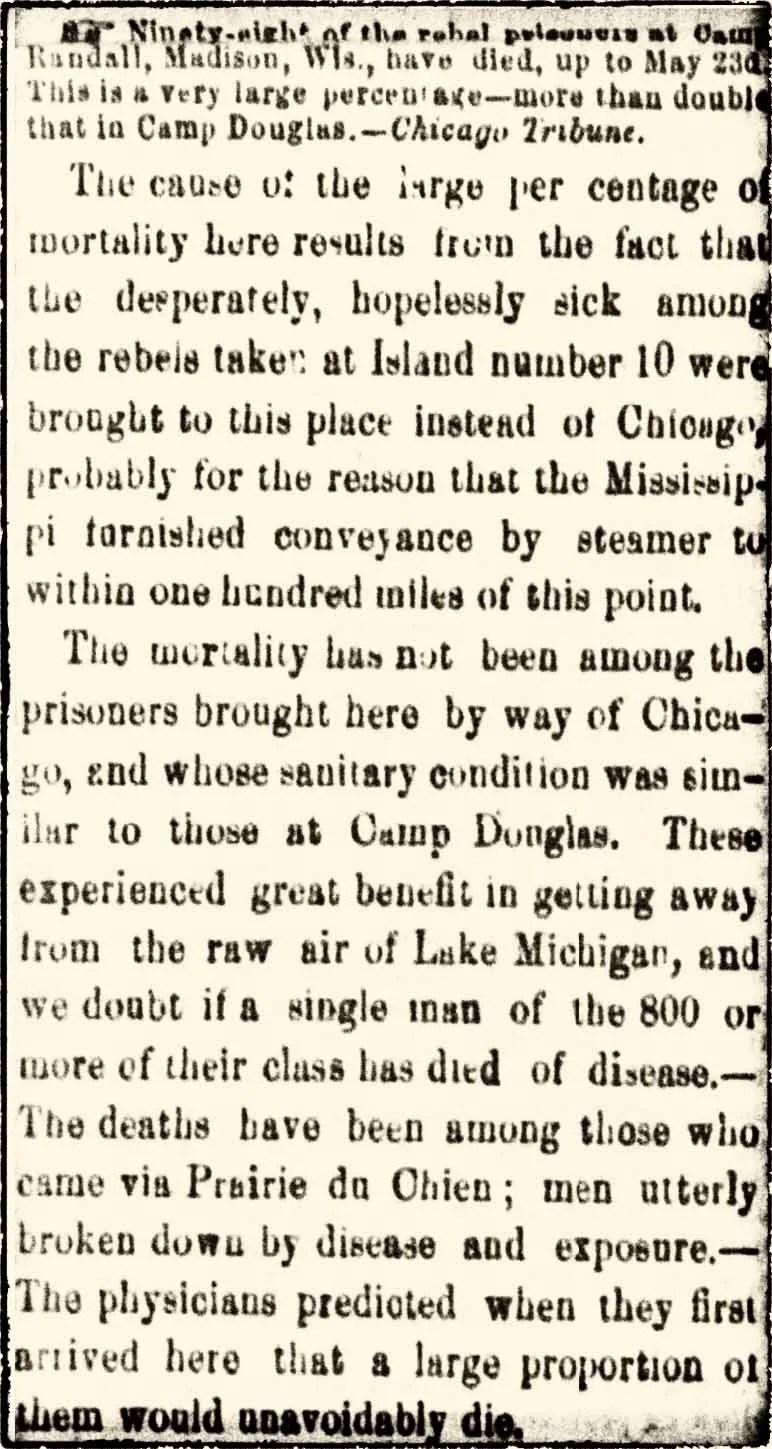
Wisconsin State Journal, May 30, 1862.
By late May, the mortality rate at Camp Randall had become a matter of open comment in the press. The Chicago Tribune noted, and the Wisconsin State Journal reprinted on May 30, 1862: “Ninety-eight of the rebel prisoners at Camp Randall, Madison, Wis., have died, up to May 23d. This is a very large percentage — more than double that in Camp Douglas.”
The State Journal offered its own explanation for why Madison’s camp was so much deadlier than Chicago’s. The men sent to Camp Randall, the paper argued, were disproportionately the “desperately, hopelessly sick” among those captured at Island No. 10, routed to Madison because the Mississippi River offered steamer transport to within a hundred miles of the city. Prisoners who instead traveled the long way around, through Prairie du Chien, arrived already broken down by exposure and disease — and it was almost entirely among that group that the deaths occurred. “The physicians predicted,” the paper concluded, “when they first arrived here that a large proportion of them would unavoidably die.”
The Camp Empties, but the Dying Continues
By the end of May 1862, President Lincoln’s call for more troops pulled the 19th Wisconsin back into active service, leaving Camp Randall without an adequate guard for prisoners of war. On May 31, 1862, most of the surviving Confederates were transferred south to Camp Douglas in Chicago. But the sickest could not travel. They remained under hospital care in Madison, and they kept dying through the month of June.

“Deaths of Prisoners at Camp Randall,” Wisconsin State Journal, June 24, 1862.
The State Journal kept a running tally. Its June 24, 1862 report named the latest dead — David Burdock of Company E, 1st Alabama; Henry Loid of Company I, 1st Alabama; Joseph Eddings of Company K, 12th Louisiana; W.H. Clifton and Samuel Depaystser, both of Company G, 1st Alabama; and W.L. Peacock of Company D — six names added to a total of 132 previously reported, bringing the count to 138. By the time the deaths finally stopped, the number had reached 140: 110 of them from the 1st Alabama Infantry, the rest from regiments in Arkansas, Tennessee, Louisiana, and Mississippi.
A Northern Lady With a Southern Heart
The 140 dead were buried in a plot near Forest Hill Cemetery, at the edge of the city. For several years after the war, the graves sat neglected, their wooden markers rotting in the Wisconsin weather. Their rescue came from an unlikely source: Alice Whiting Waterman, a Southern-born widow who settled in Madison in 1868.
Waterman discovered the abandoned burial ground and, entirely on her own initiative and at her own expense, began tending it. Over the better part of three decades she cleared the plot, planted trees and shrubs, and replaced the failing wooden markers with proper headstones. She enlisted the support of two former Union generals with Wisconsin ties, Lucius Fairchild and Cadwallader C. Washburn, both of whom lent their names and standing to her cause — a striking gesture of postwar reconciliation from men who had fought to defeat the cause these soldiers had served. Waterman spoke of the dead simply as “her boys.”
Madison took notice. In 1890 the city’s Common Council set aside a cemetery plot so that Waterman herself could eventually be buried among the men she had cared for. When she died in 1897, the city honored that promise. She rests today at Confederate Rest, among the graves she spent thirty years tending.
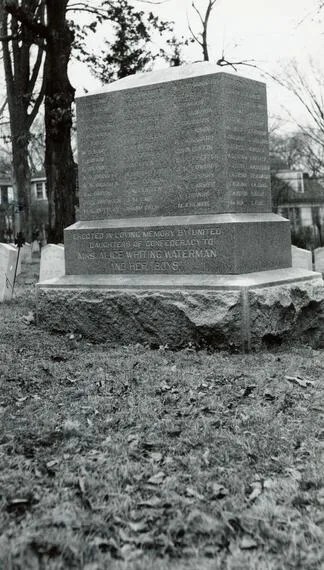
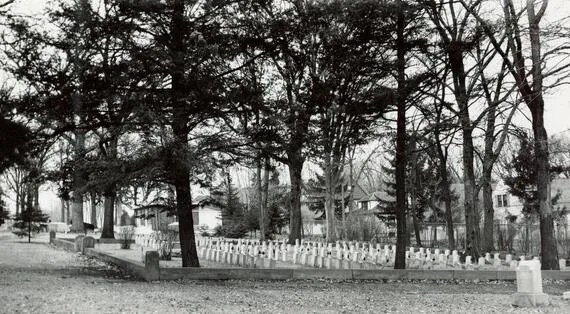
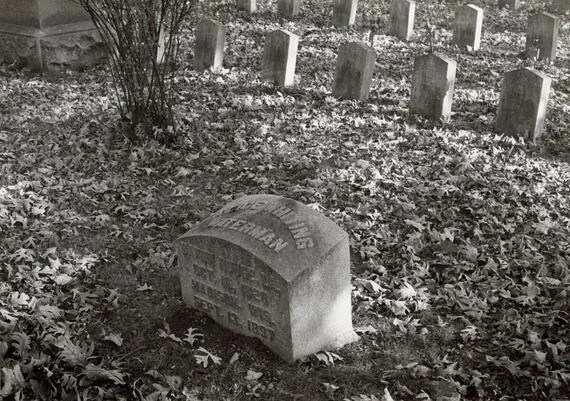

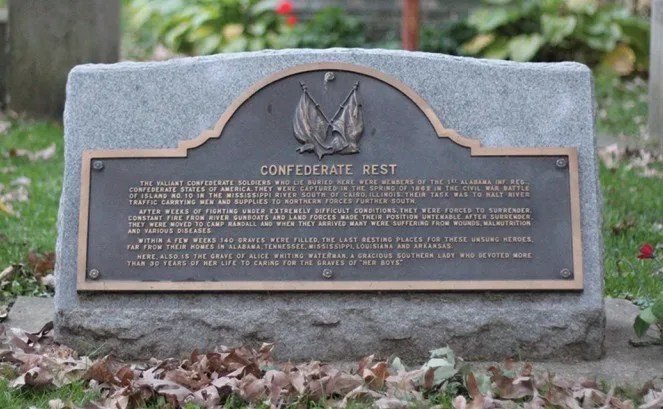
Photos courtesy of the Wisconsin Historical Society
A Monument Raised in Reconciliation
After Waterman’s death, two Union veterans took up the cause of a permanent memorial: Major Frank W. Oakley and Colonel Hugh M. Lewis, both of whom had lost an arm in the war they had fought against the men now buried at Confederate Rest. Over nine years, from 1897 to 1906, they raised funds from an unlikely coalition — the Confederate Veterans’ Association, the United Daughters of the Confederacy, and the Confederated Southern Memorial Association — for a granite monument inscribed with all 140 names.
The monument was dedicated in 1906 in a ceremony presided over by Madison’s own Lucius Fairchild Post of the Grand Army of the Republic — Union veterans formally honoring Confederate dead, a gesture meant, in the language of the era, to mark the reunion of a divided country. In 1981, a Madison resident named William Austin Huggins, whose father and grandfather had served the Confederacy, added a smaller marker and bronze plaque of his own, describing the men of Confederate Rest as “unsung heroes, far from their homes in Alabama, Tennessee, Mississippi, Louisiana and Arkansas.”
The Monument Comes Down

For more than a century the monument stood without much controversy. That changed in August 2017, in the aftermath of the deadly white-nationalist rally in Charlottesville, Virginia, which set off a national reckoning over Confederate monuments. Madison’s mayor at the time, Paul Soglin, ordered the 1981 Huggins plaque removed within days, and directed that the larger 1906 monument follow. “The Civil War was an act of insurrection and treason and a defense of the deplorable practice of slavery,” Soglin said, while also stating that “taking down monuments will not erase our shared history” — that there was a difference, in his words, between remembrance of history and reverence of it.
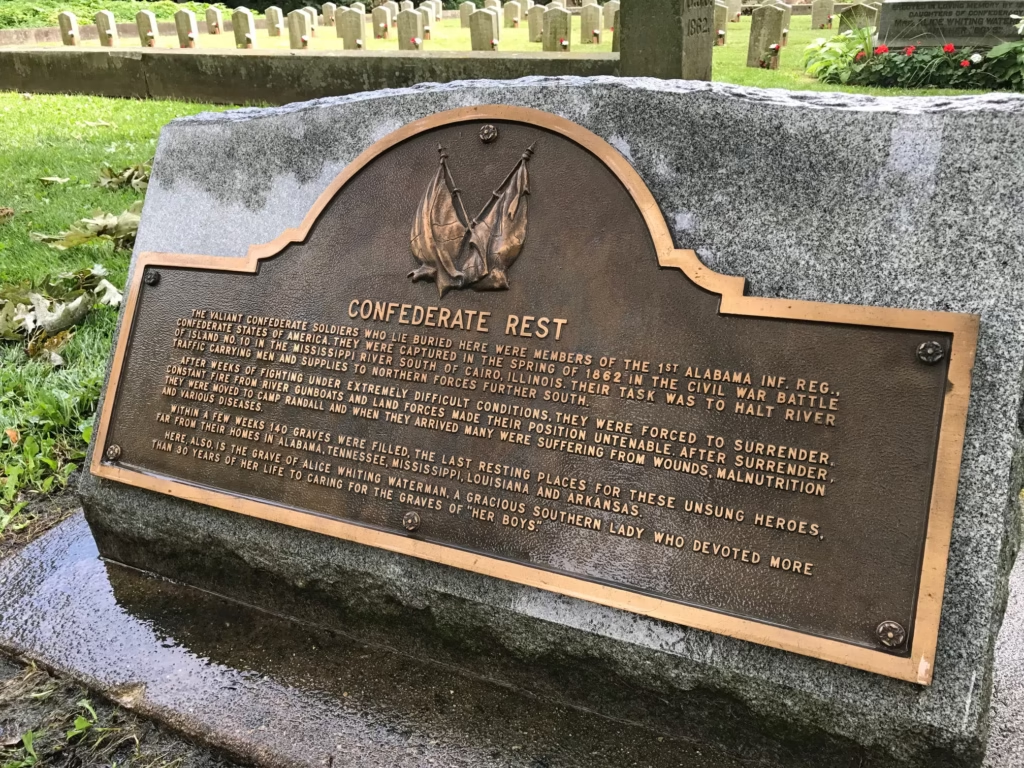
The Madison Common Council formally voted in October 2018 to authorize the monument’s removal and its transfer to the Wisconsin Veterans Museum, which agreed to accept it in part because Union veterans had helped fund its original construction. City crews carried out the removal in January 2019, waiting for cold, frozen ground to protect the surrounding trees and turf. The top two-thirds of the granite monument was taken to the museum; its roughly 4,000-pound base remains in the ground at Forest Hill under state cemetery regulations. The decision drew both support and sharp criticism — supporters argued the city should not publicly venerate men who fought to preserve slavery, while opponents, including some who maintain the Confederate Rest history website, argued the removal disregarded the site’s protected status as a burial ground and erased a genuine story of postwar reconciliation.
Confederate Rest Today
The 140 graves themselves were never disturbed — only the monuments naming the dead. Confederate Rest remains part of Forest Hill Cemetery, maintained by the City of Madison alongside the Union soldiers buried nearby, and it is still recognized as the northernmost Confederate cemetery in the United States. Alice Waterman still lies among “her boys.” Memorial observances continue there most years, a quiet corner of a Wisconsin cemetery holding soldiers who never intended to see this state at all — and who arrived only because of a Union victory on the Mississippi River that a handful of men from a small Dodge County town on Lake Horicon had helped to win.
This article is a companion piece to From the Front to Home: Horicon’s Civil War Story, which follows the men of the 7th Wisconsin Battery to Island No. 10 and back.
Sources
• Wisconsin State Journal, May 30, 1862 — “Deaths at Camp Randall” (reprinting the Chicago Tribune’s count of 98 dead by May 23, with the State Journal’s own analysis of the mortality rate)
• Wisconsin State Journal, June 24, 1862 — “Deaths of Prisoners at Camp Randall” (naming the dead of June 9–21, 1862, running total 138)
• “Confederate Prisoners Buried At Forest Hill,” newspaper retrospective drawing on The History of the First Regiment, Alabama Volunteer Infantry, C.S.A.
• Wisconsin Public Radio, “Madison Mayor Orders Confederate Monuments Removed From Cemetery” and “Confederate Monument In Madison Cemetery Removed” — wpr.org
• Badger Herald, “Confederate Captives in Madison: Camp Randall’s History as Civil War Prisoner of War Camp,” January 21, 2016 — badgerherald.com
• Wisconsin Historical Society, “Confederate Prisoners at Camp Randall ” — wisconsinhistory.org
• Wikipedia, “Confederate Rest” — en.wikipedia.org/wiki/Confederate_Rest
• Horicon, Wisconsin in the Civil War: A community’s service, sacrifice, and story https://oneshotathistory.com/from-the-front-to-home-horicons-civil-war-story/
Photo courtesy of the Wisconsin Historical Society