
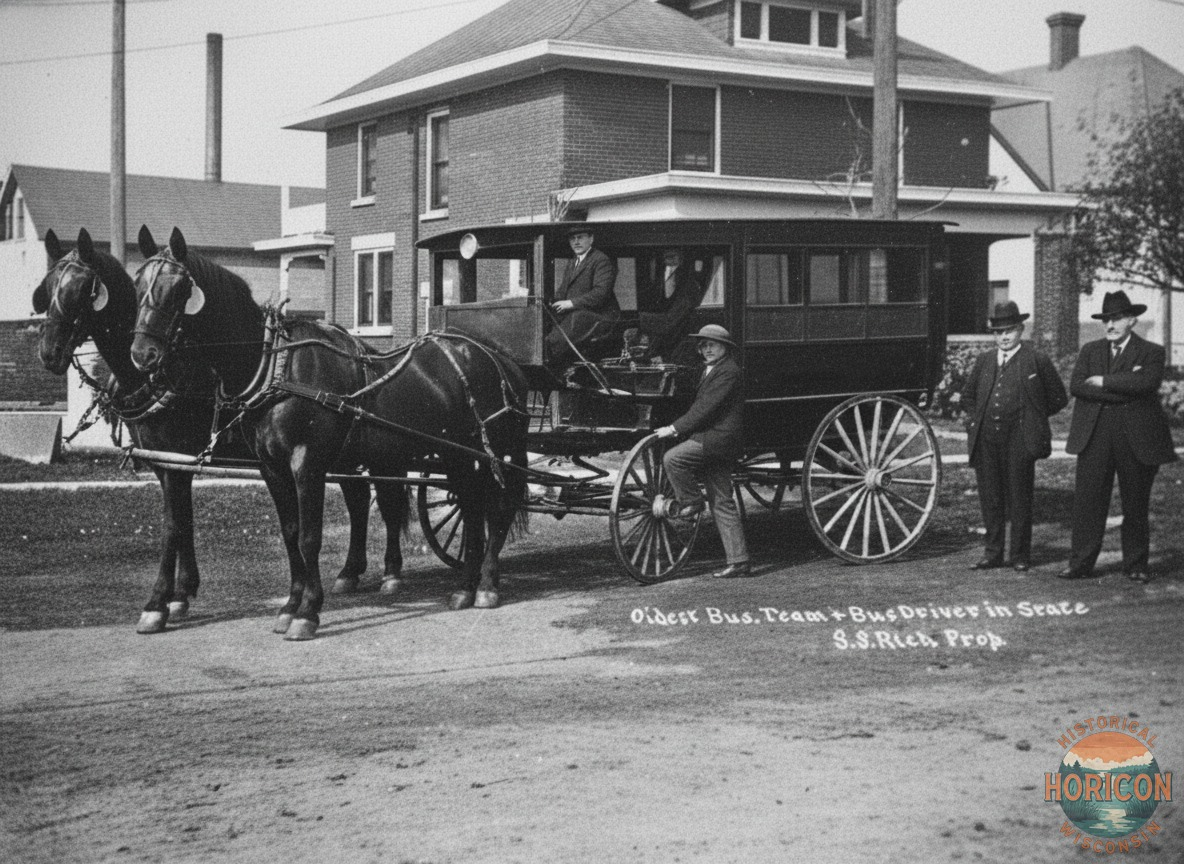

S.S. Rich: Horicon’s Man with the Team

Long before trucks and delivery vans crowded Horicon’s streets, Selby Simeon Rich was already doing the town’s heavy lifting. From 1907 until 1933 he worked behind a steady team of horses, a high‑seated wagon, and an aging bus, becoming one of the most familiar figures between Horicon’s depots and its business district. His working life traces the story of a community that still moved by horsepower even as the twentieth century gathered speed.
Selby’s first career was in the poultry business, and even though his career path shifted, he kept a keen interest in poultry, winning many awards at the Dodge County fair over the years.
Rich’s first claim to local fame came as a drayman. After purchasing a dray outfit and going into business on his own around 1907, he set about hauling freight, trunks, and merchandise for merchants, travelers, and factories. If a family was moving a piano, if a traveling salesman arrived with sample cases, or if a shipment of machinery parts came in on the afternoon train, it was Rich’s rig that backed up to the platform. His work was physical and often dirty, but it placed him at the very heart of Horicon’s commercial life.

Over time, his services expanded into a full dray and livery operation. He hauled goods by weight, trunks by the piece, and even passengers when they needed a lift. From Horicon he ran a regular horse‑drawn bus service to the railroad depots at Juneau and Minnesota Junction, linking town residents with trains that carried them to Milwaukee, Chicago, and beyond. Travelers learned to plan their journeys around Rich’s schedule, knowing he would appear with his team to meet incoming trains and gather up outgoing passengers, their grips, and their trunks.
Over time, his services expanded into a full dray and livery operation. He hauled goods by weight, trunks by the piece, and even passengers when they needed a lift. From Horicon he ran a regular horse‑drawn bus service to the railroad depots at Juneau and Minnesota Junction, linking town residents with trains that carried them to Milwaukee, Chicago, and beyond. Travelers learned to plan their journeys around Rich’s schedule, knowing he would appear with his team to meet incoming trains and gather up outgoing passengers, their grips, and their trunks.
The reliability that made him valuable to merchants and travelers also made him a natural choice for another crucial job: carrying the United States mail between the railroad depot and the post office. For many of those years between 1907 and 1933, Rich’s mail route tied the town’s daily routine to the railroad timetable. Several times a day he backed his mail bus—an old, high‑wheeled vehicle—up to the depot platform, loaded sacks and packages, and jogged his team up to the post office. That first wagon, according to Shay, was built in 1870 and continued to be used into the 1930s! It was so tall, he said you needed a running start to jump in. In an age when letters and newspapers were Horicon’s only real‑time link to the outside world, his punctual arrivals were part of the town’s rhythm.
A sign at the train depot simple read:
“BUSSES LEAVE FOR HOTEL WHEN MAIL IS LOADED – SMILE AND WAIT”
The buses and wagons themselves became almost as well-known as their driver. The main mail and passenger bus was an aging vehicle, weathered by decades of service, with a high, slanting upholstered seat that required a running start to mount. Inside, a small framed sign reminded passengers to smile and be patient. Rich was fond of his horses, giving them short, simple names like Chief and Lib and prodding them along with a bamboo fishing pole or light whip when they lagged. He talked easily with riders and bystanders, trading jokes and stories as he drove, but he never lost track of his timetable—whether he was hustling freight in town or making the longer runs to Juneau and Minnesota Junction.
For all the routine of the work, driving a team through town streets carried real risk. One evening, after loading the mail, Rich guided his horses away from the post office just as a bundle of packages shifted in the wagon. While he turned his attention to steadying the load, a sudden noise startled the team. They broke into a trot, heading into a busy crossing where two high‑school girls were just stepping from the curb. In the confusion that followed, one girl was knocked down and her ankle run over by a wheel; the other was dragged for some distance after grabbing for the neck yoke. It was a terrifying reminder of how quickly a routine mail trip could turn dangerous.
Rich brought the frightened horses under control, and the injured girls received medical care. One recovered after bruises and shock; the other suffered more serious injuries to her shoulder and face but, with time, healed as well. The episode lingered in town memory, not as a mark against the driver, but as an illustration of how precarious life around teams and wagons could be. People understood that a man who spent his days on the road with horses would, sooner or later, face trouble. Selvy’s Cousin, Joel Rich, and his team of horses were killed in Minnesota Junction after being struck by a train.

Despite accidents, breakdowns, long country stretches to Juneau and Minnesota Junction, and twenty‑six Wisconsin winters, Rich continued his dray, bus, and mail work until 1933. He built a home for his family in Horicon’s first ward, a visible sign that his long days on the wagon seat had brought him stability as well as calloused hands. Generations of townspeople came to associate his name with the sight of horses pulling freight, trunks stacked high behind the depot, and the dependable clatter of the mail and passenger bus rattling up to the post office steps.
Despite accidents, breakdowns, long country stretches to Juneau and Minnesota Junction, and twenty‑six Wisconsin winters, Rich continued his dray, bus, and mail work until 1933. He built a home for his family in Horicon’s first ward, a visible sign that his long days on the wagon seat had brought him stability as well as calloused hands. Generations of townspeople came to associate his name with the sight of horses pulling freight, trunks stacked high behind the depot, and the dependable clatter of the mail and passenger bus rattling up to the post office steps.
Selby was born in 1860 and passed away in 1950 at the age of 90.
Even after automobiles took over the hauling and passenger trade, older residents remembered the quarter‑century when the life of Horicon ran on iron rails and horse‑drawn wheels—and when one of the most important men in town was the drayman who met every train. To them, Selby Simeon Rich was not just a driver; he was a living timetable, a bridge between factory and freight house, depot and post office, town and outside world. His story is a reminder that the smooth flow of people, goods, and mail that modern towns now take for granted once depended on one man, two horses, and a well‑worn bus.
