
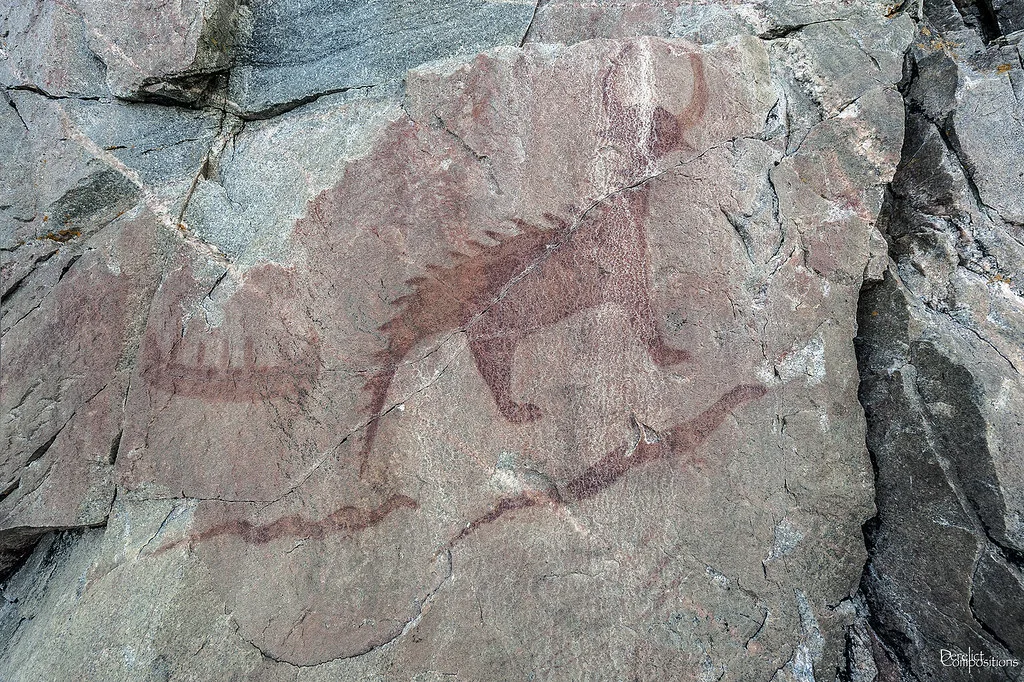

The Terror of the Rock River
An Ancient Legend of the Ho-Chunk and Potawatomi Peoples
©Carl G. Reinemann, One Shot at History

Long before European settlers pushed into the river valleys of southern Wisconsin, the Rock River was a storied waterway — a corridor of travel, sustenance, and deep spiritual significance for the Ho-Chunk (Winnebago) Ojibwe, and Potawatomi peoples who called its banks home. And according to their oral tradition, it was also a place of terror.
Passed down through generations, the legend of the Water Panther Spirit describes a monstrous creature that haunted the entire length of the Rock River. The old people spoke of a long-tailed beast with curving horns, powerful claws, and a body like a great serpent — a thing that hunted in the deep bends of the river and could drag a man beneath the surface without warning. It was known as the Wakcéxi in the Ho-Chunk language, and as Mishipeshu (Mishibizhiw)— the Great Lynx — in Potawatomi, Ojibwe, and other Anishinaabe traditions. By either name, it was among the most powerful and feared spirits of the Great Lakes world.
A River Called the River of Big Stones
The Ho-Chunk called the Rock River Eneen-ne-shun-nuck — “River of Big Stones.” Its valley, stretching from the great marsh at Horicon southward to Lake Koshkonong, served as a vital corridor through their homelands: a place for fishing, travel, trade, and ceremony. Archaeological evidence confirms the depth of that occupation — effigy mounds, village sites, and ancient trails ran the length of the river, marking a landscape shaped by human presence across thousands of years.
 It was precisely because the river was so central to daily life that the Water Panther Spirit held such power in the imagination. This was not an idle monster of fireside storytelling. The legend encoded something true and deadly: the Rock River could kill. Hidden currents, deep holes, unstable ice in spring — the river demanded respect, and the Water spirit gave that danger a face.
The Nature of the Beast
The accounts are remarkably consistent. The Water Panther ranged the entire length of the Rock River — from the outlet of the Horicon Marsh all the way to the foot of Lake Koshkonong — and it hunted without preference. Deer that waded in to drink were swallowed whole, horns and all. Canoes were overturned by a sweep of its massive tail. Men and women who crossed at the river’s fording places were pulled beneath the surface and never seen again.
Few ever actually saw the creature. Its presence was known instead by the signs it left behind: the churning and boiling of the water above its den, the early break-up of river ice each spring as its movements cracked the surface from below. Its lairs were believed to lie in the deepest holes of the river, where no light reached and where the current ran cold and strange.
Some of the old people believed there was not one such spirit in the river, but several.
Two Tribes of Water Spirits
To understand the Water Panther of the Rock River, it helps to understand how Water Spirits were seen across the broader tradition — because not all of them were enemies of humanity.
 Water spirits appear to fall into two tribes, like all other spirits: Good Water Spirits and Bad Water Spirits. Water spirits generally are associated with dangerous powers, but the Good Water Spirits are beneficent and try to use those same dangerous powers to help humanity. The creature that haunted the Rock River was of the darker kind — a Bad Water Spirit, dwelling in the cold deep places and preying on the living. Yet even its terror existed within a larger spiritual order, one in which power over water could be turned toward protection as readily as destruction. By either name, it was among the most powerful and feared spirits of the Great Lakes world.
This distinction mattered enormously to people who lived and traveled along the river. Not every unexplained current or strange eddy meant death. The world of Water Spirits was complex — inhabited by forces that could destroy, and by forces, perhaps unseen, that kept the crossing safe. Knowing which you faced, and how to address it, was a matter of life and death.
A Wider Tradition
The Rock River Water spirit was not unique to this one waterway. Across the entire Great Lakes region, Indigenous nations held similar beliefs about powerful underwater beings — feline in form, horned, with serpentine bodies — who ruled the deep waters of lakes and rivers. Ethnographers have documented these beliefs from the Ojibwe, Menominee, Potawatomi, and many other nations, noting a shared cosmology in which the Water spirit and the Thunderbird exist in perpetual cosmic opposition: sky against water, upper world against lower.
In this framework, the Water spirit was not simply evil — it was powerful, morally ambivalent, and capable of both harm and blessing. Offerings of tobacco and other goods cast into the water before a crossing were not superstition; they were protocol. A proper acknowledgment of the spirit’s sovereignty over that stretch of river, a request for safe passage. Those who honored the spirit might be spared. Those who did not took their chances with the current.
The Spirit’s Departure
The closing lines of the legend carry a different kind of weight. When the Ho-Chunk and Potawatomi peoples were pushed from their villages along the Rock River — displaced by the arrival of white settlers in the Horicon area in the 1830’s and 1840’— the Water Panthers left with them. Some believed the spirits had retreated to the Mississippi River, where they remained.
Read as history, that detail is quietly devastating. The departure of the spirit mirrors the forced removal of the people. The land did not simply change hands — something essential departed from it. A river that had been a living, spiritually inhabited landscape became, in the telling, merely a river.
The Ho-Chunk, it should be noted, never fully left Wisconsin. Through remarkable persistence and legal struggle, many returned to and remain in their ancestral homeland. The stories remained with them.
How the Story Was Preserved
The version of this legend available to modern readers was preserved largely through the Wisconsin Federal Writers’ Project of 1936, when folklorist Dorothy Moulding Brown compiled Wisconsin Indian Place Legends — a collection of Native stories tied to specific Wisconsin landscapes, gathered from State Historical Society publications, Wisconsin Archeological Society records, and directly from Native informants. Brown’s stated goal was to make this heritage accessible to teachers, readers, and community pageant writers before it faded further from public memory.
The foundational academic scholarship behind such stories was done by Paul Radin, whose monumental work The Winnebago Tribe (1923) remains the most comprehensive study of Ho-Chunk narrative and cosmology. Radin worked directly with Ho-Chunk storytellers and translators, including accounts of Water Spirits tied to specific places.
The story of the Terror of the Rock River is not a relic. It is a document — of a people’s relationship to a landscape, of a river that was once as spiritually charged as any cathedral, and of what was lost and what stubbornly endures when nations are forced from their homelands. The Rock River still runs from Horicon to Koshkonong. Somewhere in its deepest bends, the old people said, something waits.
References

A Dress for Mishibizhiw
This dress, made by Aerius Benton-Banai, honors Mishibizhiw, the great water lynx. The Ojibwe revere Mishibizhiw as the Chief of all water beings, a powerful helper to the Anishinaabeg. People have long made offerings to Mishibizhiw in thanks for its gifts. It is said to be strong and swift, able to stir whirlpools in the lakes, and to have stood with the people in times of war, protecting them and helping them win.
Every part of the dress carries meaning:
- Mishibizhiw is pictured on the dress.
- Real copper Anishinaabe Bimishimo cones carry the power of copper.
- Red velvet stands for the blood of Mishibizhiw.
- Birch bark ribbon recalls the birch bark scrolls.
In the words of its dancer: “It is my hope that when I dance this dress, it is an echo of the power of copper and Mishibizhiw.”
Photo and this amazing dress by Aerius Benton-Banai
Retelling
A note from Author Carl Reinemann: A story like this is sacred to the people it belongs to. What follows is an original re‑imagining told from an outside observer’s perspective, not a traditional version and not written in a Native voice. It is offered with respect and without claiming any tribal authority.
“Come closer to the fire. Listen to the river. Do you hear it talking?” The old ones said the Rock River remembers everything. They said it remembered when the Ho-Chunk and Potawatomi camps lined its banks from the Great Marsh all the way down to Koshkonong. In those days, when their grandfathers’ grandfathers were small children, something powerful lived beneath that water.
They called it Wakcéxi—the great Water Panther. Some nights, when the mist was low and the frogs grew silent, the old people could feel it turning in its sleep. They said it had a tail as long as a fallen tree, curling like a snake through the dark water. Horns rose from its head, sharp and shining, and its jaws were wide enough to swallow a deer whole. Its claws were hooks of stone, and its body slid like a great serpent along the bottom of the river.
The Water Panther was not a creature of just one bend or one pool. It owned the whole Eneen‑ne‑shun‑nuck, the River of Big Stones, as the Ho-Chunk people named it. From the marsh reeds at the Great Marsh, where the cranes dance, down to the broad waters of Koshkonong, it watched every bank and every crossing. It was hungry for all who forgot to show respect—four‑legged or two‑legged, it made no difference.
Deer would come lightly down the trail, hooves clicking on the stones, to drink at the edge of the river. They saw only their own faces in the water, not the shadow coiling below. Then the surface would shudder. A tail would rise, the water would open, and the deer would vanish with hardly a cry—antlers, legs, and all. In the morning, only swirls of mud and broken reeds would tell the story.
The Ho-Chunk and Potawatomi people crossed the river at shallow places where the stones lay close together. Those were the places the Water Panther loved best. When a crossing party forgot to speak to the water, forgot to offer even a pinch of tobacco, the river would grow strangely quiet. The current would slow, as if holding its breath. Then—whirlpools, dark and sudden. A canoe would buck like a frightened horse, thrown high by that long, coiling tail. Some dugout boats were turned over with a single slap, and those who fell in were pulled down where no light lives.
Few ever saw the Water Panther clearly, but everyone knew when it moved. On calm days the river would suddenly churn and boil, though no wind touched the trees. Children were told, ‘Do not play near the deep places when the water talks that way. That is the Panther turning in its den.’ In the spring, when the ice still held to the river, its restless body broke the frozen skin. Great sheets of ice rose up and crashed along the banks, piling higher than a man. The old ones would watch and say, ‘He is walking, he is waking from his winter sleep.’
Deep holes along the bends were its houses. No one fished there. No canoe passed without a word. The people knew those were the Panthers’ mouths, always hungry, always waiting. Some said there was only one such spirit in the Rock River. Others believed there were many—brothers and sisters twining together under the water, each guarding a different stretch of the current.
So the people remembered their manners. Before a journey, they would stand at the shore with their canoes resting on the stones. Someone—often the oldest among them—would pause and speak soft words into the mist. Then they would lay down a gift: tobacco scattered from the hand, a small carving, a bead, perhaps a feather from an honored bird. The gifts dropped into the water, sank from sight, and the river’s grip would loosen, the current growing gentle beneath their paddles. When the Panther was pleased, the river carried them safely.
But the river’s song changed when settlers came. They threw rocks and logs across its body, chained it with dams and walls so the water could no longer wander where it wished. They cut new paths, raised their own houses, and pushed the Native camps away from the banks where the people had always lived. The fires of their lodges no longer shone in long rows along Eneen‑ne‑shun‑nuck. The songs at night grew fewer, and the old prayers were swallowed by the grinding of their mills. The offerings to the water came only now and then, when one of the displaced families passed through.
Without those camps and those voices, the river grew lonely. Some say the Water Panthers listened for the rattle of the drums, for the children’s laughter along the shore, and heard only the ring of axes and the wheels of wagons. They tasted other smoke in the air, and it stung their nostrils. So, one by one, they left their deep houses beneath the Rock River.
On a night of heavy rain, when the river ran high and brown, they rose and followed the current south. People who watched from the bluffs said the water glowed and heaved, though no lightning split the sky. Horned shadows moved below the surface, sliding past like drifting islands. The next spring, there were no more sudden whirlpools at the old crossings, no more strange boilings in the calm reaches. The deer drank without fear. The river was quieter, but it felt emptier too.
Some say the Water Panthers made new homes in the deep places of the great Mississippi, where the currents twist, and the channels are hard to know. If you stand there at dusk and look long into the water, you might see a horn break the surface far out, or a long tail draw a black line against the moon. If you go, remember: they still listen for respect.
Our children are far from those days now, but the river is still an ancestral relative to those who remember. Those who walk beside Eneen‑ne‑shun‑nuck are told: do not shout at the water or throw stones just to see the splash. Speak to it. Remember the gifts the grandparents gave. The Water Panther may have left these bends, but other spirits watch, and the river itself has teeth of stone and ice.
So when the current is strong or the ice begins to crack in spring, think of that great horned one, turning in the depths, and walk carefully. Honor the water, and it will carry your stories as it once carried theirs.
Sources:
- Brown, Dorothy Moulding. Wisconsin Indian Place-Name Legends. Wisconsin Folklore Booklets. Madison: Wisconsin Federal Writers’ Project, 1936.
- Radin, Paul. The Winnebago Tribe. Annual Report of the Bureau of American Ethnology, vol. 37. Washington, D.C.: Government Printing Office, 1923.
- Radin, Paul. “Short Tales.” Winnebago Notebooks. Philadelphia: American Philosophical Society. Winnebago IV, #7i, Story #18, “The Elk Crossing the Stream.”
- Carver, Captain Jonathan. Travels through the Interior Parts of North America, in the Years 1766, 1767, and 1768. Minneapolis: Ross & Haines, 1956 [originally published 1778].
- Reinemann, Carl. Historical Horicon Wisconsin. One Shot at History Ethnology podcast- Interview with author. (2025)
- Hotcak Encyclopedia. “The Water spirit of Rock River.” Hocąk (Winnebago) Mythology.
- Mark Raymond Harrington (M. R. Harrington/MRH), 1882-1971 https://sova.si.edu/record/nmai.ac.001.035
- HathiTrust Digital Library. Wisconsin Indian Place Legends (1936).

Boozhoo and greeting!
I just wanted to send a message to you. Thank you for sharing this. As part of our culture (I am of the Anishinaabe people, Marten Clan) Your respect for our varying Native cultures is apparent in all the article I have read that were authored by you. I would like to invite you to participate and do a presentation, perhaps in an upcoming gathering of the Mille Lacs band of Ojibwe her in Minnesota. I look forward to hearing from you.
Thank You for your kind words, I have sent an email to you regarding the presentation idea.
Carl
My Grandfather knows this story, though from the Lake Superior Region, are they related?