
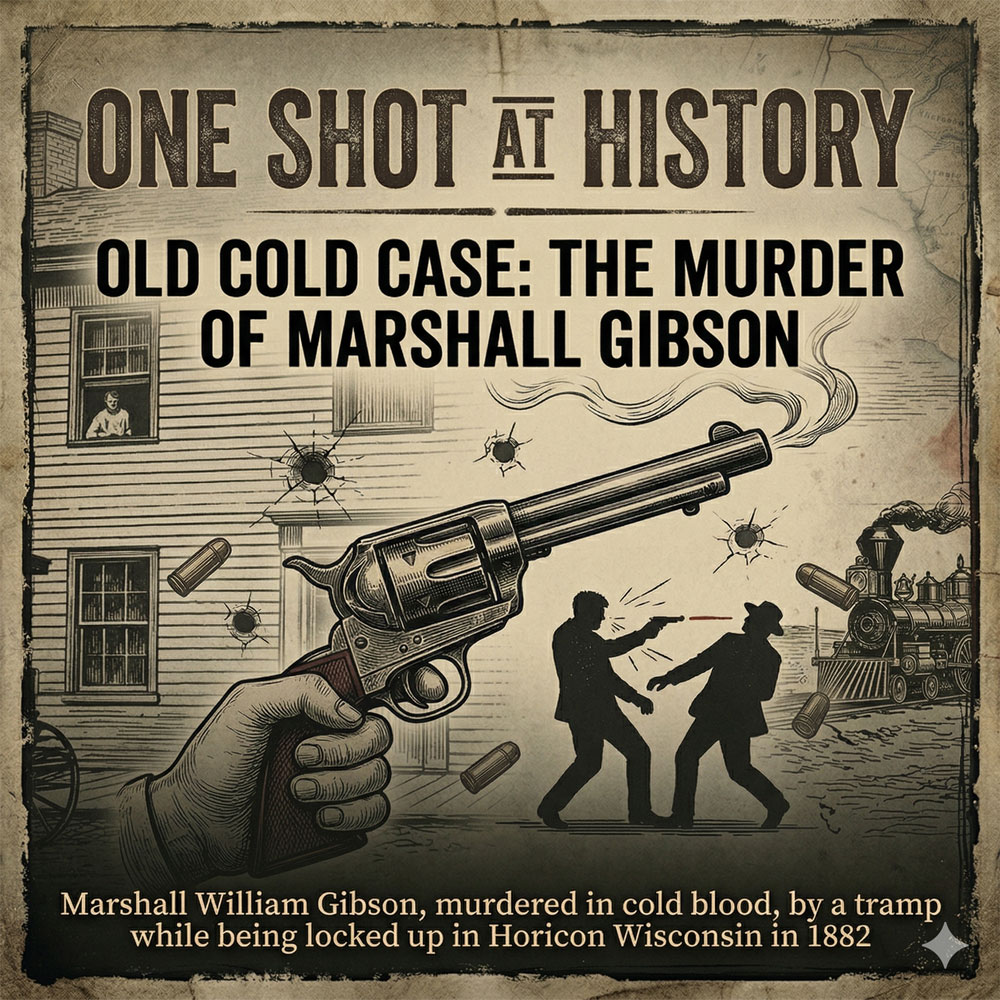

Horicon, Dodge County, Wisconsin · October 19–20, 1882

Carl G. Reinemann, Author

Author’s Note: This is also available as a podcast, The Old Cold Case, The Murder of Marshal William Gibson.
The Man Who Came Home from the War
Not all of Horicon’s losses came on distant battlefields. William Gibson, an Irish immigrant, had served his country in Company H of the 1st Wisconsin Heavy Artillery, enlisting in October 1864 and mustering out in June 1865. He had survived the war. He came home to Dodge County, worked as a farmer, a mason, later found steady employment at Van Brunt’s Agricultural Machine Works, and — in time — accepted the role his neighbors trusted him with: city marshal of Horicon.
He had held that post for approximately four years at the time of his death at the age of 52. He had been a widower whose wife, Sarah, had died two years before and had just recently remarried just 6 months prior to his death to Charlotte Town. Bill, as he was known to friends, had four children — a daughter and three sons. The youngest boy was about ten years old. The older children were employed in the village and able to support themselves, and his daughter kept house for him. He was, by all accounts, much respected by his fellow workmen and well known throughout the community. A prominent member of Horicon Lodge No. 87 of the Independent Order of Odd Fellows, Gibson was a man of standing, not merely a name on a civic payroll.
His duties as marshal were occasional ones — Horicon was no rough frontier post — but William Gibson took every one of them seriously. He had survived four years of war. He could not have imagined that a routine October arrest would be the end of him.
Civil War Service: Company H, 1st Wisconsin Heavy Artillery

Company H, along with Company G, was posted to Fort Lyon — one of the great earthwork fortifications anchoring the southern defenses of Washington on the Virginia side of the Potomac. Fort Lyon was among the largest and most strategically significant of the capital’s ring of forts, positioned to guard the approaches from Alexandria and the Telegraph Road. Company G rotated additionally to Fort Ellsworth during this period; Company H remained at Fort Lyon.
Company H, along with Company G, was posted to Fort Lyon — one of the great earthwork fortifications anchoring the southern defenses of Washington on the Virginia side of the Potomac. Fort Lyon was among the largest and most strategically significant of the capital’s ring of forts, positioned to guard the approaches from Alexandria and the Telegraph Road. Company G rotated additionally to Fort Ellsworth during this period; Company H remained at Fort Lyon.
The work of a heavy artillerist in the Washington defenses was grinding and unglamorous — manning enormous siege guns and field cannon, drilling ceaselessly, standing watch through the long seasons of a war that, by late 1864, was grinding toward its conclusion. The threat was real: just months before Gibson’s arrival, in July 1864, Confederate General Jubal Early had led a raid to the very outskirts of Washington, reaching Fort Stevens on the northern edge of the city — the only Civil War engagement fought within the District of Columbia. President Lincoln himself stood on the parapet at Fort Stevens and came under fire. The men of the 1st Wisconsin Heavy Artillery garrisoning the southern forts would have known of Early’s raid and understood that their posts were not merely ceremonial.
The regiment as a whole paid a significant price for its service — not primarily in battle, but in disease, the great killer of the Civil War. Of the 2,163 officers and men who served in the 1st Wisconsin Heavy Artillery, 83 died: four enlisted men were killed or died of wounds, while two officers and 77 enlisted men perished from disease. For the late-enlisting companies — Gibson’s among them — the months in the Washington fortifications brought the particular miseries of garrison life: inadequate sanitation, poor food, and the fevers that swept relentlessly through encamped troops.
Company H, along with Companies E through M, was mustered out of service on June 26, 1865 — nearly three months after Lee’s surrender at Appomattox. They returned to Wisconsin and disbanded in the early part of July 1865. William Gibson came home to Horicon, having spent the final eight months of the war manning the guns that guarded the capital of the United States.
He had stood watch over Washington. Seventeen years later, he would be killed keeping the peace in the small Wisconsin town he called home.
The Stranger in Town: Wednesday Through Thursday
The man who would kill William Gibson arrived in Horicon on Wednesday, October 18th, 1882, in the evening, checking in at a hotel kept by Storr Streeter — at the ‘American Hotel’ near the side track next to the Van Brunt Factory — under the name Fred Melcher. He was well dressed — dark-gray clothes and a black overcoat, a nice hat — and paid his bill in advance. He gave little outward sign of the violence to come. Yet even that first night, there were those who noticed something wrong. Several duck hunters who had gotten up for an early start on the marsh reported seeing him walking the hallway of the hotel at about two o’clock in the morning, moving as though suspicious of something.
On Thursday, he spent most of his time in the saloons of the village. At some point during the day, he became sufficiently intoxicated that Charles Herker, a saloon-keeper, hauled him back to the hotel and put him to bed. He awoke at five o’clock in the afternoon, renewed his drinking, and became disorderly once more.
By eight o’clock that evening, two women had complained to Marshal Gibson of the man’s drunkenness and disorder. Shortly before the marshal was notified, the stranger had been noticed on the corner where the Horicon House stood, now the site of Horicon’s Post Office, apparently calm — but a few minutes later, the man lay by the roadside near the corner of S. Hubbard and Mill St, a block off Lake Street. Gibson set out to make the arrest. He was not alone — by chance, he would encounter Julius Winnefeld, a private Horicon citizen, whose sworn deposition would become the most precise eyewitness account of the night’s events.
The Shooting: October 19–20, 1882
The events of the fatal evening are best told in the words of Julius Winnefeld himself, who was sworn before the inquest and gave the following deposition:
“I reside in Horicon; on the 19th of October, 1882, I came home, in the evening, about 7 P.M.; after I got my supper, I started to get my mail; when I had my mail, I went to Bossman’s (Horicon House) and took my bitters (an alcoholic medicinal tonic), when I started for home, and got to the corner of Fred Hanf’s; I then met some ladies who told me there laid a man up there; then I went and saw the man; it was pretty dark and I did not know him; Wm. Gibson came along; I said to Gibson, you are the man I want to see; I told him up there laid a man; did not know whether he was drunk or not; we went together and saw the man; Gibson went into Fred. Hanf’s and got a light; Gibson then arrested him, and called on me to help him put him in the lockup; when we got him to the lockup, Gibson took the key of the door and called upon his boy to unlock it; after Gibson was shot, he made motion to shoot me, but I succeeded in getting the revolver away from him; I do not know the name of the man; he was very strong.” — Julius Winnefeld, sworn deposition, October 1882
Julius Winnefeld, sworn deposition before Justice of the Peace, Hiram Lake, Horicon inquest, October 1882
Winnefeld’s account reveals several details absent from the newspaper reports. It was not Gibson who first found the man — it was a group of women at the corner of Fred Hanf’s property who alerted Winnefeld, who in turn flagged down the marshal. Gibson went inside Hanf’s establishment to obtain a light before making the arrest, suggesting the street was dark enough (sunset was about 6 pm that time of year) that he needed illumination to proceed safely. Marshal Gibson relieved the man of a small-caliber derringer hidden inside his coat pocket. And critically: when the party arrived at the lockup — located on Mill Street near the gas house, south west of the Horicon House — Gibson did not have his own key readily in hand. He called upon his boy — his 10-year-old son Andy — to come and unlock the jailhouse door.
That detail is among the most haunting in the entire account. William Gibson’s son Andy was present at the lockup that night. He was there when the prisoner drew the hidden revolver. He was there when his father was shot. The inquisition account notes that Andy had raised a cry of alarm — but at that same time, a fire broke out at the Van Brunt & Davis Company’s blacksmith shop, and the fire bell drowned out everything else. His father lay dying, and the village rushed toward the flames.
The prisoner drew a 40-caliber “bull-dog” revolver with his left hand — not the gun that had already been confiscated from his right hip-pocket, but a second weapon, concealed and unsuspected. He fired at Gibson, who stood with his left side toward the assailant. The ball penetrated the skull just at the top of the left ear, taking part of the ear and passing directly to the brain. Gibson, mortally wounded and falling to the floor, made a motion to shoot Winnefeld — in the chaos and darkness of that night, he could not distinguish his assistant from his attacker.
“The cry of murder could not be heard — men, women and children rushing by, near the man, who lay in an insensible condition with his brains oozing from the ugly wound.”
Winnefeld, a short but stocky man, fought for control of the gun. Still holding the prisoner’s right arm, Winnefeld grabbed the revolver and wrenched it from him. In the struggle, the prisoner loosened himself and fled east and up the hill on Mill St. The fire alarm absorbed all attention in the village. The cry of murder could not be heard above it. Men, women, and children rushed past the very spot where the marshal lay, without understanding what had occurred.
Assistance finally came. When the almost lifeless form of Marshal Gibson was carried into the house of Isaac Chandler, Dr. Anton Shimonek appeared promptly and, after a close examination, pronounced the case beyond the reach of human aid. Gibson, thinking the fellow was too drunk to flee, had not taken the precaution he otherwise would have when first disarming the prisoner. As the fire was fought at
William Gibson was shot at eight o’clock on the evening of October 19th. He died at midnight — in the early hours of October 20, 1882.
Hot Pursuit: The Manhunt
Once the news of the murder became known, excitement in the village ran very high. The Milwaukee Journal Sentinel reported that the expressions made by the crowd left little doubt that had the man been captured that night, he would have been strung to the nearest tree.
Through an unfortunate circumstance, the murderer had been given at least an hour’s head start. Searchers who went out that night returned at intervals during the night and the following morning, reporting in each case that no traces of the assassin had been found. The murderer had fled east on foot without his hat — dropping it in the scuffle, never to recover it — and was seen running across the street in that direction. He made his way east out of Horicon along the tracks off S. Hubbard, then north to the farm of Fred Puls Sr. (at Hwy 33 and Noble Rd.) where he entered the barn, fixed up a single harness, hitched a buckskin horse and democrat wagon, and drove away without being discovered. He traveled east through the town of Herman and on into Washington County toward West Bend. A constable in West Bend noted the high-speed buggy, but thought due to the time and well-dressed manner, the person might have been a doctor on his way to and emergency and did not pursue. That same night, local physician Dr. Sauerherring, returning from a call, encountered a hatless man driving a horse and wagon furiously several miles east of Horicon. The following morning, the horse had turned around and was found making its way back home. The stolen horse and wagon were recovered in the Town of Addison, Washington County, approximately sixteen miles southeast of Horicon — where the murderer’s trail, for the moment, went cold.
Before ten o’clock that night, every farmer on the main roads for three or four miles had been notified of the facts. Messengers and telegrams went to Iron Ridge, Woodland, Rubicon, Hartford, and stations beyond — as well as to Ripon, Fox Lake, Fond du Lac, Oshkosh, and West Bend. Newspapers at the time feared that the suspect would be caught and lynched by a furious citizenry. Withing days a formal proclamation was issued by the Governor of Wisconsin offering a reward of $400 for the apprehension of the murderer. Later, citizens of Horicon added $500. The Sheriff of Dodge County added another $500. The Odd Fellows of Wisconsin Horicon Lodge No. 87, consisting of a committee of J. B. Phelps, A. E. Chase, Carl Hanf, and M. L. Cottrill, pledged $600 more — payable within sixty days of conviction- to anyone who led to the arrest and capture of the murderer. By the spring of 1883, the total reward on offer had reached $2,000 (about $65,000 today).
No efforts to secure his arrest were spared. Detective Barry from the Milwaukee Police was engaged and conducted a systematic search — but returned empty-handed. The only trace Barry had found was that the suspect had called at a farmer’s place in the Town of Addison, offered $10 to be driven to Glenbeulah or Cascade, and had been well dressed and in possession of a large amount of money. Detective Barry believed the man had ultimately gone north to seek refuge in some lumber camp. He also noted that the early description of the killer as a “tramp” had significantly misled the police and, as investigators believed, frustrated the capture of the villain.
He was never found.
Arrests and False Leads: October–December 1882
The weeks and months following the murder produced a series of arrests and near-captures, none of which held up. The description of the killer had been circulated statewide, and lawmen across Wisconsin were on alert.
On October 21st, 1882 — just two days after the murder — Deputy Sheriff Drecinski of Beaver Dam and S. D. Roby of Horicon arrived at Sheboygan Falls with a suspicious-looking character answering the description of Gibson’s killer, whom they had followed since the previous night and arrested two miles west of the village. The officers felt confident they had the right man and had also gone to Sheboygan in search of another individual believed to be in the vicinity. The prisoner refused to give any name or speak on any subject, and was to be taken to Horicon the following day for identification. The search for the overcoat worn by the killer led Sam Roby to a location near Sheboygan, where the man had given it away. Roby brought the coat back to Horicon, where it was identified by several people who had seen the killer wearing it on the night of the murder. Two men were sent to Sheboygan to attempt to identify the arrested man.
In early December 1882, Officer Truax of Merril Wisconsin had under arrest a man answering the description of Gibson’s killer, and the case attracted brief attention. Days later, in mid-December, the supposed murderer a man whose name was Arnold Faller, was arrested at Marion by the Sheriff of Shawano County and taken to Shawano for identification. None of these arrests produced confirmed identification. Each suspect was ultimately cleared and released, and the true killer remained at large.
Description of the Assailant and Theories of Identity
The police dispatch circulated from Horicon on the night of October 19th gave the following description of the assailant: He was about five feet seven or eight inches in height, of heavy build — later accounts would put his weight at approximately 175 pounds — and about forty years of age. He had dark hair, long and rather thin, a dark mustache, small chin whiskers, and wore dark-gray clothes and a black overcoat. A later, more complete description added that he stood closer to five feet ten inches tall and wore a heavy black mustache. A distinctive identifying mark: he had an anchor tattooed with India ink on his right hand. The hat he lost in the struggle — a dark plug hat, liberally scented with hair oil — came into the possession of a Horicon resident named C. A. Hart and was kept by him for many years. The overcoat the killer had worn was recovered near Sheboygan, where the man had given it away; it was brought back to Horicon by Sam Roby and identified by several people who had seen the man wearing it.
Speculation quickly arose as to who the stranger might be. The timing was striking: just thirteen days before Gibson’s murder, on the night of October 7th, 1882, the town of Waupaca had been shaken by what newspapers across Wisconsin described as one of the most daring murders and bank robberies ever perpetrated in the history of the state. The victim was Henry C. Mead — a sixty-year-old bachelor who had founded and privately operated the Waupaca Exchange and Savings Bank since 1862, and who lived alone in a small room at the back of his building. Mead failed to appear for breakfast Sunday morning, and when a messenger from the nearby Vosburg House hotel was sent to investigate, he found the wire screen of the back window cut out and the upper sash lowered to the floor. Mead was dead inside — murdered and robbed. The case convulsed the state and remained unsolved.
The well-armed stranger who had come to Horicon just twelve days after the Waupaca crime, checked in under a false name, liberal spent money, and then killed a lawman rather than submit to being jailed — all of this suggested to many in Horicon that they were looking at the same man. Getting himself arrested and locked up, the theory went, might have been an attempt to establish a false alibi or buy time before his identity could be discovered. His carrying two revolvers and his readiness to kill rather than be taken lent weight to the suspicion. The fact that Gibson’s killer was never identified meant the theory could never be confirmed — nor ruled out. The murder of Henry Mead in Waupaca similarly went unsolved for decades, generating confessions, court trials, and speculation that persisted well into the twentieth century. Whether the two crimes were connected remains, to this day, an open question.
The Inquest: Medical Testimony and Jury Findings
A formal inquest was convened at Horicon on Oct 25t , presided over by Hiram Lake, Justice of the Peace for Dodge County. The following jurors were sworn: Henry Bossmann, Louis Dietz, Bernard Beck, and H. F. Schultze.
Dr. A. Shimonek, who had been called to the scene immediately after the shooting, appeared as the principal medical witness. He testified that he was a physician, a graduate of the University of Prague, and had performed a thorough post-mortem examination of the body of the deceased. His testimony described the wound: the ball had entered through the lobe of the left ear, passing through the inner part of the brain and into the skull — passing through it entirely. The ball was found having passed from the opening in the skull. The patient was, in Dr. Shimonek’s judgment, shot until his death; he placed the time of the shooting at about twenty or thirty minutes past eight in the evening, with death occurring at about midnight.
The jury, upon the conclusion of testimony, returned the following finding — signed by Hiram Lake, Justice of the Peace:
“We, the undersigned jurors, whose names are hereunto subscribed, who being duly sworn and charged, do say that we find, in what manner and by what means, the said William Gibson came to his death — upon their oaths do say that William Gibson came to his death from a gunshot wound inflicted by the hands of a person unknown to us, but by the man he was taking to the lockup.”
“Never Since the Time of the Indian Scare”
The Milwaukee Journal Sentinel noted, in its account of the murder, that never since the time of the “Indian scare” in 1861 — known in the history of Dodge County as the “Horicon War” — had there been such excitement in the village. It was a measure of how far outside ordinary experience this crime fell for the people of Horicon.
The Funeral
The funeral of William Gibson was held on the Sunday following his death, under the full auspices of Horicon Lodge No. 87 of the Odd Fellows, of which he had long been a prominent member. The sermon at the grave was delivered by Reverend A. C. Clark, chaplain of the lodge.
Nearly two hundred people attended — a great concourse of people, the newspaper noted, such as had never before assembled in Horicon on any occasion. It was a community in mourning, gathered around the man who had kept their peace and paid for it with his life.
Marshal William Gibson was laid to rest in Oak Hill Cemetery, Horicon, Wisconsin.
A Mysterious Letter: The Story Resurfaces
More than a century after the murder, the story of William Gibson surfaced again in an unexpected way. As reported by Connie Dornfeld in The Reporter in March 1993, local researchers attempting to learn more about the case came across a letter that had arrived in Horicon in recent years.
The letter was dated November 6, 1882 — just over two weeks after the murder. It was written by L. H. Clark, secretary of Horicon Lodge No. 87 of the Odd Fellows of Wisconsin, and addressed on behalf of the lodge to other Odd Fellows lodges in the state — from Beaver Dam, Neosho, Hartford, Hustisford, and Burnett. The letter sought donations to help build the reward being offered for the capture of Gibson’s murderer. On the authenticity of the letter, the Horicon Historical Society verified it. The letter remains with the Society.
The Grave Marker at Oak Hill Cemetery

Marshall Bill Gibson’s grave is marked Corpl. Co. H 1st Wis. HQ G.A.R. on a simple white marble stone, the marker stands where Gisbson rests, a monument to a man who gave his life in service to his community — a Civil War veteran who survived the battlefield only to fall on a quiet Wisconsin street, doing the quiet work of keeping the peace.
A Deathbed Confession: Minneapolis, 1899
The case was never formally solved, but almost two decades after the murder, it produced one final, startling development. In the Minneapolis newspaper, it was reported that a man lay dying in a hospital in Minneapolis. On his deathbed, he confessed to having killed eleven men during his lifetime. One of them, he stated by name, was Marshal William Gibson of Horicon.
The confession was never corroborated, and the identity of the dying man was not established beyond doubt. It cannot be confirmed as genuine, nor dismissed entirely. It stands as the only direct claim of responsibility ever made in the Gibson murder — offered 17 years after the fact, by a man who took whatever further secrets he possessed to his grave.
A Legacy Not Forgotten
William Gibson survived four years of war. He returned to Wisconsin, raised his children as a widower, then remarried, worked his trade, joined his lodge, and served his town faithfully for four years as its marshal. He answered a routine call on an October evening, extended a measure of trust to a man he believed too drunk to run — and he did not come home.
The man who shot him was never identified, never caught. The reward — which had grown to $2,000, (close to $64,000 today) contributed by the citizens of Horicon, the Sheriff of Dodge County, the Governor of Wisconsin, and the Odd Fellows of Wisconsin — went unclaimed. The case faded from the newspapers, as cases do — though never, one suspects, from the memory of that daughter who kept his house, or those three sons, the youngest of whom was 10 years old when his father died at midnight.
He had survived the war. He did not survive the peace.
Marshal Gibson is the fifth name on the Wisconsin Law Enforcement Memorial of Fallen Officers, and his name appears on the west wall panel 33, line 20 in the National Law Enforcement Memorial in Washington, D.C. His story is a reminder that the men who came home from the Civil War returned to lives that still carried risk, still demanded courage, and still — sometimes — asked the final price. Not on a distant battlefield, but on a quiet Wisconsin street, in front of the jailhouse door, doing the quiet, unglamorous work of keeping order in a small American town.
Primary Sources
Milwaukee Journal Sentinel, “A Horicon Sensation — The Village Marshal Shot Down by a Tramp,” October 20, 1882.
Milwaukee Journal Sentinel, “The Horicon Murder,” October 21, 1882.
Dodge County Citizen, “Murdered by a Tramp” and “Fatal Murder of William Gibson, Marshal of Horicon,” October 26, 1882.
The Reporter (Beaver Dam, WI), “The 1882 Murder of Marshal Gibson,” by Connie Dornfeld, March 4, 1993.
Civil War service record: William Gibson, Company H, 1st Wisconsin Heavy Artillery, enlisted October 1864, mustered out June 26, 1865.
Wisconsin Veterans Museum, “1st Wisconsin Heavy Artillery,” wisvetsmuseum.com.
Wisconsin Historical Society, “Civil War: 1st Heavy Artillery,” wisconsinhistory.org.
National Park Service, Civil War Soldiers and Sailors System — 1st Regiment, Wisconsin Heavy Artillery, regimental history, nps.gov.
Dyer, Frederick Henry. A Compendium of the War of the Rebellion. New York: Thomas Yoseloff, 1959.
Estabrook, Charles E., ed. Records and Sketches of Military Organizations. Madison, 1914.
Letter of L. H. Clark, Secretary, Horicon Lodge No. 87, I.O.O.F., dated November 6, 1882. Held by the Horicon Historical Society.
Julius Winnefeld, sworn deposition before Justice of the Peace Hiram Lake, Horicon inquest, October 1882. Published in the Dodge County Citizen, October 26, 1882.
St. Louis Globe-Democrat, “The Criminal Calendar: Further Details of the Shooting of Marshal Gibson, at Horicon, Wis.,” October 21, 1882.
Milwaukee Journal Sentinel, “The Horicon Murderer: Capture of the Supposed Assassin of Marshal Gibson,” October 22, 1882.
Sheboygan Times-Press, “A Frightful Murder at Horicon” (coat recovery and tattoo description), October 25, 1882.
Milwaukee Journal Sentinel, “Detective Barry’s Fruitless Search” (Detective Barry report and Addison detail), October 26, 1882.
Merrill Star-Advocate (Officer Truax arrest notice), December 4, 1882.
Wisconsin State Journal (Marion/Shawano arrest notice), December 18, 1882.
Dodge County Citizen, “Additional Reward” (full reward breakdown to $2,000), March 22, 1883.
The Reporter (Hartford, WI), “The Other Side: The Gibson Murder Case” (retrospective with escape route, deathbed confession, and Andy Gibson identified by name), May 27, 1904.
Johnson, June. The Headless Banker: The Murder of H.C. Mead – As Waupaca Saw It. 2001. (Background on the October 7, 1882 Waupaca murder and bank robbery.)
