


Sometimes the archive surprises you. A digitized film reel surfaces online. A few minutes of footage that should have been lost turns out not to be. Or better yet — you’re digging through a collection and there it is. An old 8mm or 16mm film, still in its canister, label faded, sitting in the dark for decades just waiting for someone to find it. Waiting to be shown to the world.
But not every discovery starts in an archive. Some of the best finds come from places you’d never expect. A neighbor down the block mentions a box in the basement. A farmer pulls something off a shelf in the back of a barn that hasn’t been touched since the 1940s. A family clearing out an old house after a passing finds a canister of film tucked behind a water heater and wonders if anyone would want it. The answer is always yes. Always.
Historic film footage is one of the rarest finds in local history research. Photographs freeze a moment. Documents describe it. But film puts you inside it in a way nothing else can. The streets move. People walk. A hand waves at the camera from a porch that doesn’t exist anymore. And for a few minutes, the past isn’t something you read about — it’s something you watch.
When footage surfaces that connects to Horicon, Dodge County, or the stories covered here on One Shot at Histroy — whether it’s a digitized reel from a national archive, a canister pulled from a barn, or a film a neighbor didn’t know was historically significant — it will be shared right here, with as much context as the research can provide.
Because some things have to be seen to be believed. And some of them have been sitting in a box in someone’s attic for sixty years just waiting to be found.
Horicon Ice Harvest!
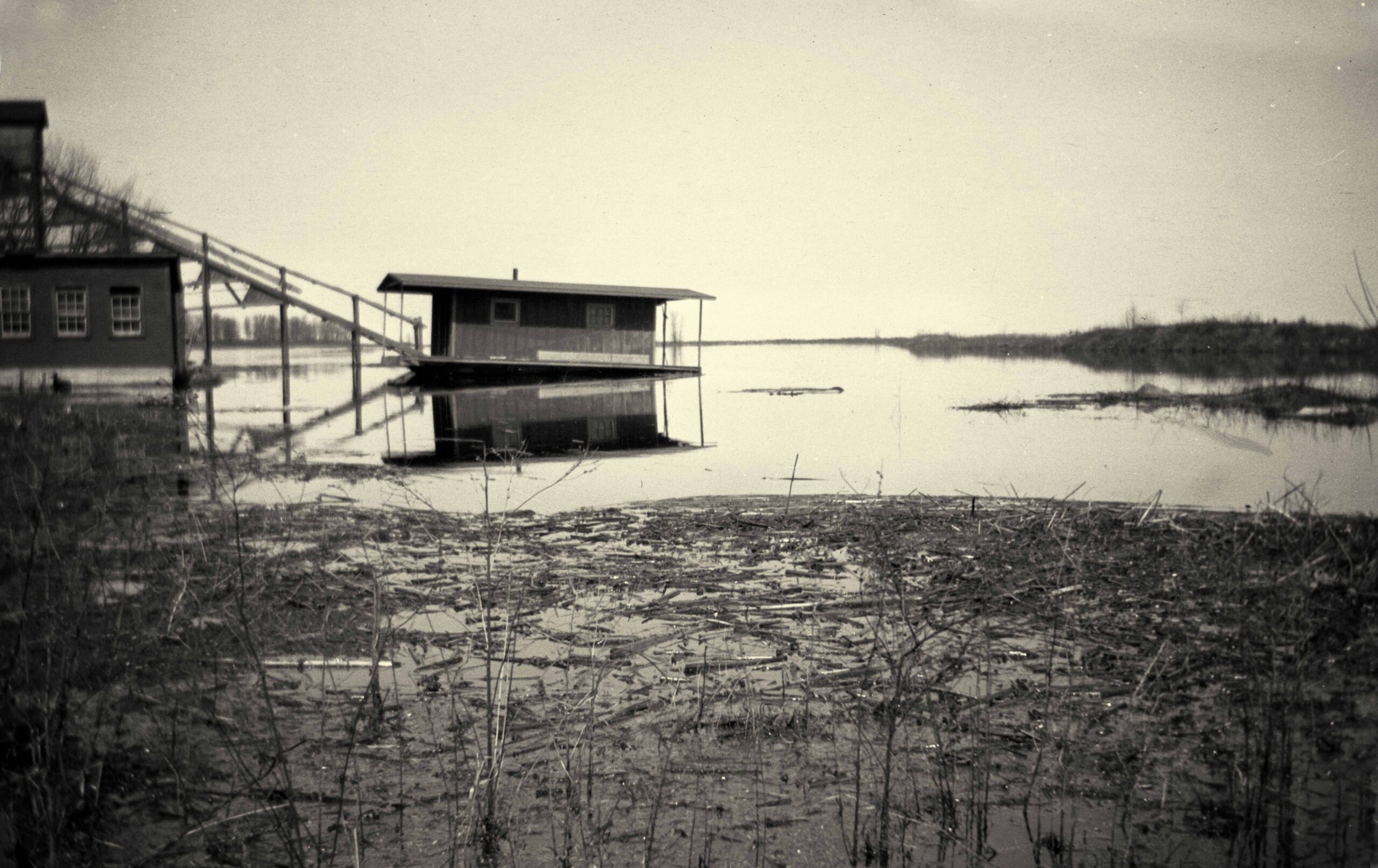
I am excited to share a newly restored, black and white, and color film of ice harvesting on the Rock River here in Horicon, the black and white film in circa 1920’s and the color film is captured around 1943–44. Watch as workers wield long pike poles, guide massive blocks along open water channels, and load ice up the great ramp of the Garbisch family’s Big Ice House — a towering 52 x 87-foot structure that once dominated the west end of Chestnut Street, just opposite the Van Brunt/ John Deere Factory. What you’re seeing isn’t just winter work — it’s an entire community’s lifeline in an age before electric refrigeration.
In those days, ice was everything. Horicon’s butcher shops, creameries, hotels, saloons, and breweries all depended on what was pulled from the frozen Rock River each winter. Families placed chalk “ICE” signs in their windows for the delivery wagons, and children eagerly waited for chips of ice on hot summer days.
The Garbisch family, along with the Melliens, the Bossmans, and generations of local workers, turned this river into one of the region’s most productive cold-storage operations — at its peak, even shipping 200 tons of Horicon ice as far as Oshkosh.
Just three years after this film was shot, it was all gone. When the Wisconsin Conservation Department purchased the property in 1947, the Big Ice House was demolished and its timbers given away as firewood.
Today that very site is the Rock River boat launch — your gateway to Horicon Marsh.
So take a moment to watch, share this piece of our history, and like our page to stay connected with more stories of the people and places that shaped Horicon. These memories deserve to live on! 

Credits can be seen at the end of the film
Music credit Nicholas Panek
Airboats, Exploders, and Marlin Perkins: Horicon’s Goose Dilemma, 1978
The Refuge That Worked Too Well: Wild Kingdom at Horicon Marsh, 1979.
On March 18, 1979, NBC viewers watched Marlin Perkins close out the season of Mutual of Omaha’s Wild Kingdom not in Africa or the Amazon, but in Dodge County, Wisconsin. No lions. No anacondas. Just a helicopter settling down at the edge of Horicon Marsh and a problem nobody had planned for: the refuge had worked too well. thetvdb
The numbers tell the story. Fall goose use at Horicon went from essentially nothing in the 1940s to 100,000 birds by 1960 and 200,000 by 1970. Crops planted on the refuge to feed them only sweetened the invitation. In October 1975 the count hit a record 225,000. The geese did not stay inside the boundary signs, and the farmers ringing the marsh watched their corn and alfalfa disappear. After a bad fall in 1965, Wisconsin became only the second state in the nation to pay for waterfowl crop damage.
By 1976, state and federal managers decided the answer was to make Horicon a worse place to be a goose. They stopped planting about 1,400 acres of refuge crops, drew the water down, and sent airboats, a helicopter, and propane exploders after the flocks. It was not popular. Conservationists went to court to stop the dewatering and hazing, and lost. National magazines picked up the story. Farmers, hunters, birdwatchers, and biologists all wanted something different from the same marsh.
That is the fight Perkins walked into. A Don Meier Productions crew spent five weeks at the refuge in October and early November of 1978, following refuge manager Jack Toll by airboat and University of Wisconsin researcher Scott Craven as his team fired cannon nets over baited geese and fitted them with neck collars. The cameras also caught something no one scripted. A botulism outbreak had been discovered on September 29, and it ultimately killed more than 5,400 ducks, so the cleanup crews you see hauling birds out of the water are doing the real thing. Toll later traveled to Chicago to record his own narration for the film.
What makes the episode worth twenty-two minutes today is that Perkins does not pretend to have the answer. He ends on an open question about whether people and wildlife can strike a workable balance, and Horicon is still working on it. In the meantime, the film is a time capsule: the marsh in full autumn color, the roar of the airboats, and a moment when our backyard was the lesson for the whole country. Watch it below.
Because the past only happens once.
