

Horicon’s Early Liquor and Lager Trade, 1850–1900
Long before temperance reformers arrived to spoil the fun, the citizens of Horicon, Wisconsin, kept themselves well supplied with locally distilled whiskey and locally brewed lager. From the moment the first settlers broke ground, the infrastructure of drink followed close behind — a distillery by 1854, rival saloons competing for the same thirsty clientele, a German immigrant brewing lager in a hillside cave by the Rock River, and a second brewer down the same street not long after. What follows is an account of those establishments and the men who ran them, drawn from the newspapers, census records, and court columns of the era.

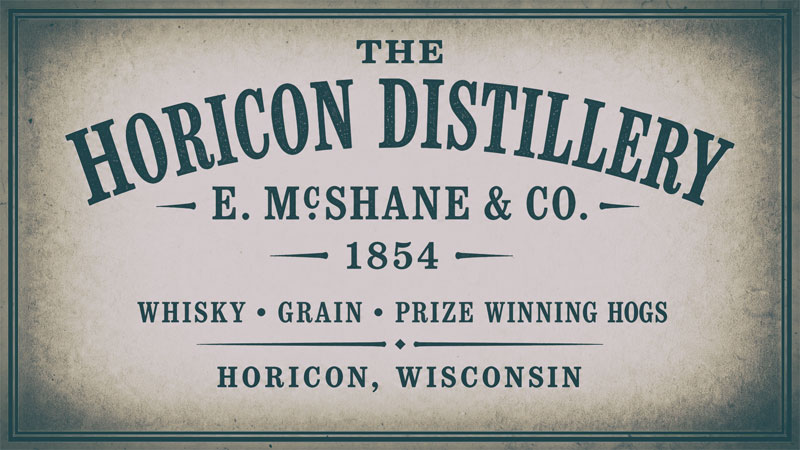
The Horicon Distillery — E. McShane & Co., 1854
Before there was a brewery in Horicon, there was a distillery. E. McShane & Company was advertising in the Horicon Argus by August 1854, announcing that it had constantly on hand at the Horicon Distillery “a superior quality of Whiskies” and stood ready to fill orders for liquors of all kinds, in quantities to suit customers. Built between the lumber, iron, and grain mills and alongside the Rock River, on what is now Legion Park and Race Street, Mc Shane’s was locally known for 4 things: good whiskey, prized fat pigs and cattle, and the stink of the feedlot….
The distillery also paid cash for grain of all kinds suited for distillery purposes — a service that made McShane a useful neighbor to the farmers of Dodge County, who could convert surplus corn and rye into ready money. And in a sideline that was perfectly logical to anyone who understood 19th-century distillery economics, McShane also offered fat cattle and hogs for sale. Spent grain mash, the byproduct of whiskey production, made excellent livestock feed; a distillery that also ran a feedlot was simply being efficient.

Advertisement, Beaver Dam Argus, August 1854: “E. McShane & Co. have constantly on hand at the Horicon Distillery a superior quality of Whiskies, and are ready to fill orders for Liquors of all kinds — and in quantities to suit customers. Cash paid for Grain of all kinds suited for distillery purposes. Fat Cattle & Hogs on hand for sale.”
The distillery’s presence in Horicon as early as 1854 is a reminder that alcohol production and frontier settlement went hand in hand. Someone had invested real capital in the infrastructure of drink before the town was firmly on its feet — and they expected a market for it. The early records don’t tell us how long McShane’s operation lasted, but by the time the Deierlein brewery opened in 1858, the distillery was no longer mentioned. Driven by a massive wave of German immigration, the market had moved on to lager.
The Pioneer Saloon — David Lewis, Proprietor, 1854–55
Whatever the distillery was producing, David Lewis was ready to sell it — along with much else besides. Lewis operated the Pioneer Saloon, which by September 1854 had been, as he announced in the Argus, “entirely re-fitted and supplied with the best of Wines and Liquors.”
Lewis was not content to run an ordinary drinking establishment. His menu stretched to oysters, clams, and lobsters, which he had arranged to have forwarded by Railroad Express direct from New York during the season of frost. Private rooms were always ready for parties of gentlemen. It was, by the standards of mid-1850s Horicon, a remarkably ambitious operation.
“Loafers and Rowdies must keep clear of these premises, or they will be duly served with a foot of ejectment.”
— David Lewis, Pioneer Saloon, September 1854
Lewis drew a firm line about his clientele. His advertisement’s closing notice left nothing to the imagination: rowdies and loafers were not welcome, and those who forgot themselves would be physically removed. The Pioneer Saloon was for gentlemen, or at least for those willing to behave like them.

By January 1855, Lewis had expanded beyond the saloon trade. In connection with the Pioneer, he stocked an entirely new supply of sugar, tea, coffee, salt, spices, fruits, and every other article in groceries, offered at prices “which cannot fail to induce purchasers.” His stock had been selected under his own personal supervision, and he felt confidence in recommending his goods to those desiring “Good Articles at Fair Prices.”.
In 1858, Lewis upped the ante and added Horicon’s first Billiard table, “best in the country..” and an expanded menu offering tame and wild game, sardines, pigs feet, as well as pork and beef steaks. And, in a way to cater to the women, a “Ladies’ Room” with a separate entrance south of the main entrance was added. By 1859, a barber was added to the saloon with the warning “Rowdies are requested to keep clear of these ‘diggins’ if they don’t want shaving with a brick.”
The Pioneer Saloon, in short, served the whole community — whether they came to drink or to stock the pantry, as long as they were well-behaved.
The Excelsior Saloon — Smith, Proprietor, 1855
Across town, a competitor was working the same territory. The Excelsior Saloon, operated by a Mr. Smith, opened in January 1855 and immediately reached for the dramatic. Its debut advertisement ran under the headline “SEBASTOPOL TAKEN! — Supplies for the Allies!!” — a reference to the ongoing Crimean War that must have stopped readers in their tracks before they realized they were being invited to a saloon.

Advertisement, Beaver Dam Argus, January 1855: “The best Wines, Liquors & Cordials, Hot Punches, and Fresh Shell Oysters anxiously waiting to render themselves useful. Fancy Groceries always on hand. Front Door always open; All Smith wants is a proper appreciation on the part of the public. Nobody turned out of doors except rowdies.”
Like Lewis at the Pioneer, Smith offered wines, liquors, cordials, hot punches, and fresh shell oysters. Like Lewis, he kept fancy groceries on hand. And like Lewis, he had no patience for rowdies. The parallel is almost too neat: two saloons, one small town, identical menus, identical clientele policies. In the emerging social world of Horicon, respectable drinking establishments apparently all looked the same.
Smith’s advertising copy had a breezy confidence to it — all he wanted, he wrote, was “a proper appreciation on the part of the public” — but his anti-rowdy policy made clear that appreciation had its limits. The front door was always open. The back door, presumably, was for those who needed to leave quickly.
Joel F. Nickols — Hair Dressing and Shaving Saloon, Lake Street, 1855
Not every “saloon” of the era served only alcohol; some had a side-hustle. In 19th-century usage, the word simply described a large room devoted to a particular purpose — and in Joel F. Nickols’s case, that purpose was hair. Nickols opened his Hair Dressing and Shaving Saloon on Lake Street in July 1855, advertising in the Argus that he was ready at all times to wait upon those who might favor him with a call, and would use every exertion to merit their patronage and support.

A brief editorial notice in the same paper warmly recommended Nickols to “those requiring tonsorial operations.” In a frontier town where a barber was still something of a novelty, the endorsement carried weight. Nickols appears to have been the first dedicated barber in Horicon, and his establishment served a genuine need in a community that was beginning to think of itself as a real town rather than a settlement.

The Spring Water Brewery — Deierlein Family, 1858–1891

Paul Deierlein (1858–82) · Charles H. Deierlein (1882–84) · John S. Deierlein (1884–91)
The story of Horicon’s brewing industry begins with a German immigrant named Paul Deierlein, who came to this country from Franconia near Nuremberg. His wedding certificate described him simply as a beer brewer, and he came to Wisconsin with the intention of practicing his trade. In the year 1858, he acquired property at the south end of Hubbard Street, toward the Rock River — a location that gave him the two things a brewer needed most: water for brewing and ice for storage.
The Horicon Argus announced his plans in late August 1858, reporting that two Germans had purchased brick and lumber and would soon commence building a brewery on Hubbard Street, near the depot. The paper predicted it would be “on a large scale, and will be a good investment.” As the opening approached, the Argus grew positively enthusiastic about the proprietor himself.
“Paul is an old brewer, and says he can make as good Lager as any men dare drink. Good for Paul, say we.”
— Horicon Argus, 1858
The praise for the quality of the beer may have been accurate. The expectation of a large-scale brewery was not. The 1860 industrial census recorded the Spring Water Brewery as one of the smallest operations of its kind in the region, with an investment of just $600 and an output of 150 barrels of beer, selling for $6 each. Production grew modestly to 175 barrels in 1870, then fell back to seventy-six barrels in 1878 and seventy-three in 1879. Neither expansion nor ambition came naturally to this particular brewery. It produced what Horicon needed, and little more.

Paul Deierlein managed the brewery until 1882, when his second son Charles took over operations. Charles had done something his father apparently had not: he went to Milwaukee and served what the Juneau Telegraph described in May 1884 as “a long and thorough apprenticeship in the best breweries there,” returning to Horicon with the skills needed to compete with the city brewers whose products were flooding small-town markets via rail.
“Wherever he has once gained a foothold for trade, he has retained it. Having tested the Spring Water beer, lovers of that beverage have constantly called for it until saloon and hotel keepers have been obliged to acknowledge that they must keep Deierlein’s beer in order to supply the demand.”
— Juneau Telegraph, May 23, 1884
The Telegraph reported that three of Horicon’s principal saloons kept Spring Water beer on tap, and that the majority of drinkers considered it fully equal in strength, color, and flavor to the products of the Milwaukee breweries. It was a remarkable achievement for a brewery that had been producing under 100 barrels a year.
Charles managed the brewery until 1884, then passed it to his younger brother John S. Deierlein, who ran it until the Spring Water Brewery finally closed in 1891. Behind the property on Hubbard Street, built into the hillside, and is visible from Horicon Marsh Tours, the brewery’s storage cave still survives on private land — a remnant of the days when a conveniently located hillside and a nearby river were all the refrigeration a small-town brewer could afford.
The Deierlein home and brewery at 516 S. Hubbard Street remained in family hands until 1909, when Anna Margaretha Deierlein, then seventy-eight years old, left Horicon to live with her daughter. The family had been a fixture of the street for more than fifty years.

Grosskopf’s Brewery — Hubbard Street, 1864–1884
John Grosskopf (1864–66?) · Herman, Marquart & Co. (1866?–68) · John Grosskopf (1868–70) · Grosskopf & Wolfram (1870–72?) · Lawrence Wolfram (1872?–78?) · John Grosskopf (1878–84)
John Grosskopf was the second man to try his luck as a brewer in Horicon, establishing his business in 1864, according to the county histories. His brewery, also on Hubbard Street, was comparable in scale to Deierlein’s: slightly more capital invested ($1,000 against Deierlein’s $600), but nearly identical output. Grosskopf reported 175 barrels in the 1870 industrial census — the same figure as his neighbor — and about seventy and seventy-five barrels in 1878 and 1879. Neither Horicon brewery produced much beyond what was needed to satisfy local thirsts.
The ownership of Grosskopf’s brewery shifted several times over the years. The 1867 excise records list the operation under the name Herman, Marquart & Co., though Grosskopf himself does not appear in those records — suggesting the firm was leasing his facility rather than operating a third independent brewery. Grosskopf had resumed direct management by 1868. For a few years around 1870, he partnered with Lawrence Wolfram, who was also listed in the 1870 census as a saloonkeeper — a convenient arrangement that ensured at least one reliable retail outlet for Grosskopf’s product.
Grosskopf’s brewery found its way into the newspapers twice, and not for reasons that reflected well on the establishment. In 1878, a man named Dan Crowley was killed in a fight on the premises. Six years later, in 1884, four drunken railroad workers attempted a robbery at the brewery; the marshal arrived in time to make arrests, but the incident had already attracted attention of the wrong kind. The brewery vanished from local directories after 1884. It is possible that the last incident persuaded Grosskopf to leave the business, and that the Spring Water Brewery — which continued until 1891 — thus became Horicon’s sole surviving brewery for its final years.
— ✦ —

Eagle Hill and the Later Tavern Trade, 1858–c. 1900
Not all of Horicon’s drinking establishments were in the city center. Overlooking the town from a hill stood a building that accumulated history the way old structures do — one use at a time, none of them quite what the builders intended.
The building had begun life as Horicon’s old Presbyterian church, on the corner of S. Cedar and Mill Street. When the congregation built a new church, the old frame structure was sold and moved to Eagle Hill by a man named Otto Weber, who used a steam engine for the task. The building was pressed into service as a classroom after the local school burned, and later served as a Socialist club — a range of occupations that speaks to the flexibility demanded of frontier-era structures. According to those who knew it in that period, it was nothing more than a big frame building, with no living quarters, no electricity, no water.
The building that eventually became the Eagle Hill Tavern thus carried within it more than a century of Horicon life by the time the Burrow family took it over in 1933. Its history as a drinking establishment belongs properly to the 20th century, but the building itself — and the hillside it sat on — had been a feature of the Horicon landscape since the town’s earliest years. Eagle Hill Tavern was a fixture in Horicon until the mid-1990s.
By the era’s end, the saloon landscape of Horicon had shifted considerably from the days of David Lewis and his oysters-by-express. The McShane distillery had disappeared from the record. Grosskopf’s brewery had closed after the railroad workers’ robbery. The Spring Water Brewery followed in 1891. The Pioneer and Excelsior saloons were long gone. What remained was a collection of taverns and drinking houses whose names and proprietors turned over with the years, serving a town that had grown well beyond its frontier origins but retained, as towns like it always do, a steady appetite for a cold glass of something at the end of a working day.
— ✦ —
The history of drink in a small Wisconsin city is, in the end, a history of the city itself — its ambitions, its immigrants, its working population, its relationship to the wider world of trade and commerce. The men who ran these establishments were not romantic figures. They were businessmen operating in a competitive market, dealing with difficult customers, reading the newspapers for advertising ideas, and hoping the marshal arrived before things got entirely out of hand. That they left enough of a record for us to find them at all is its own kind of luck.
