

144 Years Ago… When Smallpox Came to Horicon — April 28, 1882
Smallpox had a devastating effect on Native Americans when Europeans arrived on this continent, and it did not end there. Smallpox was a constant threat, with mortality rates up to 70%. A new wave of immigration from Europe in 1880–1883 really leapfrogged the disease’s progression.
On April 28, 1882, a brief but chilling dispatch appeared in the Chicago Tribune under the headline “A German Immigrant Takes the Small-Pox to Horicon, Wis.” A man named Herman Schitzke, freshly arrived from Germany ten days before, walked into O. G. Stolz’s drugstore seeking a doctor.

The examination left no doubt — it was a genuine case of smallpox. Authorities had him removed to the pest house immediately.
It was a scene playing out across Wisconsin and the entire Midwest in the early 1880s.
The Disease Itself
Smallpox symptoms begin with headache, fever, and body pain, followed roughly two days later by a rash that spreads across the face, hands, and feet before becoming pustular lesions across the entire body. The disease runs its full course in about a month, and those who survive are left with deep scars or pockmarks. Fatality rates among those never before exposed could run as high as 30 to 70 percent. The pustules described in the Tribune article — large, pus-filled sores — were the unmistakable, terrifying signature of the disease in full bloom.
Trivia: Smallpox is thought to be one of the oldest identifiable diseases in human history, with evidence of pustular rashes found on Egyptian mummies dating back over 3,000 years, including that of Pharaoh Ramses V.
Wisconsin in the Crosshairs

Throughout the 19th century, smallpox remained a persistent threat across Wisconsin. Vaccinations were known but often unavailable, and the disease sometimes swept through entire villages.
The movement of immigrants — like Herman Schitzke — was a significant driver. Throughout history, migration, trade, and war allowed diseases to travel from one environment to another, often with far-reaching consequences.
Horicon in 1882 was a growing railroad and manufacturing town, connected to the wider world in ways that made it vulnerable to exactly this kind of arrival.
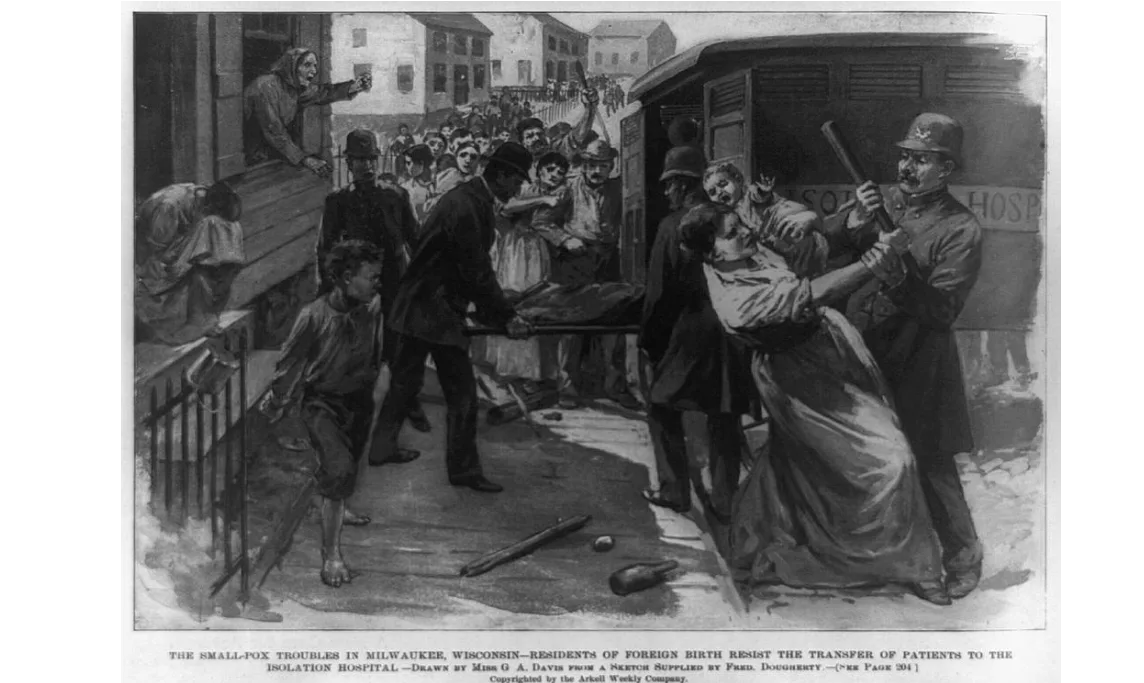
Wisconsin saw smallpox outbreaks repeatedly in this era — notable outbreaks occurred in 1872 and 1894, with the 1894 Milwaukee outbreak sparking near-riots in the streets as residents resisted quarantine efforts. The 1881–82 period was particularly active across the region.
Trivia: Vaccination itself was already nearly a century old by the time Schitzke walked into Stolz’s drugstore. Physician Edward Jenner had pioneered the practice in 1796, using cowpox — a much milder relative of smallpox — to trigger immunity. The word “vaccine” actually comes from vacca, Latin for cow.
When the authorities had Schitzke “taken to the pest house,” they were following standard public health practice of the era — though “standard” is a generous word for it.
During the 19th century, regular hospitals would not accept patients with communicable diseases, as they were not equipped to house contagious patients without putting everyone else at risk. With limited funds and high infection rates, communities built or converted structures specifically to segregate those with communicable diseases — and called them pest houses.
The term was common throughout America, used in the official published minutes of city and county governments when bills were paid for services rendered.
Trivia: The word “pest house” comes from “pestilence,” and the practice wasn’t uniquely American — Britain, France, and other European nations operated similar isolation facilities for centuries, some dating back to the plague outbreaks of the Middle Ages.
These were not hospitals in any modern sense. The medical care and standards of cleanliness we know today were virtually non-existent, and many patients died.
Pest houses were typically placed as far from town as possible — a deliberate choice. To be sent to the pest house was, in many communities, to disappear from public life entirely until you either recovered or didn’t.
A Town on Edge
Herman Schitzke’s arrival in Horicon must have sent a ripple of alarm through the community. Smallpox cases in Dodge County were at an all-time high — everyone knew what it looked like and what it could do. The swift action of local authorities in removing him to the pest house reflected both genuine public health instinct and the very real fear that one sick man, walking into a drugstore, could be the beginning of something far worse.
Vaccination and quarantine measures did not totally stop smallpox epidemics until 1893, due to the large number of unvaccinated immigrants coming to Wisconsin. By this time, a mutated form of smallpox called Variola Minor had become the most common form of smallpox in the U.S. It conferred lifetime immunity to smallpox, but only had a one percent death rate compared to the thirty percent death rate of Variola Major, or classic smallpox.
Trivia: Smallpox eventually became the only human disease ever fully eradicated. The World Health Organization declared it wiped out worldwide in 1980, following a global vaccination campaign — nearly a century to the day after Herman Schitzke’s brief, frightening appearance in the Horicon news.
Whether Schitzke survived is a story the Chicago Tribune never followed up on. But for one April day in Dodge County, his name made the national press — a reminder that in 1882, the wider world arrived in small Wisconsin towns whether they were ready or not.
1903: History Rhymes
Twenty-one years after Schitzke’s case made the Tribune, Horicon faced smallpox again — and this time, the local paper made a point of putting the scare in historical context. The Reporter’s January 16, 1903 edition ran the story under a headline that pulled no punches: “SMALL POX SCARE IN HORICON — Biggest Fright City Has Experienced Since Indian Massacre of 1861.”
The comparison wasn’t just dramatic flourish. The paper noted, almost bemusedly, that a retrospective piece on the 1861 “Indian Massacre” scare happened to be running in that very same issue — pure coincidence, but one the editor couldn’t resist pointing out.
This time, the outbreak traced back to a group of men who’d been working in the North Woods lumber camps before taking jobs at the Van Brunt Manufacturing Company in Horicon. They’d felt “slightly indisposed” but kept working anyway — and with a shop full of coworkers exposed daily, it wasn’t long before others started breaking out too. It took a while before anyone thought the symptoms serious enough to see a doctor. Even then, the local physicians couldn’t agree on what they were looking at, until Dr. Hallock was called in from Juneau and confirmed it: a mild form of smallpox.
The city’s board of health moved fast. Houses with symptomatic residents were quarantined immediately, but there was a problem — Horicon’s own pest house, overseen by Superintendent Sol Rudolph, was in such poor condition it couldn’t be used. With no vacant house left in town that wasn’t uncomfortably close to public gathering places, the board had to look outside the city limits entirely, eventually securing the old Stellmacher residence on William Maaske’s farm in the town of Burnett. In a burst of remarkably efficient 1903 civic effort, the board had the place cleaned, weatherproofed with storm windows, and stocked with supplies in under twenty hours. Six patients were moved in that Wednesday night, with William Godfrey serving as steward. Schools closed and public gatherings were suspended as a precaution.
Trivia: The 1903 article’s comparison to 1861 wasn’t incidental — Wisconsin’s frontier-era communities had a long institutional memory of epidemic and conflict scares, and local newspapers of the period frequently framed new crises against a town’s most dramatic remembered event, whether medical, criminal, or violent.
The paper’s tone by the end was almost self-congratulatory — and not without reason. The cases turned out to be mild, closer in severity to measles than to the deadly form the disease was capable of, and the board of health’s quick, largely unpaid effort was credited with keeping it that way. As The Reporter put it, the board members who weren’t already public officials had donated their time freely, and the paper felt strongly they deserved credit rather than criticism for how the scare was handled.
Two scares, four decades apart, both rooted in the same anxious question: how much of the wider world’s dangers could a small Wisconsin manufacturing town keep at its own front door?
