

Thirty Trains a Day, a Wreck in the Dark, and the Hotel at the Crossing
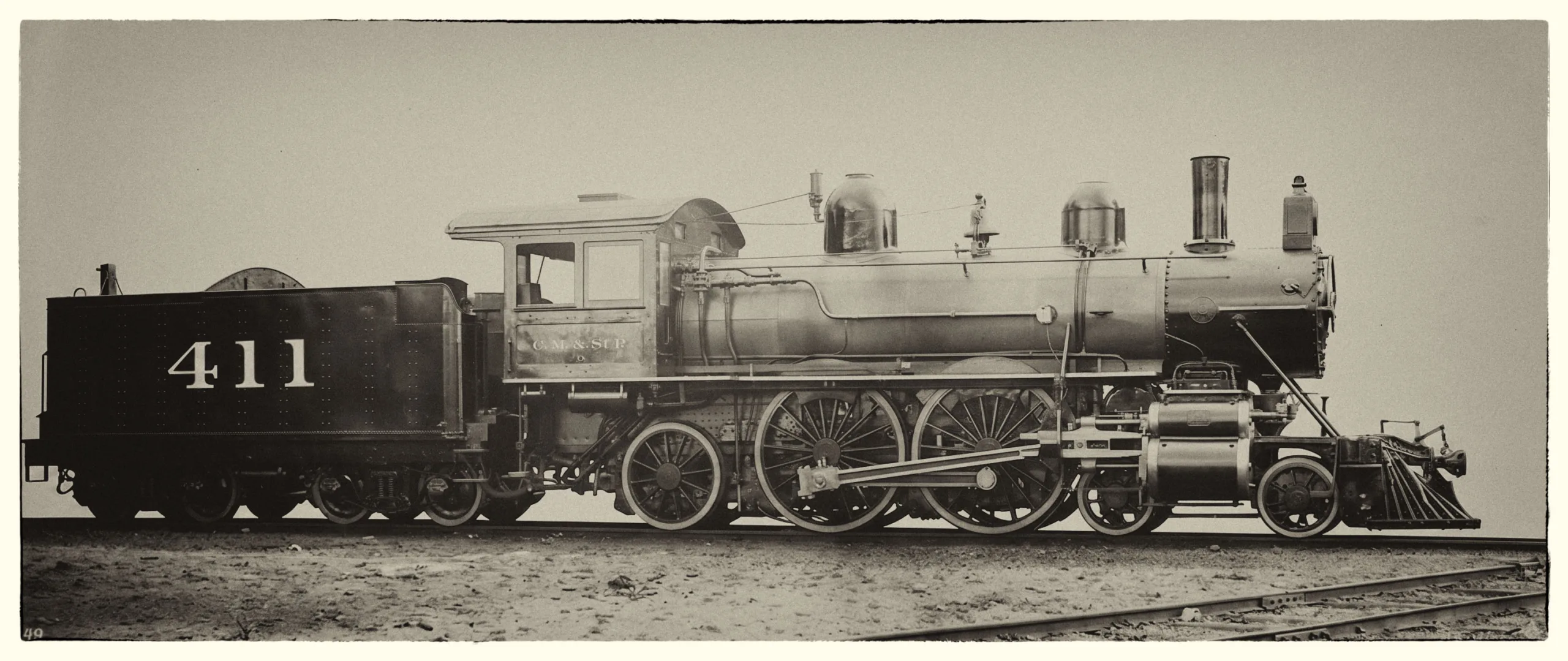
Sometime before dawn on the morning of July 12, 1901, the engineer of Chicago, Milwaukee & St. Paul passenger train No. 3 — due into Portage at a quarter to four — throttled up for the crossing at Minnesota Junction, a scattering of houses and a hotel four miles west of Horicon, Wisconsin, where the Milwaukee road’s main line crossed the tracks of the Chicago & North Western at grade. Ahead in the dark, unseen or half-seen, sat a North Western freight of some forty cars, mostly empty flats, easing slowly across the diamond. Within a few seconds, one of the Milwaukee road’s big Atlantic-type engines — No. 411 — had cut into the side of that freight, torn through it, and gone off the right of way into the gully the Minnesota Junction depot platform was built over, landing on its side with its driving wheels level with the planking above.

It is one of those small, almost-forgotten wrecks that never made a history book, but which two newspapers happened to cover within a day of each other in enough independent detail that, laid side by side, they tell us a surprising amount — not just about the wreck itself, but about how a piece of news assembled itself, sometimes contradicting itself, as it moved by telegraph and correspondent’s pen through the country papers and the city dailies of 1901.
A slender thread of flatcars in the dark
The most detailed account of the wreck — evidently written by a correspondent close to the scene, since it follows the train all the way to its delayed arrival in Horicon — lays the blame squarely on geometry and bad luck rather than any failure of a signal system, for the simple reason that Minnesota Junction had no signal system to fail. There were no semaphores, no derailing switches, no signal tower, not even a night telegraph operator on duty at the crossing. Engineer Thomas Little, of Portage, an Irish Immigrant from County Kildare, Ireland, brought No. 3 to a stop short of the North Western track, as the operating rules required, and he and his fireman, Albert Anderson of Milwaukee, looked the crossing over. The night wasn’t unusually dark; they could see the lights that should have marked a train on the North Western line, and saw none. What they could not see — because its engine was still rounding a curve to the north and its caboose lights were hidden in a cut — was the freight itself. All that showed above the rail was, in the reporter’s memorable phrase, “the slender dusky thread” of empty flatcars sliding across the crossing, low, dark, and all but invisible against the night. Fireman Anderson called out that it was clear. They went ahead. No. 411 struck the freight fourteen cars back from its caboose.
A second account — a special dispatch that reached the Milwaukee Sentinel the same day, filed from Minnesota Junction itself — tells a version of the story that doesn’t quite square with the first. In this telling, there was a lookout posted at the crossing who gave Little a semaphore signal that the way was clear; Little, who had already slowed the train, opened the throttle again and picked up speed approaching the diamond, only for a heavy freight to move up rapidly on the North Western track “a few rods from the crossing” — too late for reversing the engine and throwing the emergency brake to do any good. Whether this means Minnesota Junction did have some manner of flagman with a hand signal (which the local reporter’s “no semaphores” might not have counted as a fixed signal installation) or whether one of the two accounts is simply wrong, the discrepancy is itself a small window into how quickly-filed newspaper accounts of the same wreck, on the same day, could diverge — one shaped by a reporter walking the wreck site and interviewing the crew’s neighbors, the other shaped by whatever a railroad man or telegraph operator told a wire correspondent in the first confused hour.
“Like a Kansas lumber yard after a cyclone”


Whatever put it there, the freight was in the way, and the wreck that followed was substantial for an accident that both papers agreed was, by the standards of the era, extraordinarily lucky. No. 411 knifed through the side of the freight and went down through the depot platform into the gully beneath it. A car or cars of the freight were destroyed outright — one account describes a car of telegraph poles scattered in confusion across the right of way; the more local account describes a flatcar of shingles demolished so thoroughly that “the vicinity looked like a Kansas lumber yard after a cyclone.” Both details may simply describe different wreckage from the same forty-car train; a mixed freight of that size would have carried both kinds of load, and two reporters arriving at the scene at different hours may each have fixed on whichever ruin was most vivid in front of them.
What did not happen was, by far, the more remarkable fact: none of the passenger cars left the rails. The first car behind the tender was smashed at its front end, and the first two cars of the train were derailed, but the couplings held, the following cars stayed upright and on the track, and not one passenger was hurt badly enough to be worth reporting. Little and Anderson stayed in the cab as the engine rolled, rather than jumping — the decision, more than any luck of geometry, that most likely saved their lives, since a locomotive engineer’s instinct to ride out a wreck in the cab rather than leap from a moving engine was, by 1901, already understood by railroad men to be the safer of two bad choices far more often than not.
On the question of how badly Little himself was hurt, the two accounts disagree outright. Local reports insist that both men crawled from the wreckage “uninjured beyond bruises, strains and a general shaking,” and when a reporter visted at the Little residence in Portage that afternoon, found Little, a Civil war Veteran, engineer asleep, “very tired and badly bruised and upset nervously,” his back strained, but able to have walked home from the depot under his own power — appearances, his wife said, “indicating nothing very bad.” The Sentinel’s dispatch, filed the same morning from the scene, says flatly that Little “had several of his ribs broken and was badly bruised about the body and head.” It is entirely possible both things were true at different hours of that long day — that Little’s injuries looked worse in the immediate aftermath than they did once he’d been gotten home and examined, or the reverse, that the full extent of broken ribs only became apparent once a doctor had actually looked him over, after the first optimistic wire report had already gone out. Either way, it is a small, honest reminder that “no one hurt” headlines from any era are worth reading with some care.
Six minutes late into Horicon

The response to the wreck was fast by any standard. Wrecking trains from both railroads — the Milwaukee Road’s from Milwaukee, the North Western’s from its Fond du Lac shops — were on the scene quickly enough that every trace of the wreck except the ditched engine itself was cleared from the right of way by eight o’clock that morning. Conductor Dusenbury’s train, evidently following behind No. 3 on the same line, reached Horicon only six minutes behind schedule. No. 3 itself had to wait for a fresh engine to be sent out from Portage; when it arrived, the battered smashed-up car was coupled onto the rear of the train, rather than left behind, and the whole assembly pulled into Horicon at 10:05 that morning — passengers disembarking for breakfast at the Fox House while Conductor Young, now in charge of the train, presumably sorted out the rest of the day’s running.
The Horicon correspondent couldn’t resist a closing editorial jab at both railroads over the state of the crossing itself: no semaphores, no derailing switches, no signal tower, “not even a night operator in the telegraph office” at a junction where two major lines crossed at grade in open country. “Mayhap the railroad companies will now properly equip the crossing with up-to-date safety appliances,” the piece concludes — a small-town paper’s dry way of saying an accident like this one had been a long time coming. It’s a complaint that fit its moment: American railroads were, in exactly these years, in the early stages of a decades-long push toward interlocking towers, automatic block signals, and eventually federal safety mandates, driven crossing by crossing, wreck by wreck, by exactly the kind of local pressure this article was applying.
Thirty trains a day, and chicken for dinner

The wrecked engine came to rest almost in the shadow of the one thing that made Minnesota Junction more than a name on a timetable: a large frame hotel, built about 1866 at the height of the junction’s railroad boom, when traffic on the crossing lines ran to thirty trains a day and more. It went up first as the Junction Hotel and was later known as the Maple Shade Hotel, and for the better part of two generations it was the actual reason Minnesota Junction existed as a place rather than just a diamond in the rails.


Its first purpose was a practical one. In the years before passenger trains carried their own dining cars, a hungry traveler ate where the railroad stopped long enough to let him, and Minnesota Junction was one of those stops. The conductor would walk the length of the train counting how many passengers wanted a meal, then wire ahead so the house would know how many places to set by the time the cars pulled in. By 1872, the man on the receiving end of that telegram was Thomas Young Sr., who ran the Junction’s railroad eating house together with his wife, Zemira Flemming Young — good linen on the tables, and the silver and glassware kept by a young woman named Eliza Farley, who had come over from Iron Ridge to work there and ended up marrying the proprietor’s son, Charles Mortimer Young, in what amounts to the hotel’s own small love story. A full dinner ran about seventy-five cents, and the house kept rooms for travelers who needed to stay the night, with the telegraph key and the ticket window sharing the same building as the dining room.
What kept the place known well beyond Dodge County was its chicken. The Maple Shade’s chicken dinners became enough of a destination in their own right that, in the later nineteenth century, it wasn’t unusual to see fifty carriages pull in from the surrounding villages on a single Sunday. The hotel’s summer trade went further still: it drew wealthy families up from the South every year, arriving with their fine horses and the Black household staff who traveled with them, who would take rooms at the Junction for the season and stay on until prairie-chicken hunting closed for the year each fall — a small, unlikely resort trade built entirely on a railroad crossing in rural Wisconsin.
By the summer of 1901, the hotel had passed to new proprietors, the Krouse brothers, who were advertising the same season as the wreck that they had just finished enlarging and rearranging the place to keep up with its patronage — the whole building now lit with acetylene gas, a new bath room fitted with “all modern improvements,” and sleeping rooms more than doubled to handle the crowds. It was, in other words, a going concern and a point of local pride at exactly the hour engine No. 411 went off the rails and down through the depot platform a short distance away — the same crossing that had built the hotel’s fortune for thirty-five years very nearly ending, on one July morning, in something far worse than a derailed freight car and a badly shaken engineer.
The Maple Shade’s later troubles
The hotel that had once set good linen for Sunday chicken dinners did not stay quite so respectable forever. At some point after Prohibition took hold — the “STATE DRY OFFICERS” who did the work leave little doubt about the era — three members of the state’s prohibition enforcement squad raided the Maple Shade Hotel at Minnesota Junction and came away with a quantity of alleged illicit liquor, hauled off to the county jail at Juneau to be held as evidence. The press notice on the raid was terse to the point of anticlimax: no warrants, it noted, had yet been served as of noon that day. It’s a small, almost bureaucratic postscript to the hotel’s earlier reputation for hospitality — the same building that once wired ahead to Thomas Young about how many chicken dinners to set out was, a half-century or so later, having its cellar searched by dry agents.
That was not the Maple Shade’s last brush with the law. In a later, considerably larger sweep — datable to 1935, 1936, or 1937, the three years Walter E. Buschkopf held the office of Dodge County sheriff — it turned up again as one of nine Dodge County “roadhouses” raided simultaneously by squads of state agents working with Sheriff Buschkopf’s department, in a coordinated cleanup he was at pains to note had been kept secret even from his own raiding squads until the moment they moved. The timing fits the moment neatly: Prohibition had been repealed in December 1933, and this second raid is no longer a “dry” action against liquor itself but a vice-and-licensing sweep — disorderly houses and after-hours sales — of exactly the kind that swept through Wisconsin’s roadhouse culture in Prohibition’s immediate aftermath, when the old bootleg joints simply re-opened as taverns and dance halls and had to be brought, sometimes forcibly, under the new licensing regime. Forty-one people were arrested that weekend on charges of operating disorderly houses, selling liquor after hours, and simply being “inmates” of the raided places, all of them released on bond ahead of a preliminary hearing. The Maple Shade’s name appears in the list alongside Phil Evans’ place, the Golden Lantern and Hilltop tavern near Beaver Dam, the Willow Inn and the Edgewood on County Trunk Highway G, and the Midway and Rainbow taverns — but the raid’s real showpiece, by the newspapers’ telling, was Alice King’s establishment at Minnesota Junction itself, described as “one of the most elaborate roadhouses in Dodge county,” where the women arrested as inmates were found dressed in evening gowns and were allowed to change into street clothes before being taken to the jail at Juneau, carrying with them, one wire account couldn’t resist noting, their candy bars, cleaning tissue, toilet articles, and cigarettes. (State agents also came away from the Midway tavern with a dog.) Investigators, it was said, had spent two weeks quietly building the case before the raids went off, acting on complaints from Dodge County’s own licensed tavern keepers, who apparently had grown tired of competing with places that stayed open, and stayed loose, past hours.


Between the two episodes, the arc of the place is a small, complete story of its own: a railroad boardinghouse built for hungry passengers and vacationing families in 1866, famous within a generation for its chicken dinners and its fifty carriages of Sunday visitors, still standing and respectable enough to be freshly renovated the summer an express engine went into the ditch across the tracks in 1901 — and, within the same building’s lifetime, eventually swept up as one of Dodge County’s notorious roadhouses in a coordinated vice raid, its cellar and its guest list both, by then, of considerably more interest to the state than its kitchen.
A second escape
The most striking detail in the whole record, though, is almost a throwaway line at the end of the Horicon account: that Thomas Little was “one of the oldest engineers in the employ of the Milwaukee road,” and that he had been the engineer of “the ill-fated limited express wrecked at Rio fourteen years ago,” from which he had “narrowly escaped with his life.”
Run the arithmetic backward from July 1901, and “fourteen years ago” lands almost exactly on October 28, 1886 — the date of one of Wisconsin’s worst nineteenth-century railroad disasters, a Chicago, Milwaukee & St. Paul limited train that struck a switch left open, by the railroad’s own later admission, through the negligence of an employee named C. H. Wells, near East Rio, Wisconsin. The train was doing something like forty miles an hour when it hit the open switch; it telescoped, and the day coach caught fire. Contemporary estimates of the dead ranged from eleven to seventeen — a far worse disaster, by an order of magnitude, than the one at Minnesota Junction. The same man who walked out of that inferno at East Rio in 1886, presumably having seen and lost fellow trainmen or passengers in the wreck, was back at the throttle of a Milwaukee Road passenger engine fifteen years later when it went into a ditch at Minnesota Junction — and walked, or was carried, home to his wife in Portage a second time.
Click for more on the October 28, 1886 Wreck
The Burning of the East Rio Night Train, October 28, 1886
Just after half past midnight on October 28, 1886, a switch stood open at the siding outside East Rio, Wisconsin, and a westbound train was running toward it in the dark at something close to forty miles an hour.
Two freights were meant to be waiting at that siding that night — No. 14, running on schedule, and a second train running “wild,” without a set place on the timetable, the kind of unscheduled extra that railroads of the era slotted in and out of the timetable by telegraph and by the judgment of the men on the ground. Whichever hand had last thrown that switch had left it open to the main line instead of closed to it, and there was nothing to warn the oncoming train of the mistake until the locomotive was already into it.
A swerve, and a wreck no one could outrun
Engineer Thomas Little felt the train leave the rails before he could have explained why. The locomotive, the tender, the mail car, the baggage car, and one day coach went into the siding together and derailed, and the whole tangled mass of iron and timber drove into an embankment at speed. What had been a train came apart into wreckage in the space of a few seconds — cars telescoped into one another, the lighter wooden coach crushed and folded against the heavier cars ahead of it, and the wreck came to rest in the dark in a state its own crew could only describe afterward as chaos.
It was the fire that made the night unforgettable. The coaches were lit by oil lamps, as every passenger car of the period was, and heated at one end by a stove, and in the impact both found something to ignite. Within moments the splintered wood of the wrecked cars had caught, and the fire spread through the tangled wreckage faster than anyone trapped inside it could escape. At the rear of the train, three sleeping cars had stayed on the rails entirely, untouched by the derailment, and the passengers riding in them — forty or more people, most of them asleep when the crash came — walked away from a disaster that was, a few car-lengths ahead of them, already turning fatal.
It was Little’s own doing that the sleepers survived intact. The instant he felt the train going into the open switch, with the crash already unavoidable, he set the brakes — an act contemporaries described as requiring almost superhuman strength under the circumstances, wrestling a train at speed into an emergency stop as it was actively derailing beneath him. It was that braking, more than anything else, that kept the rear sleepers from being dragged into the wreck along with the cars ahead of them. Little himself was thrown and seriously injured in the crash. He did not wait to be rescued. He crawled out from under the wreckage himself and spent the rest of that night helping pull other survivors free, injured as he was.
The coach
The disaster fell almost entirely on the single day coach that derailed and telescoped with the mail and baggage cars ahead of it. Many of its passengers were asleep when the crash came, which meant many of them never had the chance to get clear before the fire took hold. Eighteen passengers in that one car alone died in the flames — the single worst concentration of loss in a wreck that, discounting that one car, might otherwise have been a bad derailment with survivors to spare.
One story from inside that car survived the night in more detail than most. A mother traveling with her two small children was pinned beneath her seat by the wreckage, unable to free herself, but her arms were not trapped. As the fire closed in around her, she worked her children free of the wreck and passed them, one and then the other, out through a broken window to whoever was outside to take them — and then died in the fire herself, in the same car she had just emptied of her own children. It is the kind of detail that a wreck report does not usually preserve, and the kind that the people of East Rio evidently did not forget.
A death toll that never fully settled
How many people died at East Rio that night was disputed almost from the start, and it has never been entirely resolved. Contemporary counts ranged from eighteen to twenty-two dead, and of those, twelve were never identified at all — the fire that killed them had also erased the ordinary means of knowing who they were. In the weeks and months afterward, as many of the dead as could be identified were, some by jewelry or luggage recovered from the wreckage rather than by any surer method. Even so, a dispute over the exact final count persisted for years, and probably never closed to everyone’s satisfaction. Later secondary accounts of the wreck, drawing on incomplete newspaper coverage rather than the fuller local record, have sometimes given a lower figure — as few as eleven — which likely reflects how quickly a disaster like this one outran anyone’s ability to keep a single, final count, rather than any real disagreement about what happened that night at the siding.
What is not in dispute is the shape of the disaster: an open switch, a train running too fast to stop for it, a fire that turned a bad derailment into a catastrophe, and an engineer who, badly hurt himself, spent the worst night of his career pulling other people out of the wreckage he had just survived. For a stretch of track outside a village most people outside Dodge County had never heard of, October 28, 1886, earned East Rio a grim distinction it never asked for and has been remembered for ever since — for a time counted, by the people who lived through it, as the worst train wreck in the nation.
It’s the kind of coincidence that a small-town reporter in 1901 could toss off in a single sentence, trusting readers to feel its weight without being told to. A career spent at the front of passenger trains in the last years before automatic signaling was, for men like Thomas Little, simply a career spent gambling, trip after trip, on sightlines, on switchmen, and on the darkness ahead of the headlight — and, twice in one lifetime that we happen to have a record of, on losing that gamble and living to make the next run anyway.
The Hotel today still stands, – The Maple Shade Hotel in Minnesota Junction, Wisconsin (Dodge County) is a historic, Civil War-era landmark built in 1866. It is no longer operating as a public hotel or business and is privately occupied, though it remains a notable piece of local history
Saw this pop up on my feed, extrodinary! I lived in Burnett Junction for about 40 years, and was always driving through Minnesota Junct. daily, even in the 80 and 90’s when the trains came through, it was always a thought in the back of my head about accidents. Now I know. Nice detective work on this.
In the mid 1970s we used to go this place because they used to have a weekday $.05 beer night and they didn’t check ID’s. (18 YO drinking age in those days) Also my father worked for Milwaukee Road and said this place had a reputation for “professional” ladies of the evening in the 1920s and 1930s!
You are correct, they did have the ‘vice’ squad come and make several arrests for prositution there.