
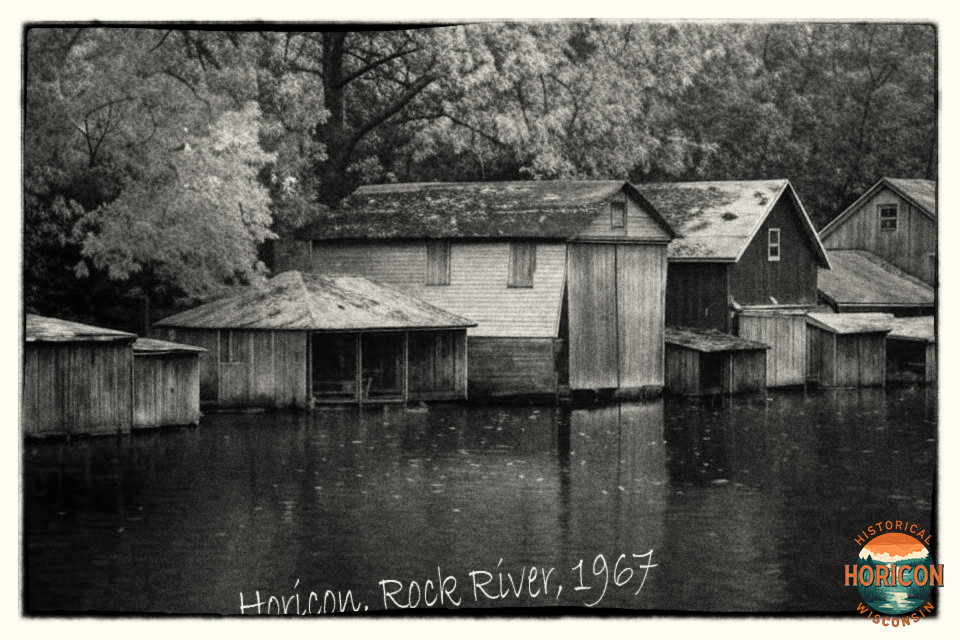

Where Water Shapes Memory: Horicon’s Boathouses through Time.

The history of boathouses in Horicon, Wisconsin, is deeply intertwined with the evolution of Horicon Marsh. When European settlers arrived in the vast wetland once known as the “Great Marsh of the Winnebago,” they built some of the earliest structures along the banks of the Rock River. The transformation of the area began in 1846, when a dam was constructed on the river, converting the marsh into Lake Horicon—then celebrated as the largest man-made lake in the world. During the lake era (1846–1869), the region bustled with commercial activity. Steamboats transported logs, stone, and farm produce, while hunters and fishermen frequented its shores. This surge in use led to the development of docks, landing sites, and boathouses that supported both commerce, hunting, fishing, and recreation.
The Van Brunt Era and Horicon’s Industrial Waterfront
The rise of industry along the Rock River in the mid-19th century transformed Horicon from a small sawmill settlement into a thriving manufacturing hub. Central to this transformation was the Van Brunt Manufacturing Company, founded by the inventive Van Brunt brothers, who revolutionized American agriculture with their mechanical broadcast seeder, or “Seed Drill.” By 1863, they had established a major manufacturing operation on the east bank of the Rock River, accompanied by the elegant Van Brunt house on the west overlooking the complex.
The Van Brunt Manufacturing Company, later becoming the John Deere Horicon Works, dominated Horicon’s industrial landscape for decades. Its riverfront location was strategic—goods could be floated in and out via barges and shallow-draft boats even after Lake Horicon reverted back to river and marshland. Company records and historical maps show that several utility boathouses and loading docks were attached directly to the manufacturing buildings, allowing materials to move efficiently between rail, lake, river, and factory floor. Some of these former dock areas are now “high and dry,” but their brick foundations remain visible reminders of the city’s Lake Horicon waterborne commerce.
Industrial Neighbors and Shared River Access
Horicon’s prosperity was not shaped by Van Brunt alone. Other firms also relied heavily on the Rock River’s access for logistics and craft transport. The Horicon Iron Works forged tools, windmills, and machine parts that were shipped by boat and rail. Firehammer Lumber used boathouses and docks to load and unload cut timber to and from their yards for milling and construction supply. Nearby, the Rice Brothers operated barges for both freight and construction materials, maintaining their own modest boathouses south of the Van Brunt plant. The steamer M. Winter, a 102’ steamboat, also utilized these docks and boat houses.
Together, these companies created a network of river access points—industrial docks, wooden ramps, and covered boathouses—that served as an early logistical system linking Horicon’s factories to the wider economy of southeastern Wisconsin, which included the trains which arrived in Horicon in 1856..
The Van Brunt Corporation’s Boathouses
The Van Brunt Corporation’s boathouses stood as vital infrastructure for the movement of machinery, materials, and supplies along the Rock River. Historical photographs and property descriptions indicate that the company repurposed existing vessels for moving goods and maintained boathouses for storage, repair, and docking of boats. These structures were built in practical, utilitarian fashion—timber-framed and sided, positioned alongside the main plant area.
As industrial transport declined with the arrival of heavy rail in the mid 19th century, many of these boathouses transitioned in purpose. Most were removed as the lake disappeared, but some became maintenance sheds; others, leased by fishermen and hunters, began the slow evolution of Horicon’s waterfront toward its more hunting, trapping, and fishing 20th-century character.
From Lake to Marsh: Shift from Commerce to Hunting, Trapping, and Fishing
When the lake was drained in 1869, the area returned to poor quality marshland. The commercial era faded, and with it, the first wave of industrial boathouses gave way to smaller, utilitarian structures supporting hunting, trapping and fishing, particularly as market hunting became a major pursuit. The marsh’s abundant wildlife attracted both market and sport hunters, with many accessing the resource through boathouses situated along new ditches and waterways carved by drainage attempts in the 1910’s.

Exclusive hunting clubs and private boathouses became more prominent on the marsh’s edges, facilitating regulated sporting pursuits rather than mass commerce. Boathouses at this time stored specialized boats and tools vital for marsh navigation, trapping, waterfowl hunting, and fishing.
Legacy Along the Rock River

By the early 20th century, as Horicon Marsh shifted from an industrial resource to a conservation landmark, very few remnants of these larger boathouses and piers persisted beside new, smaller structures built for recreation, trapping, and waterfowl hunting. Many were simple, functional buildings of wood and drop siding, maintained and built by local citizens, some being passed down through generations.
Although the primary economic purpose of river transport faded, the legacy of Horicon’s manufacturers—Van Brunt, Firehammer, the Rice Brothers, and Horicon Iron Works—remains embedded in the shoreline’s shape. With many old cutouts in the shoreline, stone and cement foundations still exist. Their structures laid the foundation for a community whose identity remains tied to water, industry, and resilience.
The Persistence and Legacy of Boathouses
Horicon’s boating legacy lives on most vividly along the dredged southern waterways of Horicon Marsh, notably at Arndt’s Slough (sometimes called Arndt’s Ditch) near Nebraska Drive. Here, the remains of more than 50 historic boathouses—now numbering about 40—stand as silent witnesses to a century of marsh activity, with many dating back to the early 1900s.

Another notable concentration of boathouses once existed at the “Four Ditches” west of N. Hubbard Street. Don Miescke, who enjoyed writing about boathouses along the river, Arndt’s Ditch, and the Four Ditches, documented this history in a series of articles published in the Horicon Reporter in October 2008 and later in his 2012 book Horicon Marsh History.
He noted that in 1946, just after the end of World War II, his grandfather Max Miescke decided to have ditches dug from the river back toward the higher ground near his home. Augie Feucht of Mayville Engineering began excavating the first ditch that winter, roughly 30 feet wide. The Miescke family’s boathouse was among the first constructed there. Over the next decade, three more ditches were added, and lots were leased until, by the 1960s and 1970s, nearly 100 boathouses lined the waterways. This short-lived boathouse community disappeared by 1984, when the remaining structures were removed. Today, the “Four Ditches” site is owned by Deere & Company and was annexed by the City of Horicon in 1984, despite repeated but largely unsuccessful efforts to convert it into state property or a city park. The survival and repurposing of these boathouses, originally built for hunting and fishing access, underscore the enduring spirit of Horicon’s outdoor traditions. Even as commercial boathouse operations declined, hunting, trapping, and recreational boating remain central to the marsh’s character.
Modern Regulation
Today, Wisconsin law tightly regulates “wet” boathouses—those partially or wholly below the Ordinary High Water Mark (OHWM). Strict conservation laws prohibit the construction of ANY new wet boathouses. Existing historic structures, including those dating from the Van Brunt era into the early 20th century, can be preserved only under stringent certification, provided they retain historic features and have not been converted to nonconforming uses. Statutory exceptions exist primarily for boathouses constructed before 1979, or those designated as having historical or cultural value.
The Boathouses of Today

The remaining boathouses in Horicon and along the Rock River, many well over 125 years old, stand as resilient symbols of the town’s evolving relationship with water—from commerce and industry, epitomized by the Van Brunt, FireHammer, Horicon Iron Works, Horicon Boat Livery and others, to hunting, trapping, fishing, recreation, and heritage.
However, the ravages of time and decades of neglect have taken a toll on many of these privately owned boathouses. Without consistent upkeep, numerous structures have deteriorated and fallen into disrepair, collapsing and giving way to the natural reshaping of the river shorelines. This cycle of decay and natural reclamation underscores both the fragility and enduring presence of Horicon’s boathouse tradition as it blends history, community, and the evolving landscape of the Rock River and Horicon Marsh.

These surviving boathouses, once vital nodes in industrial and natural economies, are now valued for their cultural and hunting legacies.

Boat Houses 1940
Author: Carl G. Reinemann
