
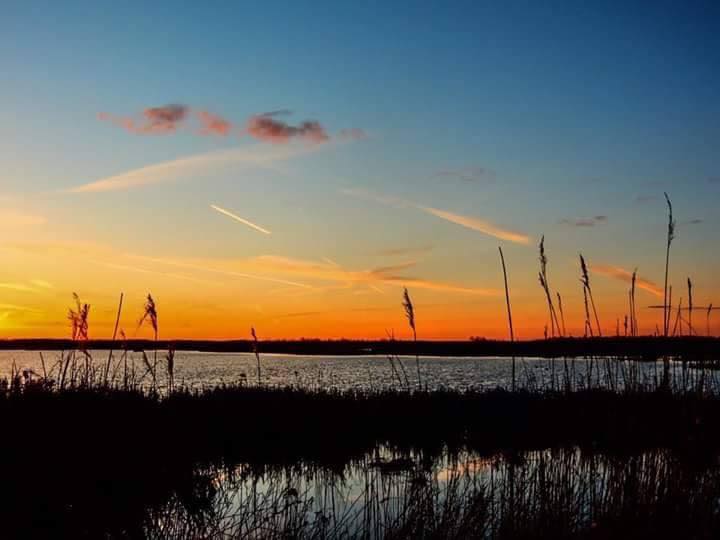

A History of Tourism at Horicon and Horicon Marsh
Long before Horicon was a city — before the dam, the ducks, the duck hunters, the drainage ditches, and the hard-won restoration — this corner of Dodge County was shaped by forces far older than any of us. What we now know as Horicon Marsh began its life not as a marsh at all, but as a glacial lake. Its story stretches across 12,000 years of human connection to this land and water. And the story of how people came to visit, celebrate, and ultimately fight to preserve it is as rich as the marsh itself.
Born of Ice: The Glacial Origins
The Green Bay lobe of the great Wisconsin glacier moved through this region roughly 70,000 years ago, grinding and sculpting the landscape beneath its immense weight. As it advanced, it created the rolling, oval-shaped hills — called drumlins — that still define the terrain around Horicon today. This part of Dodge County holds the highest concentration of drumlins anywhere in the world, a geological distinction that often surprises visitors more accustomed to thinking of the marsh itself as the local wonder.
Twelve thousand years ago, a retreating glacier left behind a ridge of rock and sediment that would one day change the course of an entire community. Meltwater pooled behind that natural dam, forming Glacial Lake Horicon. Layers of silt, clay, and peat accumulated across the former lakebed, and in their place, a vast, shallow wetland was born: Horicon Marsh. Over centuries, the lake drained, and in its place rose something more enduring — a vast, shallow wetland covering well over 33,000 acres, a watershed of 259 square miles and includes 335 stream miles, 1,629 lake acres, and 34,062 total wetland acres, making it the largest freshwater cattail marsh in the United States. Its average depth is just one to two feet, a wide, shallow basin that supports an extraordinary diversity of life. The Horicon Marsh State Wildlife Area is recognized as part of the Ice Age National Scientific Reserve system, honoring the unique glacial evidence still visible across the landscape.
The First People of the Marsh
Humans have been drawn to Horicon Marsh since it was in its earliest stages. Archaeological evidence suggests nomadic hunters arrived here as long as 12,000 years ago, following game across a landscape still recovering from the ice. Over the centuries, they were succeeded by the Paleo-Indians, the Hopewellian people, and the Mound Builders — prehistoric cultures who recognized the marsh as a place of abundance and spiritual significance.
Among the most striking reminders of these early inhabitants are the effigy mounds scattered across the low ridges surrounding the marsh. Built between roughly 700 and 1200 A.D., these earthen sculptures were shaped to represent animals and geometric forms. The first state geologist of Wisconsin, Increase Lapham, mapped more than 500 mounds around Horicon Marsh alone in the 1850s. Some of the finest surviving examples can be seen today at Nitschke Mounds Park in Dodge County.

By the time European settlers arrived, the marsh was home to the Potawatomi to the east and the Ho-Chunk Nation to the west. Seven major Native American foot trails converged at the southern end of the marsh — at what is now the city of Horicon — making this a significant crossroads of indigenous travel and trade for generations. The settlers who followed named it ‘The Great Marsh of the Winnebagos’ before adopting the Algonquin name Horicon, meaning ‘land of clean, pure water.’

The area that would become the city of Horicon has been known by many names, Hochungara, White Breast, Doty’s Rapids, and Hubbard’s Rapids, named after Governor Hubbard of Vermont, a large landowner in the area. When the first settlers came, a captain named Larrabee — who came from Horicon, New York — prevailed in giving the new town its name. The spirit behind it captures something real: this has always been a place whose identity is tied to the water and the wildlife.

Lake Horicon: A Man-Made Wonder
In 1846, Horicon’s founders made a decision that would reshape the landscape entirely: they built a dam on the Rock River to power the town’s first sawmill. The dam backed up water throughout the entire marsh basin, raising the water level by nine feet and flooding the wetland. What emerged was Lake Horicon — a sprawling, 50-square-mile body of water said at the time to be the largest man-made lake in the world.


Steamboats navigated its waters, carrying logs and farm products between communities. Visitors came from across the region to fish and hunt its shores. For a generation, Lake Horicon was a genuine destination. But the lake’s existence was never without conflict. Farmers argued the flooding damaged their fields; water rights disputes simmered for years. After 23 years, legal battles finally led to the dam’s removal. Workers dismantled it plank by plank in 1868, using a horse and windlass. Lake Horicon drained back into the Rock River, and the marsh began slowly returning to its natural state.
The era of Lake Horicon left behind artifacts that still surface today. In 1934, a pair of local men hiking across the frozen marsh discovered the remains of a boiler — likely from one of the steamboats that once plied those waters — preserved in the peat.
The Hunting Era: Bounty and Its Cost
With the return of the marsh came the return of wildlife, and with wildlife came hunters. By the 1880s, sportsmen’s clubs were reporting enormous flocks of geese and staggering numbers of ducks nesting and migrating through the marsh. One account from 1883 estimated that 500,000 ducks hatched annually and that 30,000 muskrats and mink were trapped from the southern half alone.
This abundance attracted not just sport hunters but market hunters — men who killed waterfowl commercially to supply restaurants and markets across the Midwest. With no regulations to limit the harvest, the duck population was devastated in a matter of decades.


The idea of draining Horicon Marsh for farmland took shape decades before a single ditch was cut. Wisconsin lawmakers had already anticipated the eventual removal of the dam that once backed up Lake Horicon, and in 1867 they authorized the sale of the exposed lakebed; speculators moved quickly, buying up roughly 20,000 acres at prices as low as six to ten cents an acre. By 1904, drainage interests took the next formal step, petitioning the courts to organize the marsh into a drainage district. The Wisconsin Supreme Court pushed back, ruling that the Rock River and its bays through the marsh were navigable waters whose course could not lawfully be altered. Undeterred, the drainage interests began ditching the marsh anyway in 1909, starting at its far northern end near Waupun.
What followed was one of the largest reclamation efforts Dodge County had ever attempted. For the better part of five years, dredge crews cut a Main Ditch roughly fifteen miles long down the center of the 32,000-acre marsh, along with a web of lateral ditches, work substantially complete by 1914 though drainage continued in some form for years afterward. The digging was done with giant steam-powered dipper dredges, floated in and assembled at Ice House Slough to widen and deepen the Rock River itself, while other crews raised embankments and built pumping stations to wall off and dry out the land section by section. Once the peat was dry enough to work, farmers turned to heavy Rumely tractors, built by the Advance-Rumely company, to break the tough new ground, machinery substantial enough that Advance Rumely itself later turned up holding a financial interest in some of the reclaimed acreage. By 1916, the transformation was unmistakable: roughly 2,200 acres had been plowed and planted, crisscrossed by 60 miles of drain tile, with rows of onions stretching nearly a mile across what had been peat bog. Reclaimed marshland that had once been worthless was selling for as much as 400 dollars an acre.


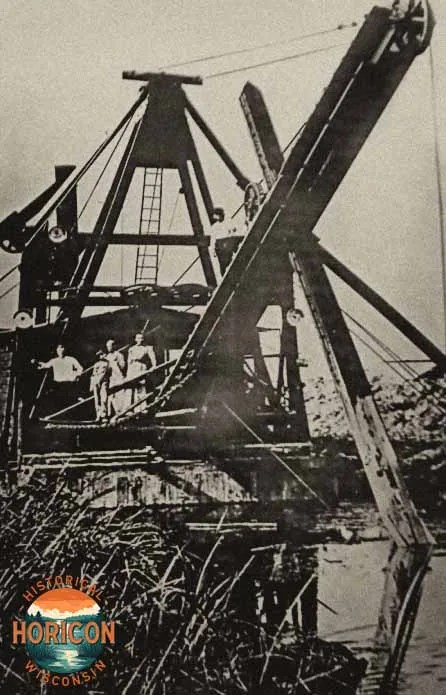

The marsh, it turned out, would not stay tamed. A five-week heat wave near 100 degrees in July 1916 scorched crops across the whole region, marsh and dry land alike. The following year brought the opposite problem: a cyclone and months of heavy rain flooded the reclaimed farmland, and even with a deepened river channel and dozens of miles of new ditches, the water simply had nowhere to go fast enough. Crops failed, debts on the drainage work went unpaid, and by 1920 the entire development scheme had collapsed, its buyers losing their land to foreclosure that fall. The drained peat, left exposed and dry, caught fire and smoldered on and off for years afterward. Not until 1927 did the State of Wisconsin begin buying the land back, reversing more than a decade of ditching and starting the long process of turning the farmland back into a marsh.
The Fight to Restore Horicon
The conservation movement that saved Horicon Marsh is one of the great stories of Wisconsin environmental history. It began in earnest in 1921, when conservation-minded citizens — hunters and nature lovers alike — started pushing for state action. Among the most passionate voices was Louis ‘Curly’ Radke, a Horicon native who would later be inducted into the Wisconsin Conservation Hall of Fame.

“A heritage has been stolen, a sacred trust has been trampled underfoot, a beauty spot has been crucified. We fight not for the dollar, not for a name in the halls of fame, nor for the glory of man or state, but for the millions to come.”
— Louis ‘Curly’ Radke, conservation advocate, c. 1921
In 1927, after six years of sustained advocacy, the Wisconsin State Legislature passed the Horicon Marsh Wildlife Refuge Bill. A new dam was completed in 1939 — and when it opened, armed game wardens stood guard, such was the hostility from some landowners. The federal government joined in 1941, when the U.S. Fish and Wildlife Service designated the northern portion as the Horicon National Wildlife Refuge — created specifically to protect nesting habitat for the redhead duck. In December 1990, Horicon Marsh was designated a Ramsar Wetland of International Importance, one of the most significant conservation designations in the world.

Early Tourism: Getting People Out on the Water
For much of the marsh’s early restored life, seeing Horicon Marsh meant driving up Conservation Hill and looking at it from a distance, or perhaps driving up to Highway 49 and watch the thousands of Cananda Geese. Visitors who came to town asking how they could actually experience the marsh were largely out of luck. That changed in 1963, thanks to a Horicon man with deep roots in both the community and the wetland.

Roland ‘Rollie’ Zuelsdorf and the Birth of Horicon Marsh Boat Tours
Long before he was shepherding tourists through the wonders of Horicon Marsh, Roland “Rollie” C. Zuelsdorf had a knack for sending folks ‘up the river’ — in the official sense. Rollie was a Justice of the Peace and Judge in Horicon, a man who knew the ins and outs of the local legal system. But he had another passion: the marsh. He knew every nook and cranny of the wetland, and in the early 1960s, a brilliant idea sparked: why not share this hidden gem with others?
In 1963, Rollie approached the Horicon City Council with a plan to offer boat tours of Horicon Marsh. The council readily agreed, granting him permission to use the docking area off Vine Street and to put up a portable sign. Zuelsdorf started with a 16-foot steel pontoon boat capable of carrying 8 to 10 adults — he called it the Blue Heron.


From the start, the tours were a revelation. A reporter who rode along on one of the early trips wrote enthusiastically in the Horicon Reporter that the Horicon Marsh was ‘a world of its own,’ and that the boat tours were ‘the first opportunity for many people to actually see and learn about the Marsh.’ Rollie knew the marsh deeply and pointed out areas of special interest: flocks of birds, a hawk carrying a field mouse in its claws, and a graceful great blue heron. The one-hour trip from the Vine Street landing to the fish trap and back gave visitors an escorted view of the Rock River channel, the historic Horicon Dam site, and the center of the marsh.
Before the tours existed, the best advice anyone could give an out-of-town visitor was to drive up on Conservation Hill and look at the marsh from there. Rollie changed that. He ran the tours through spring, summer, and fall, welcoming individuals and groups alike.
Source: Horicon Reporter, April 11, 1963
Growing the Business: Boats, Buses, and the Rock River Water Trail
The tours grew quickly. By 1964, Zuelsdorf had added an all-aluminum 30-foot pontoon boat capable of carrying 20 adults — again named the Blue Heron — and expanded his offerings of the marsh considerably. Bus tours now circled the perimeter of the marsh in roughly four and a half hours, with field lunches at scenic spots, covering the Dike Road and old Highway 49 with wildlife and waterfowl observation throughout.
He also added what he called the ‘Rock River Water Trail Trip’ — a scenic journey of the lower Rock River starting in Horicon, continuing downstream to Lake Sinissippi, stopping at a scenic spot for a chicken shore lunch served piping hot by experienced caterers, touring the homes on Lake Sinissippi, stopping at Hustisford, and returning to Horicon. The full trip took four to five hours and was available by reservation on Sundays or by special group arrangement.
Source: Horicon Reporter, 1964
Up in the Air: Pieper Bros. Aerial Marsh Tours
Boat tours were not the only way to see Horicon Marsh from a fresh angle during the 1960s. Pieper Bros. Aerial Service — operating out of the Pieper Texaco Station on Highway 33 in Horicon — offered what they advertised as Aerial Marsh Tours, alongside flight instruction, air express, aerial photography, and FAA-approved air taxi service. The chance to look down on the vast sweep of the marsh and its wildlife from above gave visitors a perspective no pontoon boat could match, and speaks to the entrepreneurial energy the restored marsh was generating across the community.

Source: Horicon Reporter, May 25, 1961
A Wisconsin Institution: The Blue Heron Tours Carry On
Over the following decades, Rollie Zuelsdorf’s boat tours became a Wisconsin institution. The Blue Heron name endured, and the operation — eventually run by Rollie’s son Jeff, and other qualified guides — continued welcoming visitors spring through fall. By 1976, the Blue Heron Tour Boats were prominently featured in the official Horicon Marsh Visitor Guide as the most popular way to see the marsh in summer. The boats were still docked on the Rock River at the Vine Street bridge, right where Rollie had started. Sons Jeff, Marc and Terry all served as guides.
The tours were described as starting at the Rock River dock next to the Highway 33-Vine Street bridge, taking viewers down the Rock River to the historic Horicon Dam site, then turning north upriver into the center of the marsh. Running commentary covered the history of the river and the marsh, pointing out birdlife, natural plants, and wildlife throughout. It truly was a family affair running the business; Rollie’s whole family pitched in, running tours, boat maintenance, driving, even cooking and serving the picnic meals. Robert “Bob” Zuelsdorf painted the original design for the Blue Heron Landing. He was Rollie’s younger brother.

Source: Horicon Marsh Visitor Guide, Horicon Reporter, 1976-77 Edition
Marc Zuelsdorf: The Second Generation
When Rollie Zuelsdorf eventually stepped back from piloting the Blue Heron, the operation passed to his son Marc — and if anyone was born to run a marsh tour business, it was Marc Zuelsdorf. Folks flocked to Horicon, Marc was as the quintessential ‘marsh rat’: someone who knows the 32,000-acre wetland as intimately as his own neighborhood, and whose enthusiasm for sharing it with strangers is genuine and infectious.
As a boy, Marc had helped his father ferry filmmakers deep into the marsh to shoot ‘The Marsh Community,’ a nature film that would go on to be shown to school children across the region. By the time he was running the tours himself, Marc and his wife Gayl were operating the business together, with help from their three children — the third generation of the family at the helm of Blue Heron Landing.
Marc understood something fundamental about the marsh that he worked hard to convey to every visitor: that you cannot really experience Horicon Marsh from a car window or a roadside overlook. ‘They drive around it and they don’t see a thing and they don’t learn a thing and they go home disappointed, but if you venture into the marsh, you’ll see, hear and feel the changes.’
Thousands of visitors flock to the marsh each fall to see the migration — but that they don’t really experience it unless they get out on the water. Marc Zuelsdorf spent decades making sure they could.
Travel Green: The Zuelsdorf Commitment to the Marsh
In the early 2000s, Marc and Gayl Zuelsdorf deepened the operation’s commitment to environmental stewardship while continuing the tradition of scenic pontoon and canoe tours. In 2007, Horicon Marsh Boat Tours became the first business in Dodge County to receive Travel Green Wisconsin certification — recognized specifically for innovative best practices, including the use of camouflage boats and quieter four-stroke motors that minimize disruption to the marsh’s wildlife.
“We have been doing business this way for years, but it’s great to be recognized and see that the state is working to get the word out that there are ways to travel in Wisconsin while leaving the places you visit just as beautiful as you found them.”
— Gayl Zuelsdorf, business owner, 2007
Horicon Marsh Boat Tours scored 61 points in the Travel Green evaluation — more than double the minimum 30 required — excelling particularly in wildlife and landscape conservation, waste reduction, material reuse, and energy efficiency.

Source: Daily Citizen, August 7, 2007
Into the Future: New Owners, Enduring Spirit
Sadly, Marc Zuelsdorf passed away in September of 2021 and the pandemic years temporarily paused the tours, as they did so much of Wisconsin’s tourism industry. But the spirit of adventure never died. In 2023 — sixty years after that first maiden voyage on Rollie Zuelsdorf’s little pontoon boat — Troy and Jodell Kirchoff, local Horiconites, purchased the business and ensured the legacy would continue under the name Blue Heron Landing, LLC, operating from 305 Mill Street in Horicon.

What the Kirchoffs inherited was more than a boat operation. They took on a living institution — and they have built on it in every direction.
The Full Menu: Tours for Every Kind of Adventurer
Today’s Blue Heron Landing offers a lineup of experiences broad enough to satisfy the first-time day-tripper and the devoted marsh regular alike. At the heart of it are the guided pontoon tours, led by experienced boat captains (one of whom is your’s truly!) who bring the marsh to life with deep knowledge of its wildlife, ecology, and history — and with the kind of easy, engaging storytelling that turns a pleasant boat ride into a lasting memory. These aren’t just sightseeing runs. They’re escorted introductions to one of the great wild places of the Midwest, narrated by people who know and love it.
The daily one-hour sightseeing tours offer the classic experience: a relaxed cruise up the Rock River and into the marsh, with the captain pointing out great blue herons, eagles, warblers, painted turtles, and whatever the season has brought to the water. Sunset cruises transform the marsh into something otherworldly as the light drops low across the cattails and the birds settle in for the evening — an experience past visitors have called simply unbelievable. Birding adventure tours are tailored for those who come specifically for the marsh’s renowned avian diversity, with captains attuned to the subtle movements and calls that a casual visitor might miss. And for groups — whether families, corporate outings, clubs, or visiting motor coach tours — private group tours can be arranged to fit the occasion.
For those who want to go deeper — literally and figuratively — the mud boat adventure is the answer. These flat-bottomed, high-powered vessels skim across the shallows and push through the cattail channels that no pontoon boat can reach, carrying passengers into the interior of the marsh in a way that feels genuinely wild. It is the kind of ride that makes grown adults laugh out loud with surprise. Experienced captains navigate confidently, pointing out the marsh’s secrets along the way.


On Your Own: Kayaks, Canoes, and the Paddle-Back Option
Not every visitor wants a guide. For those who prefer to set their own pace, Blue Heron Landing offers canoe rentals, single kayak rentals, and tandem kayak rentals — putting visitors directly on the water with the freedom to explore the marsh’s channels and backwaters at their own rhythm. Paddlers move quietly through habitat that rewards patience: a heron lifting off ten feet away, a muskrat cutting a V-shaped wake, a chorus of frogs in the cattails.

One of the more appealing options for paddlers is the drop-off service: Blue Heron Landing will transport you and your kayak or canoe to a put-in point deeper in the marsh, and you paddle your own way back to the landing at your leisure. It is a solo adventure with a safety net — and it opens up stretches of the marsh that most visitors never see. Rentals are available Wednesday through Sunday during operating season; reservations can be made at horiconmarsh.com.
The Landing Lounge and Gift Shop

After a morning on the water — whether you’ve been on a guided tour, a mud boat run, or a solo paddle — the Landing Lounge is waiting. Visitors can conclude their adventure with the best muffins in the midwest, a crafted espresso, fresh pastries, a light lunch, or one of the locally acclaimed Bloody Marys that have become something of a signature. The lounge sits with views of the Rock River and the marsh beyond, giving the whole experience a satisfying arc: out into the wild, and back to warmth and good company.


The gift shop is stocked with essentials — birding books, sunscreen, hats, bug spray — as well as Blue Heron Landing merchandise that makes for a genuine souvenir of a genuine Wisconsin experience.
Opening Weekend and the Horicon Marsh Bird Festival
Blue Heron Landing launches its tour season each year on the same weekend as the Horicon Marsh Bird Festival — one of the most celebrated birding events in the Midwest, and a perfect pairing. The festival, now in its 29th year and hosted by the Horicon Marsh Bird Club, draws birders and nature enthusiasts from across the country to the marsh at the very peak of spring migration.


Photos by the Author and Members of the Horicon Marsh Bird Club
Festival highlights include guided birding tours, night sounds walks, waterfowl identification sessions, live birds of prey demonstrations, and smaller, intimate guided explorations. Over the years, a remarkable 304 species of birds have been recorded on the marsh, and the Bird Festival weekend consistently produces some of the most spectacular sightings of the year, as migrants move through in enormous numbers during early May.
Combining a Blue Heron Landing boat tour or paddle rental with a Bird Festival event makes for one of the richest wildlife weekends available anywhere in Wisconsin
Plan Your Visit
Blue Heron Landing is open Wednesday through Sunday, 8:00 a.m. to 4:00 p.m., and is closed Monday and Tuesday. The operation is located at 305 Mill Street in Horicon. Tour bookings, rental reservations, and motor coach group inquiries can all be made online at horiconmarsh.com or by calling 920-643-7072. Whether you are looking for an hour on the water or a full day’s adventure, there is something here for everyone — and the marsh has a way of making people want to come back.
So come on down. Visit Blue Heron Landing and get sent up the river — in the best possible way.
Wildlife: Why People Come From Everywhere
The wildlife that draws visitors to Horicon is extraordinary. Each spring and fall, hundreds of thousands of ducks — mallards, green-winged teal, northern pintail, gadwall, and many others — move through the marsh during migration and is one of the most spectacular wildlife events in the Midwest. Bald eagles, great blue herons, sandhill cranes, black terns (a state-endangered species), wood ducks, and pelicans are among the many species regularly seen here.
The marsh is home to painted turtles, snapping turtles, map turtles, muskrats, mink, frogs, snakes, and a dazzling array of marsh plants. The diversity of habitats — open water, cattail marsh, forest, and prairie — supports wildlife throughout every season. Today the marsh is co-managed by the Wisconsin DNR, overseeing the southern 11,000 acres as the Horicon Marsh State Wildlife Area, and the U.S. Fish and Wildlife Service, managing the northern 22,000 acres as the Horicon National Wildlife Refuge.
A Community Built Around the Marsh: Local Business and Tourism

The marsh has never been just a natural resource — it has been the economic and cultural engine of the community around it. From the earliest years of restored tourism, local businesses, civic organizations, and the Horicon Chamber of Commerce recognized that the marsh was the town’s most powerful calling card, and they worked to make sure visitors who came for the birds and the water stayed long enough to eat, sleep, and spend time in Horicon.
The 1976-77 Horicon Marsh Visitor Guide — published as a supplement to the Horicon Reporter and distributed free to travelers — was an early example of that coordinated promotion. Produced by local civic and business interests, the guide advertised Blue Heron Tour Boats, local dining, lodging, and the many features of the marshland area to visitors arriving from across Wisconsin and beyond. Its front-page story explained the county’s history and name, introduced readers to the marsh, and directed them to businesses and services throughout the area. The guide’s tagline — ‘Guide to the Famous Horicon Marshland Area’ — spoke to a community that had already embraced its identity as a tourism destination.
The Marsh Area Chamber of Commerce has long served as both a business advocate and a visitor information hub, providing travelers with maps, brochures, menus, and coupons for local establishments — all organized around the draw of the famous marsh. The chamber works in partnership with Dodge County Tourism, which promotes the marsh and surrounding area to visitors from the entire state and beyond. Together, these organizations have helped position Horicon Marsh as one of southeastern Wisconsin’s signature natural destinations, listed prominently on Travel Wisconsin and in regional tourism publications.
Over the decades, the symbiosis between the marsh and the local economy has deepened. Hotels and motels in Horicon and Mayville — including the historic Audubon Inn, which takes its very name from the legacy of bird conservation — have catered to birders, hunters, and nature travelers who come to spend multiple days in the marsh. Restaurants have built their identity around the seasonal rhythms of the marsh, with the fall goose migration in particular drawing visitors who plan meals and stays around the spectacle. The Royal Oaks Motel in Horicon has consistently welcomed overnight visitors who combine an evening boat tour with a stay in the area.
Among the most celebrated places to stay in Horicon is the Honeybee Inn Bed and Breakfast, located at 611 East Walnut Street — just eight blocks from the marsh. Founded by Barbara and Fred Ruka and now operated by innkeeper Kristen, the Honeybee Inn has built a devoted following among birders, romantics, and anyone who wants a genuinely comfortable home base for exploring the marsh. The inn has been rated one of the top bed and breakfasts in Wisconsin, with more than 400 traveler reviews on TripAdvisor. Rooms feature fireplaces, whirlpool baths, private balconies, down comforters, and luxury robes, and full breakfasts are served by candlelight in the dining room in winter or on the wicker veranda when the weather is fine.

The Honeybee Inn actively promotes the marsh as the centerpiece of a Horicon visit, packaging its stays with Blue Heron Landing mud boat and pontoon tours, kayak rentals on the Rock River, and cycling on the Wild Goose State Trail — the 34-mile trail that runs along the western edge of the marsh and begins less than two miles from the inn. Innkeepers have long served as informal ambassadors for everything Horicon has to offer, steering guests toward the boat tours, the Bird Festival, local restaurants, and the Visitor Center. The inn also points guests to Blue Heron Landing’s own cafe and baked goods for breakfast, and to other beloved local spots like Mother’s Day restaurant and Ginger’s Hideaway. That blend of personal hospitality and genuine local knowledge is exactly what makes a marsh-centered tourism economy work.
The Horicon Marsh Bird Club, founded by local enthusiasts, has been one of the most energetic boosters of marsh-based tourism through its annual Bird Festival — now in its 29th year — which draws participants from across Wisconsin and neighboring states and fills local lodging and dining establishments each May. The Friends of Horicon Marsh organization, which supports the Education and Visitor Center’s programs, trails, and facilities, has also played a key role in turning casual visitors into repeat travelers and committed supporters.

What all of this represents, taken together, is a community that has understood for more than six decades what Rollie Zuelsdorf understood when he first pointed his little pontoon boat up the Rock River in 1963: that Horicon Marsh, shared with care and enthusiasm, is the kind of place people come back to. The businesses, the chamber, the civic organizations, and the families who have built their livelihoods around the marsh have all been part of making that possible.
Visiting Horicon Marsh Today
Modern visitors find something far richer than a roadside overlook. Blue Heron Landing offers guided pontoon tours with expert captains pointing out the amazing wildlife and bird species and telling history of Horicon and the marsh in fun and enjoyable trip, mud boat adventures through the cattail channels, kayak and canoe rentals, a drop-off paddle service, and a lounge serving espresso, pastries, beer, wine and a Bloody Mary that regulars plan ahead for. Tours run Wednesday through Sunday from 305 Mill Street; reservations at horiconmarsh.com.
Each spring, the operation opens alongside the Horicon Marsh Bird Festival — now in its 29th year — which draws birders from across the Midwest as thousands of ducks and geese push through during peak migration, Many are amazed at the site of so many of the migratory species, warblers, terns, sandpipers, and vireos of all sorts, Bald Eagles, Egrets, and more and a wide variety of wild life. Over 304 species have been recorded on the marsh. This migration, in both spring and fall is a spectacle that brings visitors from across the world.
The Horicon Marsh Education and Visitor Center, completed in 2009 on Highway 28, offers interactive exhibits, a life-size woolly mammoth sculpture named “Curly,” and the Explorium. Miles of hiking trails wind through forest, prairie, and wetland. A six-mile water trail follows the Rock River.
The northern two-thirds of Horicon Marsh is managed by the U.S. Fish and Wildlife Service as the 22,000-acre Horicon National Wildlife Refuge. Established in 1941, the refuge was created to serve as a protected sanctuary for migrating birds and waterfowl while offering people meaningful opportunities to connect with nature. Visitors can enjoy a wide range of wildlife-dependent activities such as birdwatching, wildlife photography, environmental education programs, interpretive tours, fishing, and regulated hunting.
The Horicon National Wildlife Refuge Visitor Center provides exhibits, information, and stunning views of the marsh. In addition, the Marsh Haven Nature Center on Highway 49 offers more interpretive displays, trails, and educational programs focused on the marsh ecosystem.
It is, in short, exactly what Curly Radke was fighting for. A place built by glaciers, shaped by mistake, recovered through stubborn advocacy, and shared — for more than sixty years now — one boat ride at a time.
A Place Worth Fighting For
The story of Horicon Marsh is not a simple one. It is a story of ice and time, of abundance and destruction, of loss and hard-won recovery. The people who fought to restore this marsh — and those who built a tourism tradition around it — understood something that had taken generations to learn: that a living wetland is worth more than a drained field, a man-made lake, or a depleted hunting ground.
That lesson is visible every morning when the geese rise from the water in a sound like thunder, and every quiet afternoon when a great blue heron stands motionless in the shallows. Horicon Marsh belongs to all of us — hunters and birdwatchers, paddlers and hikers, families on a Sunday afternoon, and naturalists chasing a rare sighting. It has been that way since the first people followed the game to its shores 12,000 years ago. May it remain so for the millions to come.


Author’s Note: Carl Reinemann is a guide and captain at Horicon Marsh Tours (Blue Heron Landing), where he shares his deep historical knowledge and passion for the marsh with visitors year after year.
