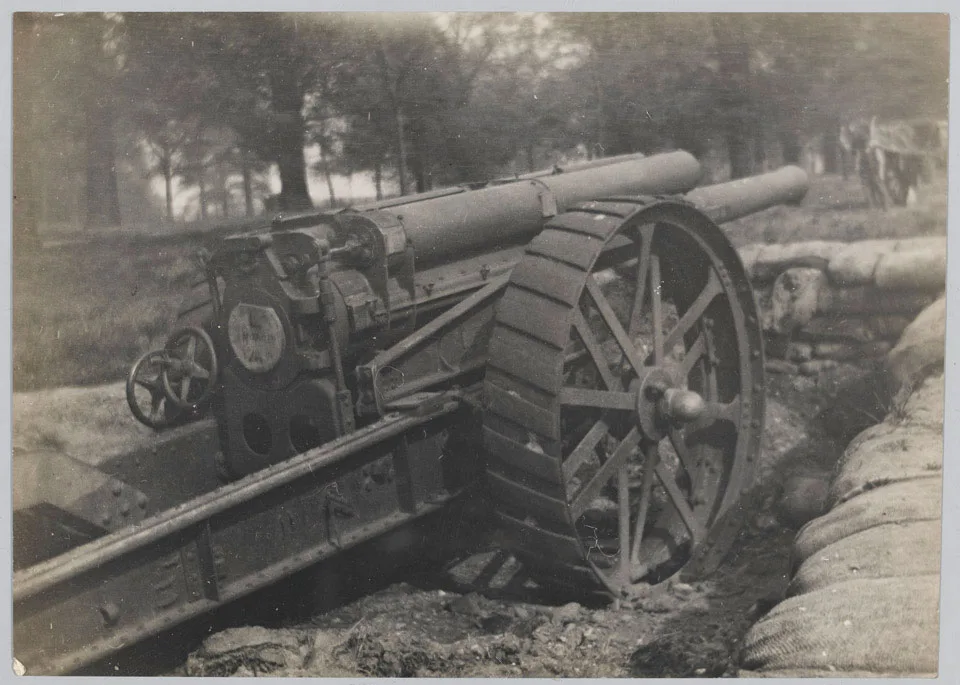

Nestled within the peaceful confines of Bowling Green Park in Horicon, Wisconsin, stands a historic relic: a World War I MK1 60-pounder artillery piece. This imposing gun offers a fascinating glimpse into the technological advancements and strategic considerations of early 20th-century artillery — and its arrival in Horicon is a story worth telling.


Special Note and Update:
Someone wrote in that his father had told him the cannon was pointed at Europe. So I stopped at the cannon today 07/03/2026 on a walk, and used GPS to sight in the cannon in the direction it is mounted and pointed. It is pointed in a bearing of 42° NE. So, not only is it pointed at Europe, but the cannon’s compass line really is pointed almost dead-on at Berlin.
Great sense of humor they had here in Horicon when it was placed.
How Horicon Got Its Cannons
The story of how two World War I artillery pieces came to rest in Horicon is, at its core, a story about civic determination — and knowing the right people in Washington.
In the years following the Armistice of 1918, the United States government found itself holding an enormous inventory of surplus military equipment, including hundreds of artillery pieces that had either returned from Europe or never made it overseas at all. Across the country, communities, veterans’ organizations, and civic groups lobbied Congress and the War Department to release these guns for use as public memorials — tangible reminders of the war’s human cost and a way to honor the men who had served. Cities and military bases often displayed large war trophies in central parks or near prominent buildings, sometimes incorporating them into local memorials. It became a widespread practice on both sides of the Atlantic, as governments sought to channel surplus war material into symbols of remembrance rather than simply scrap them.
Horicon was no exception. By 1933, the Horicon Advancement Association had set its sights on securing artillery pieces for the community, and the effort fell to Louis “Curly” Radke, chairman of the Public Service Committee. But obtaining surplus military hardware wasn’t simply a matter of filling out a form — it required political connections, and the Advancement Association had them.
As reported in The Reporter on September 28, 1933, the acquisition was largely attributed to the “aggressive instigation” of two men: Congressman C. W. Bland of Portage, who worked through federal channels, and Adam Port of Horicon, who helped coordinate locally. Together, they “pulled the strings” necessary to secure the release of not one but two guns for the community. The phrase itself speaks to the bureaucratic effort involved — surplus military equipment, even a decade and a half after the war’s end, did not flow freely to every community that wanted it. It took advocates willing to press the case.
With the guns approved for release, Radke traveled to the Rock Island Arsenal on the Mississippi River between Illinois and Iowa — the Army’s primary manufacturing and storage facility for artillery equipment — where approximately six 60-pounder guns of the same type were available. He personally selected the MK1 now standing in Bowling Green Park, and it was turned over to him on the spot with all proper credentials. It was not a casual transaction; the gun came with its full documentation, reflecting the Army’s careful accounting of surplus ordnance even as it passed into civilian hands.
The logistics of moving a 12,000-pound, 35-foot artillery piece across two states required more than a horse and wagon. The gun was transported on a large truck supplied by the John Deere Company in Moline, Illinois, and arrived in Horicon on Tuesday, October 3, 1933. It was unloaded at Bowling Green Park under the supervision of the Superintendent Harold Miller, where it remained while a permanent display location was prepared on the park grounds.
The second gun arrived shortly after, traveling a longer route — by train from Fort Robinson, Nebraska, a U.S. Army post near the South Dakota border. This was a 2.95-inch mountain gun, far lighter than its companion at roughly 1,000 pounds, and the Advancement Association designated it for the public school grounds rather than the park. The two guns together represented different chapters of the same conflict: one a heavy field piece built for the grinding work of breaking fortified lines, the other a compact mountain gun designed for mobility in difficult terrain.

previously displayed at Horicon School Grounds
previously displayed at Horicon School Grounds
The fates of the two guns could not have been more different. The 60-pounder has stood in Bowling Green Park for more than ninety years and remains there today. The smaller mountain gun did not survive the next world war — it was scrapped in WWII as part of the national drive to collect metal for the war effort, a quiet irony in which a relic of one war was consumed by the demands of another.
What brought these guns to Horicon was more than paperwork. It was a community that believed its veterans deserved a permanent, visible tribute — and a handful of determined individuals who made sure that belief translated into action.


Born from the Boer War: The Gun’s Origins
The 60-pounder did not emerge from a drawing board in isolation — it was a direct response to battlefield lessons learned in South Africa. During the Boer War, a number of naval guns had been fitted with field carriages and impressed the Royal Artillery with their range and hitting power. British commanders came away from that conflict acutely aware that they needed a purpose-built heavy field gun capable of matching what the Boers had fielded against them. History of War
A Heavy Battery Committee was formed in 1902, composed mainly of soldiers who had fought in the Boer War, and after reviewing several prototypes, selected the 60-pounder design. The resulting gun was designed for both horse draft and mechanical traction, intended to serve throughout the main theatres of any future conflict. By the time war broke out in 1914, it was already in the hands of the Royal Garrison Artillery. RammbockFandom
The Gun Goes to War
The MK1 60-pounder was one of the most effective British field guns of the First World War, despite being rather heavy and cumbersome to move. World War One was fundamentally an artillery war — artillery dominated the battlefield and inflicted more casualties than any other weapon. Heavy artillery was used to destroy entrenched positions, dugouts, and lines of supply. The 60-pounder was built precisely for that work. History of WarNational Army Museum
At the outbreak of war the gun equipped heavy batteries of the Royal Garrison Artillery, with four guns assigned to each infantry division. By 1916, all batteries on the Western Front were being increased to six guns, and the heavy batteries were reorganized out of individual divisions into larger Heavy Artillery Groups, concentrating firepower where it was needed most. Wikipedia
The gun served on virtually every front the British fought on. By the end of the war, 74 batteries were in service with the British Expeditionary Force on the Western Front, three in Italy, eleven in Macedonia, seven in Palestine, and four in Mesopotamia. Two Canadian batteries also operated the weapon on the Western Front. In total, 1,773 guns were produced by the end of the war — a testament to how central the 60-pounder had become to Allied heavy artillery operations. FandomRammbock
The Argonne: Where This Gun Made History
According to the 1933 newspaper account of its arrival in Horicon, the specific gun now standing in Bowling Green Park saw extensive service during the Battle of the Argonne — one of the most grueling campaigns of the entire war.


The Battle of the Argonne Forest was a pivotal component of the Meuse-Argonne Offensive, the final major battle of World War I, with the immediate objective of capturing the critical railroad junction at Sedan. The 600,000-man U.S. First Army attacked northward along a fifteen-to-twenty-mile corridor bounded by the impassable Meuse River on the east and the dense Argonne Forest on the west, supported by 2,700 pieces of artillery, 189 tanks, and 821 aircraft. The Germans had occupied the area for years and developed an elaborate defensive system of four fortified lines, dense wire entanglements, machine-gun positions, and concrete fighting posts. HistorycentralArmy Heritage Center
At 5:30 a.m. on September 26, 1918, after a three-hour artillery bombardment, General Pershing launched the assault. Heavy rains soon turned the terrain to mud, bogging down tanks and artillery and slowing resupply efforts, while German artillery rained fire from the heights of the Meuse and the Argonne Forest, turning the advance into a continuous series of bloody, hard-fought engagements. Army Heritage Center
The rolling hills and densely wooded forests of the region gave the Germans ideal defensive positions from which to unleash devastating machine gun and artillery fire upon advancing American forces. It was in precisely this environment that heavy guns like the 60-pounder proved their worth — capable of reaching German positions dug into hillsides and forests well beyond the range of lighter field artillery. www.army.mil
The Americans fought in the Meuse-Argonne region for 47 days, suffering 117,000 casualties while inflicting nearly 100,000 on the Germans, including 26,000 prisoners of war taken and 874 artillery pieces captured. When the guns finally fell silent on November 11, 1918, the Argonne campaign had helped break the German line and end four years of war. Foreign Policy Research Institute
A Heavy Hitter: The 60-Pounder’s Design
The 60-pounder was a formidable “gun of position,” engineered for heavy field artillery roles. Designed for mobility, it could be towed by either a horse team or a mechanized vehicle. A defining feature was its quick-firing recoil system — a significant advancement that kept the carriage stationary during firing, greatly enhancing both accuracy and rate of fire.
The gun’s construction was a marvel of its era. Its wire-wound barrel, encased in a jacket with a screw breech, was designed for separate-loading ammunition, with the shell and bagged cartridge loaded independently. The lower carriage used a box-trail design built for single-person operation, with traverse and elevation controls positioned on the left side for efficiency.
Evolution of the MK1: Recoil and Sighting Systems
The MK1’s recoil system employed two tubes above the barrel, combining a hydraulic buffer with a hydro-spring recuperator to rapidly return the barrel to its firing position after each shot. This design was later superseded by the MK2, which relocated a hydro-pneumatic system below the barrel.
Sighting technology evolved alongside the gun’s mechanical systems. The original 60-pounder carried tangent sights on a rocking bar, with a range scale extending to 10,400 yards. In the years before World War I, these gave way to oscillating sights using the No. 5 sighting telescope, and later to the No. 3 carrier for the No. 7 dial sight — each upgrade reflecting the artillery corps’ relentless pursuit of greater precision.
Mobility and Manufacturing
The original 1904 design incorporated an ingenious feature: the ability to shift the barrel and recoil mechanism rearward during travel, equalizing weight distribution between the gun carriage wheels and the limber, and reducing stress on any single wheel. However, the complexity of the cradle posed real manufacturing challenges. The MK1 carriage also featured traditional wooden spoked wheels with iron tires, standard for field artillery of the period.
Wartime demands in February 1915 ultimately drove a simplification of the barrel construction, producing the Gun MK I — a practical compromise between engineering refinement and the need for rapid, reliable production during an active conflict.
Our cannon was once considered Horicon’s Number 1 Draft Dodger in WWII
Scrap in WWII was serious. In Horicon, a banner hanging in the city hall window reading “Who’s boy will die because you failed?” and “Don’t be a Scrap Slacker”, an inventory of metal scrap on Dodge County farms showed 337 tons of available scrap.

By 1942, Horicon’s old park cannon had earned itself an unlikely wartime reputation. While scrap metal drives were sweeping across the country — pulling old pipe, wire, farm equipment, pots and pans, and even children’s toys into the national salvage effort — the cannon in Bowling Green Park sat untouched. Local wags took to calling it the town’s “number one draft dodger,” a sly dig at a relic that seemed to be sitting out the war in comfortable style while everyone else was being urged to contribute.
On the front page of the Horicon Reporter, a call was put out to conduct a kangaroo court over its No. 1 Draft Dodger – the Bowling Green Cannon. “High Treason” was the charge, and a swift and immediate conviction was called for.


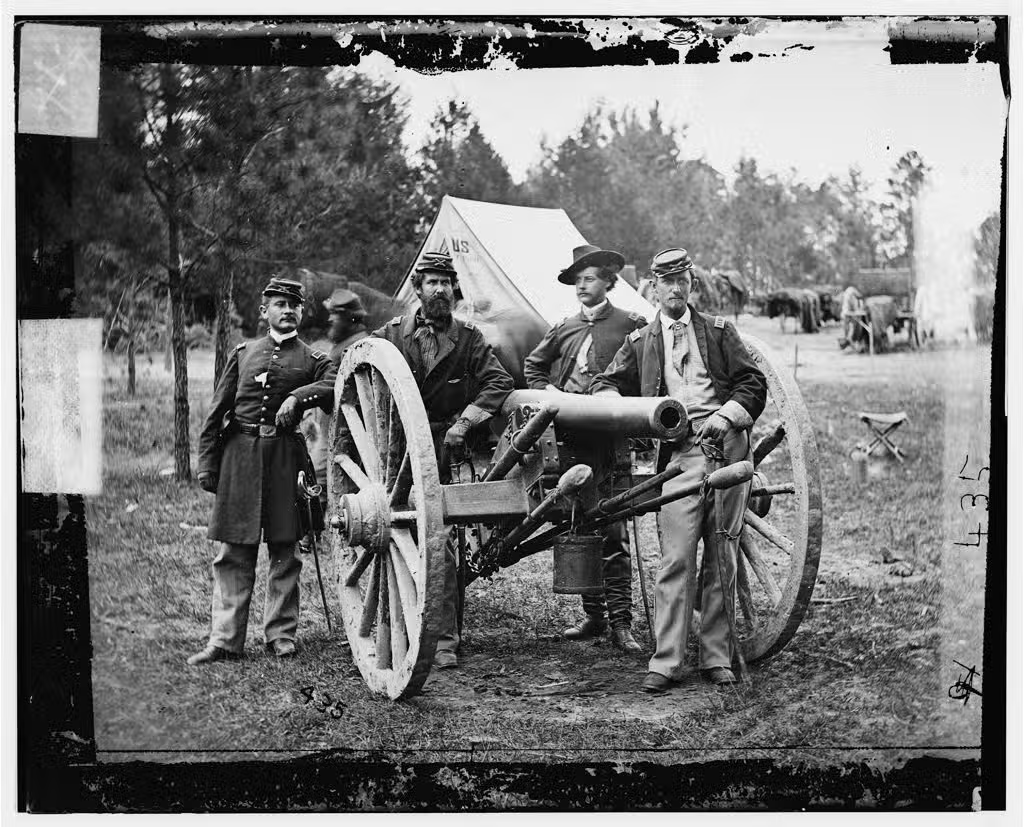
and on the left Horicon’s Civil War U.S. Model 1861 3-inch Ordnance Rifle
Sitting in the Horicon scrap pile in 1942.
Horicon’s scrap drive was falling behind expectations, and the town felt the strain. In response, farmers, homeowners, businesses, and the city of Horicon pitched in with whatever they could find. Old water lines, wagons, bed frames, spikes from the old mill dam, railroad ties, broken farm implements, and more. Horicon schoolchildren staged a parade to the scrap pile as a demonstration of patriotic duty. The procession eventually absorbed two familiar pieces of town ordnance: the smaller U.S.-made Vickers-Maxim QF 2.95-inch mountain gun, or pack howitzer, which had stood before Union School since 1933 and was locally known as the “Grover Cleveland” gun, and a Civil War U.S. Model 1861 3-inch Ordnance Rifle. Their removal lent the occasion a note of solemnity, even as the community embraced the wartime spirit.
The humor surrounding the cannon only half-concealed a serious point. The Smithsonian Institution had already surrendered a quantity of its own guns and field pieces to the scrap effort, and towns across the country had given up their memorial cannons without much ceremony. The implicit challenge to Horicon was straightforward: either establish that the old gun was a legitimate, historically significant field piece worth preserving, or acknowledge that it was simply high-grade steel occupying park space at a moment when the nation needed every usable pound of metal it could gather. For a time, the cannon had managed to outwit that argument — sitting smugly in the park, the old soldier who somehow stayed behind.
A Piece of Horicon History
The MK1 artillery piece now standing in Bowling Green Park is far more than a decorative relic. It is a proud emblem of service, sacrifice, and local stewardship — a lasting link to the nation’s struggle in the Great War and to the citizens of Horicon who brought it home more than ninety years ago. Since that October afternoon in 1933, it has stood as a silent tribute to the soldiers who carried America’s cause onto the muddy hillsides of the Argonne, to the craftsmen who forged it, and to a community that understood the value of preserving its heritage. As the nation approaches its 250th anniversary, the gun endures as a reminder that patriotism is not only measured on the battlefield, but also in the care communities show for the symbols of their shared history.