


Elmina L. Clinton was born on September 3, 1823, in Canaan, Connecticut. She married George Beers on June 21, 1846, in Ithaca, New York — George’s first wife, Mary, having died just a year earlier in childbirth. Like so many young couples of their era, the Beers wasted little time. They packed up and headed west to Wisconsin, settling in Horicon that same year. Later, George’s Father (Henry) and Mother (Clarissa) would join them on the ‘frontier’.
Their first daughter, Mary, died at age 2. Their second child, a girl, Emma, was born in 1851, married in 1880, and her husband passed in 1900. Emma, a widower, left for L.A. as a housekeeper. She passed away in 1942 in California
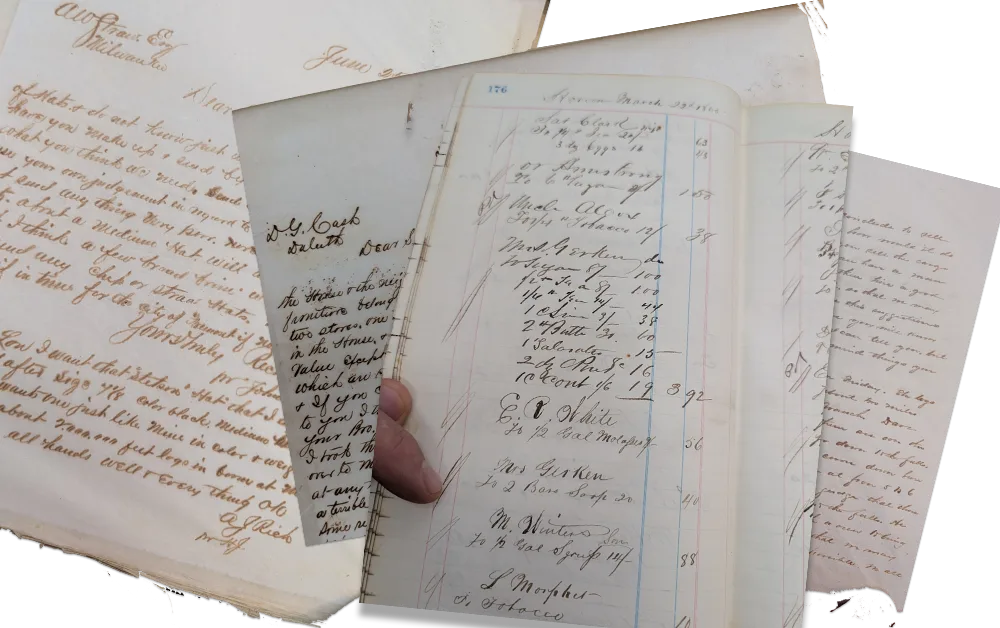
George tried his hand at farming first, then mechanics, and eventually owning and running one of the mills at the foot of the dam that created Lake Horicon. George built two large stone mill buildings, first as a sash manufacturing company, and the second one as a grist-mill (both later purchased by Van Brunt). But it is Elmina who left us something far more valuable than any bushel of grain or milled board — she wrote it all down.
In a series of letters, Elmina recorded her earliest memories of Horicon: the marsh still called Winnebago, the Indian trails worn deep into the riverbank, the wigwams near the depot, the ponies grazing in the dark. She was writing about a world already slipping away, and she knew it.
Elmina passed away on September 27, 1894, at the age of 71. She and George rest together at Oak Hill Cemetery here in Horicon. But thanks to her pen, a piece of the Horicon she first saw in 1846 survives.
This is Part 1 of 3 of her transcribed letters.
Mrs. George H. Beers, a resident of Horicon, has drawn some graphic sketches of the place as she saw it in its infancy. The lady possesses a rare and peculiar talent and has drawn what seem to be very accurate pictures of Horicon in the 1840’s
“In permitting us to quote from these sketches for the purposes of this history, the authoress has consented that eliminations of such matter as belonged particularly to the occasion for which she wrote may be made at our discretion.”
I will give you a sketch of Horicon as it was nineteen or twenty years ago.
This place was wild, yet beautiful.
It was formerly an Indian planting-ground, and many of their corn hills are still visible, as they planted in the same hills each year without plowing as our farmers do.
And where our beautiful lake now is was a marsh called Winnebago, after the warlike tribe that formerly occupied this place.
Rock River flowed quietly along, and on its eastern bank near the [old] depot lay scattered along a number of mounds; whether thrown up by the God of Nature or the Indians, I know not, but we called them Indian mounds.
They were similar to each other, usually with a large tree in the center of each.
On the bank near the river, was an Indian trail worn deep into the earth; for it had been trodden by Black Hawk and his tribe, as well as other tribes for many long years.
There was a fine spring on the bank of the river under a large tree; it was a splendid place, and for a long time we got all the water from there that we used for drinking or cooking purposes, crossing the river in a small boat to obtain it. I well remember the first night I ever stayed in this place.
It was dreary enough.
The Indian ponies were grazing around the house all night, and their bells kept up a constant tinkling.
The fear of the Indians troubled me somewhat, as my thoughts would go back to the narratives I had read of Indian cruelties to frontier settlers; but here they seemed harmless.
They called themselves Pottawatomies or Menomonees, and seemed ashamed to be called Winnebagoes, as the latter were considered by the whites to be much more cruel than the former.
We could usually distinguish the Winnebagoes by their red blankets, while the other tribes wore white or blue.
Ofttimes, while about my work, I would look up to see black faces peeping in at my window, as that was their habit always before entering a house.
Such sights startled me at first, but I became accustomed to it and learned to trade with them, and buy venison, fish, ducks, berries, etc.
They usually wished to “swap” for flour or salt.
They always seemed much pleased with the salutation ‘bazhu, , which means, “How do you do?” and would respond with the same word immediately. I had nothing stolen by them except a pie, which I left out to cool; but they were almost always begging, saying they had no ‘shoneau’ (money).
In the winter the squaws and papooses would come to warm themselves by our fires. I very much disliked to let them in, as the house would smell of smoke for hours afterward; but they would say, “Heap cold,” and look so wretched that I could not say ‘puckachee’ (go away).
During certain seasons of the year [in the winter], there would be a large number of wig-wams where the [old] depot now is.
We visited them, and found some of the squaws dressing fish, roasting venison or tanning deer-skins.
Everything seemed quite comfortable, excepting the smoke from the fires built in the center of each wigwam, which scented the surroundings with an unpleasant smell.
They often buried their dead above ground, usually in an old canoe, supported by four posts and covered over with bark, but as the white people came and settled here the Indians were induced to discontinue the habit and also to remove the old sarcophagi.
Occasionally the Indians would have a pow-wow, which I always dreaded very much, as at such times they bought whisky, or ‘goodnatush’ as they called it, from enterprising dealers in Grubville, now Beaver Dam.
They would keep up their fires and make night hideous with their yelling, singing and dancing, but such things did not occur very often.
Coming Soon, Parts 2 and 3.
Click For Historical Notes:


The “Old” Depot was located at the eastern side of the Rock River, at the southern end of South Cedar, where the “Johnson Bus Service is now located.
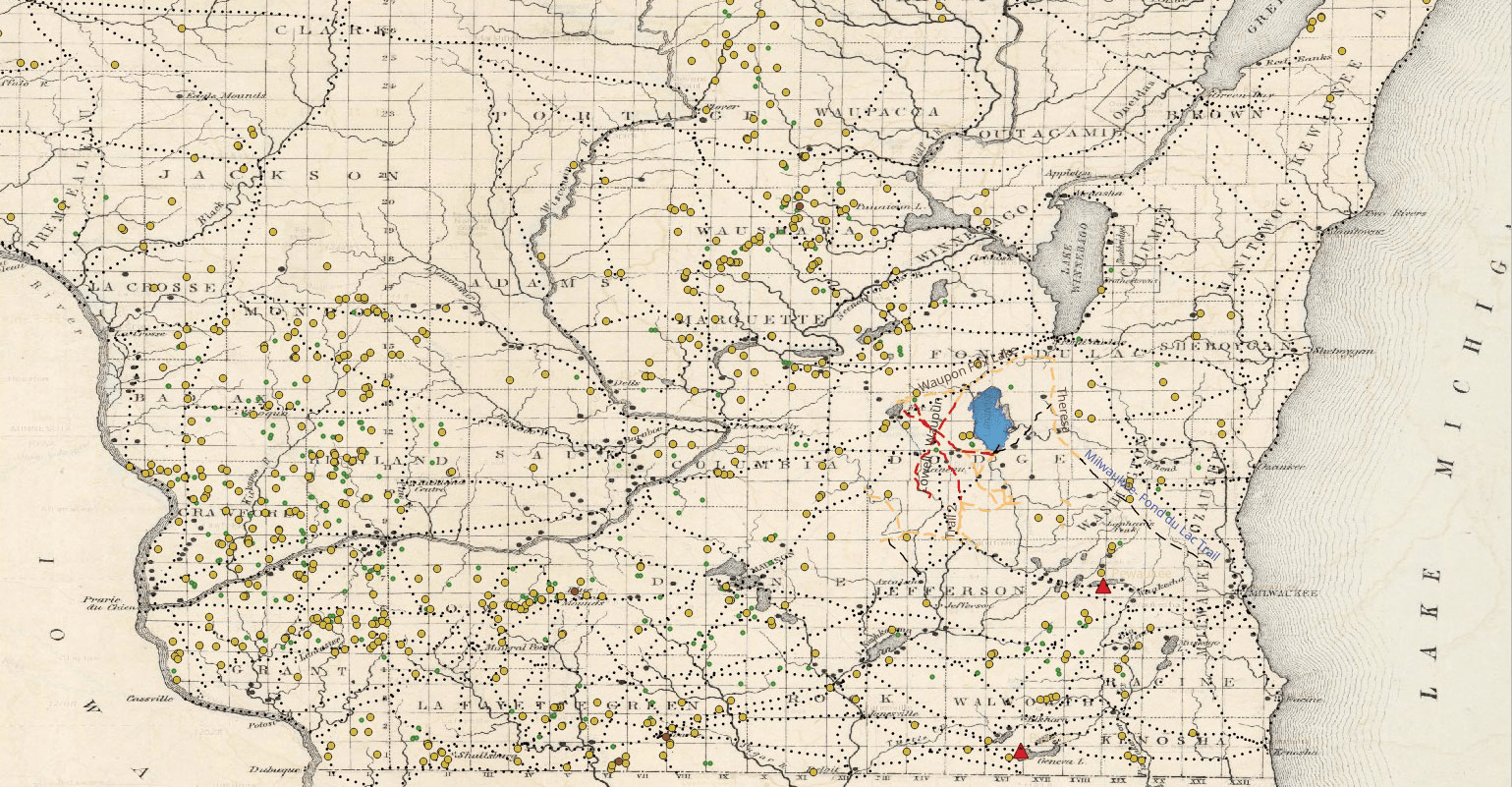
Increase Lapham’s Map of Horicon Effigy and Mounds in 1851

What and interesting and engaging read. Sounds like the residents had reasonably mutually beneficial experiences with the local
tribes. Look forward to more chapters